Here is something worth getting straight from the top: the article you are probably looking for is called “essential oils for wrinkles,” and it is the wrong article. Essential oils are the volatile, aromatic compounds, frankincense, ylang ylang, rose otto. They smell beautiful and they do some things, but they are not what actually works on fine lines. What works is facial oils, also known as carrier oils, the heavier plant-pressed lipids like rosehip, argan, and jojoba. The distinction matters because it changes what you buy. Get the right one and you have a genuinely useful addition to your skincare. Get the aromatherapy blend and you have something that smells lovely and does very little for your skin.
What actually causes the signs that bother people
Free radicals, UV exposure, and a slowdown in natural oil production. A 2020 review in Current Environmental Health Reports confirmed that traffic-related pollution and UV are the two biggest accelerants of extrinsic ageing, working synergistically. Intrinsic ageing adds its own layer: after roughly age 30, collagen production drops by around 1% a year, sebum output falls, and the lipid barrier thins. The result is drier, thinner, more reactive skin that shows damage more easily than it used to.
Facial oils address two of those three things directly. They replace lost lipids, and the better ones bring antioxidants that neutralise free radicals. They will not undo UV damage, and they are not a substitute for sunscreen or retinol. What they are is the quietly effective, evening-based workhorse that most anti-ageing routines benefit from.
The ones with the strongest evidence
Work top to bottom. These are ordered by the strength of the clinical data behind them, not by price or novelty.
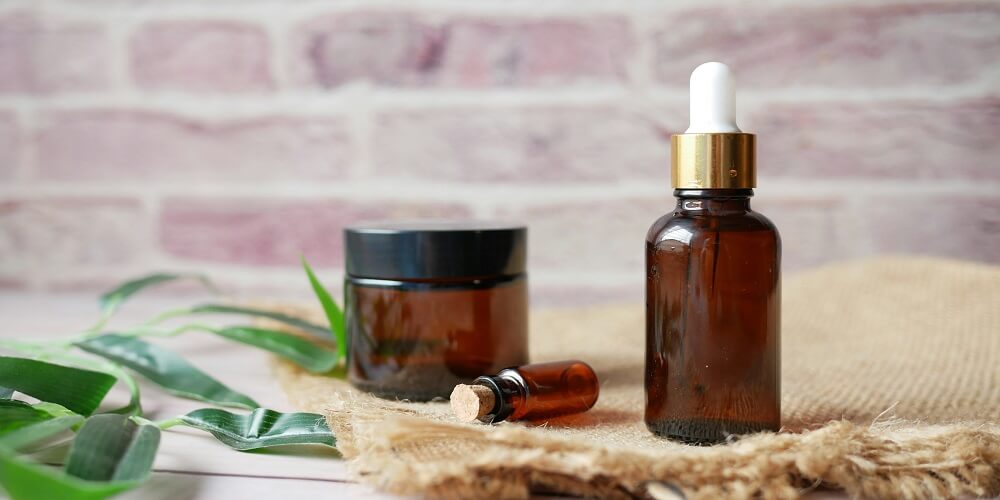
01. Rosehip seed oil (Rosa canina). The most interesting plant oil in skincare. It contains naturally occurring trans-retinoic acid (the active form of vitamin A, the same molecule as prescription tretinoin) at concentrations between 0.01% and 0.1%, per a 2015 analysis in Skin Pharmacology and Physiology. A 2015 randomised trial in Clinical Interventions in Aging gave 34 adults aged 35–65 a standardised rosehip preparation for eight weeks and measured significant reductions in crow’s-feet wrinkles and improvements in skin moisture and elasticity. A smaller 2025 pilot study in MDPI Cosmetics found measurable wrinkle and UV-spot reduction after five weeks of topical use. Format recommendation: cold-pressed, unrefined, stored in dark glass. Oxidises quickly, so buy small bottles and keep them out of sunlight.
02. Argan oil. Rich in vitamin E, squalene, and linoleic acid. A 2015 study in Clinical Interventions in Aging found that daily application to the face increased skin elasticity measurably over 60 days in postmenopausal women. Best for people whose main issue is dryness and a thinning barrier rather than hyperpigmentation.
03. Squalane (plant-derived, usually olive). Not strictly an oil, but the closest mimic of the skin’s own sebum, which makes it exceptionally well-tolerated. Sits under or over other oils without interfering. No strong anti-ageing data of its own, but it solves the delivery-vehicle problem for everything else in the routine.
04. Jojoba oil. Also a wax ester rather than a true oil, also very close to sebum in structure. Good for oily or combination skin that cannot tolerate heavier oils. Mild evidence for barrier support; not a standalone anti-ageing agent.
05. Sea buckthorn oil. Very high in vitamin C, carotenoids, and omega-7. Antioxidant-rich. Will stain cotton a faint orange if you use too much, which is a good reminder that you almost certainly are. A few drops, no more.
06. Marula oil. High in monounsaturated fats and tocopherols. Lighter texture than rosehip, less prone to oxidation. Limited direct clinical data, but the lipid profile is genuinely good.
The role essential oils actually play
Essential oils (frankincense, ylang ylang, sweet orange, lavender) appear in most “anti-ageing facial oil” blends at 0.5–2% for fragrance, mood, and mild antioxidant contribution. That is a legitimate role, but it is supporting, not leading. Frankincense in particular is often marketed as a cell-regenerative active; the evidence is limited to in vitro work on boswellic acids and has not been replicated on human facial skin. Enjoy the scent, do not pay a premium for the claim.
One note of caution: citrus essential oils (bergamot, sweet orange, lemon) can be mildly phototoxic, so a blend that contains them is best used at night only, not in the morning.
How to use a facial oil without wasting it
Clean, slightly damp skin. Four to six drops warmed between clean palms, then pressed into the face rather than rubbed. If the skin is already treated with a water-based serum, the oil goes last, sealing everything in. If oil is the only leave-on step, a heavier moisturiser is not required; the oil does the barrier work.
One thing that sabotages oil use more than anything else: applying it under SPF in the morning. Most mineral and hybrid sunscreens do not play well with a heavy oil underneath, and the finish tends to pill. Oils work best as a nighttime step. If you want a morning option, squalane or jojoba are the ones that layer well under most sunscreens; leave the heavier oils for evening.
The ones that aren’t ready yet
“Anti-ageing” essential-oil blends without a substantial carrier-oil base. If the ingredient list starts with rose or frankincense before any carrier is named, you are paying for fragrance at skincare prices.
CBD facial oils marketed for wrinkles. The skincare evidence is genuinely thin. CBD may help with inflammation and reactive skin, which is useful, but it is not an anti-ageing ingredient on any rigorous reading of the data.
Anything promising to “boost collagen” topically without retinoids, vitamin C, or peptides. These are the three ingredient classes with credible topical collagen evidence. A facial oil alone does not belong in that category.
If you live in a UK city, the useful version of all this is short: a rosehip or rosehip-argan blend at night, a vitamin C serum in the morning, daily SPF, and sleep. Everything else is refinement.
Rosehip seed oil has the strongest clinical evidence for reducing the appearance of fine lines. A 2015 randomised trial in Clinical Interventions in Aging, using a standardised rosehip preparation on 34 adults aged 35–65, found measurable reductions in crow’s-feet wrinkles and improvements in elasticity after eight weeks. The active ingredient is trans-retinoic acid, the same molecule as prescription retinoids, present naturally at low concentrations in cold-pressed rosehip oil.
Are essential oils actually good for wrinkles?
Not really, and this is worth getting right. “Essential oils” (frankincense, ylang ylang, lavender) are the fragrance fraction of most facial-oil blends. They contribute a mild antioxidant effect and a pleasant scent, but the clinical evidence for wrinkle reduction sits with the carrier oils (rosehip, argan, jojoba), not the essentials. Be cautious of products that lead with essential-oil marketing.
How long does it take to see results?
Five to eight weeks of daily consistent use is the honest answer, based on the clinical trial data. The 2015 rosehip trial measured results at 8 weeks. The 2025 MDPI Cosmetics pilot saw changes by 5 weeks. If a product promises visible results overnight, it is selling you hydration, not structural change.
Can I use facial oil instead of moisturiser?
For some skin types, yes. A good plant oil provides lipid barrier support, locks in water, and delivers antioxidants in a single step, so a separate moisturiser is often unnecessary, especially at night. If your skin is very dry or very dehydrated, layering a water-based serum or hydrator under the oil works better than oil alone. Combination and oily skins usually prefer jojoba or squalane, which are the closest mimics of natural sebum.
Why do facial oils go rancid?
Oils oxidise when exposed to light, heat, and air, and oxidised oils on skin cause free-radical damage rather than preventing it. This is why the packaging matters: dark glass, small sizes, a pump or dropper rather than an open-mouth bottle, and ideally a vitamin E component to slow oxidation. If an oil smells sour, waxy, or markedly different from when you bought it, it has gone off. Replace it.
Benzoyl peroxide. Dihydroxyacetone. Glycerin. Emollient. The ingredients list on most skincare products reads like a chemistry paper. Many of those ingredients are harmless, some are useful, and a fair number are there mainly to extend shelf life. All of them come wrapped in beautiful packaging with a price tag to match.
Slow beauty is a direct response to that status quo, asking the same questions slow fashion asks but about what we put on our skin. Fewer ingredients. Local and seasonal where possible. Less packaging, less shelf-life engineering, and more attention to the full journey of the product. Foraging for your own skincare ingredients sits comfortably inside that movement, and it’s a surprisingly practical place to start if you want a near-zero-waste beauty routine.
Foraging is the practice of sourcing ingredients from the wild, most often for food, but also for home remedies and skincare. There’s an abundance of natural ingredients with skincare benefits growing in British woodlands, hedgerows and gardens, and many of them can be combined with other natural sources to produce serums, toners, scrubs and bath salts. Most cost little to nothing beyond the effort of finding them.
Natural ingredients grow by season, so you can’t forage the same things all year. Here’s a seasonal guide to the most useful plants for skincare, where to find them, and four recipes to get started. A few important notes on safety first.
A note on foraging safely
Before you head out, read the Woodland Trust’s foraging guidelines. The short version: only forage what you can identify with total confidence, take small amounts from abundant sources, never uproot plants (which is illegal on land you don’t own under the Wildlife and Countryside Act 1981), and never forage in protected sites.
Plant identification matters enormously. Some plants that look edible are toxic, and several common look-alikes can cause serious harm. If you’re in any doubt, leave it alone and check a reliable reference like Kew’s guide to poisonous plants or go with someone experienced. When you’re foraging for skincare in particular, patch-test on a small area of skin before applying anything more widely. Natural doesn’t automatically mean non-irritant.
One more thing. The NHS is clear that herbal and plant-based products are not a substitute for medical treatment. If you have a persistent skin condition, see a dermatologist. Foraged skincare is for everyday routines, not for treating serious issues.
Spring
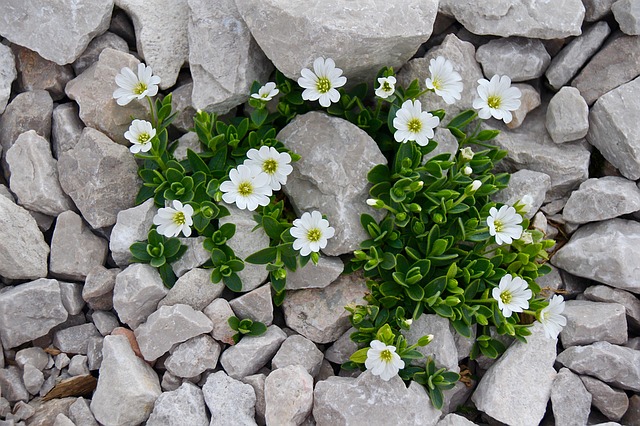
Chickweed
Where: shady, moist locations including gardens and woodland edges. Chickweed forms small low-growing mats with distinctive white star-shaped flowers.
Benefits: chickweed has traditionally been used to soothe a range of skin issues thanks to its natural antiseptic, antifungal and anti-inflammatory properties. It’s often used as a quick remedy for itchiness and surface irritation.
Dandelion
Where: dandelions prefer moist, sunny areas, only going dormant in the coldest winters. They’re one of the easiest foraging plants to find in the UK because they grow almost everywhere, including lawns and pavements.
Benefits: the sap from dandelions is naturally alkaline, which makes it useful against germs, bacteria and fungus. It’s been used traditionally to treat ringworm and eczema. Seen as a natural detoxifier, dandelion juice also appears in homemade acne treatments, and the plant’s vitamin C content can support the appearance of scars and inflammation.
Goose grass
Where: turf, landscaped areas like crop fields, orchards and gardens. Goose grass, also known as cleavers, is the sticky plant children used to throw at each other in playgrounds.
Benefits: goose grass has long been used in folk medicine for skin complaints like psoriasis and eczema, and for helping small cuts, scrapes and abrasions to heal. It’s usually applied as a cooled infusion or a cold-pressed juice.
Wild garlic
Where: near marshland or water drainage ditches across much of the UK, often carpeting the floor of damp woodland in spring. You’ll usually smell it before you see it.
Benefits: wild garlic is rich in allicin, which gives it antiviral, antifungal and antiseptic properties. It’s used in cleansing products and in homemade acne treatments because it helps remove the bacteria that cause breakouts. Garlic also contains vitamin C, known to support collagen production and protect against the effects of UV exposure.
Recipe: dandelion face serum
Designed to brighten the complexion and firm the skin. The flower’s properties are known for supporting the appearance of age spots and scars, so it works well as a serum layer before your moisturiser, morning or night.
Ingredients: 6 fresh dandelion flowers and leaves, 1 aloe vera leaf, 1 teaspoon vitamin E oil.
Wash the flowers and chop off the base of the stems to remove any dirt. Leave to drain.
Slice the aloe vera leaf down the middle and scoop out the gel to fill half a cup.
Blend the dandelions and aloe vera gel in a food processor or NutriBullet.
Leave the mixture to sit for one hour.
Using a cloth or strainer, squeeze the gel into a bowl until all you have left is dandelion pulp in the strainer and dandelion-infused gel in the bowl.
Gently mix in the vitamin E.
Pour into a pot or bottle, preferably dark glass to preserve the contents for longer.
Apply to clean skin morning and night. Use within 10 weeks.
Summer
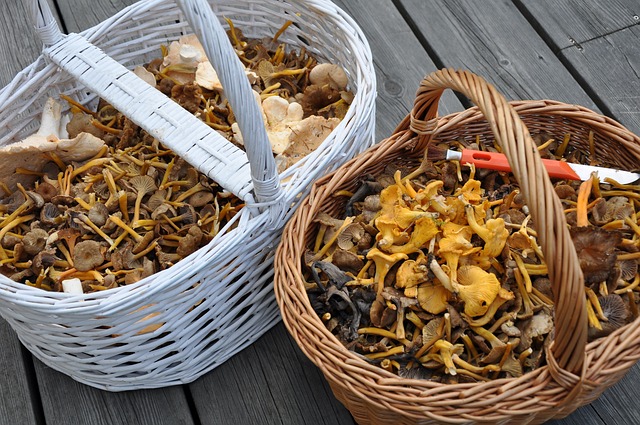
Chanterelle mushrooms
Where: growing in clusters in mossy coniferous forests, and also in mountainous birch forests. Chanterelles have a distinctive trumpet shape and a golden-yellow colour, with false gills rather than true ones.
Benefits: like many fungi, chanterelles are rich in vitamin D. They’re also rich in niacin, which has been used traditionally to address conditions like eczema and rosacea by helping to reduce redness, inflammation and irritation. Only forage mushrooms with expert ID. Several UK species are lethally toxic.
Blackberries
Where: commonly found in brambles across most UK woodland and along hedgerows. Pick them ripe and jet-black, never at the roadside where exhaust residue will have settled on the fruit.
Benefits: blackberries are rich in antioxidants, which support circulation and immune function. They feature in face masks because of their astringent properties. The high vitamin C content supports collagen production, and the antioxidants help the skin look brighter and healthier.
Hazelnuts
Where: moist, lowland soil and under the shade of oak trees. The nuts ripen in late summer and early autumn.
Benefits: hazelnuts contain a high concentration of antioxidants and are often applied to the skin as a cold-pressed oil. Naturally rich in fatty acids and vitamin E, hazelnut-based products support hydration and elasticity. They’re also a good protein source if you want to take some home for the kitchen.
Honeysuckle
Where: honeysuckle grows close to home, often on the exteriors of buildings and along hedgerows and woodland fringes. Its strong sweet scent makes it easy to find in the evening.
Benefits: honeysuckle features in traditional remedies for eczema, acne and rosacea. Oil distilled from the plant is also used in hair products to strengthen roots and strands. As an essential oil, honeysuckle is used in aromatherapy and is thought to help with headaches, sinus pressure and stress.
Recipe: rose face spritz
Doubles as a face toner and as a cooling spritz on hot days. Use fresh, unsprayed roses from your own garden or a friend’s.
Ingredients: 7 roses, 1.5 litres of distilled water.
Gently pull the petals from the roses and place them in a colander under lukewarm running water to remove any dirt.
Once clean, put the petals in a pan with the distilled water. If 1.5 litres isn’t enough to cover them, add more.
Over a low to medium heat, bring the petals to a simmer for about 25 minutes until they’ve lost their colour and gone very pale pink.
Strain the mixture and separate the petals from the water. Don’t throw the petals away, you can add them to a bath that evening.
Pour the rose water into a dark bottle and use as a cooling face spritz throughout summer.
Foraging is a near-zero-waste way to learn what actually grows around you.
Autumn
Rosehips
Where: rosehips develop from the seed pods of wild roses along hedgerows, waste ground and woodland edges. They ripen from late summer onwards and are at their best after the first frost.
Benefits: rosehips are known for their astringent properties, which help tighten the skin and close pores. They also contain lycopene and beta carotene (the same compound that gives carrots their colour) and have been used to address hyperpigmentation: skin that has darkened in places due to sun, hormones or medication. Rosehip oil is a staple in natural skincare for its essential fatty acid content.
Hawthorn
Where: hawthorn grows in hedgerows, woodland and scrubland. The berries (haws) ripen to a deep red in autumn.
Benefits: hawthorn berries are naturally rich in polyphenols, and are traditionally associated with supporting the immune system and cardiovascular health. Cosmetically, they appear in hair products where they have a reputation for supporting fast hair growth and strong roots.
Walnuts
Where: in woodland, most commonly in southern parts of England. Wild walnut trees are less common than their cousins in orchards, so take only what you’ll use.
Benefits: most of the skincare benefits come from the shell and leaves, which makes walnuts an excellent near-zero-waste option. Walnut extracts help protect the skin from free radicals, and the shells make a brilliant natural exfoliant thanks to their rough texture. Grind them fine before use on the face. Shells are gentler on arms, legs and feet.
Recipe: walnut body scrub
Supports circulation, buffs away dead skin cells, and leaves skin smoother and brighter. Use no more than once or twice a week.
Grind the walnut shells into tiny particles. You can do this in a pestle and mortar, in a canvas bag with a rolling pin, or in a blender. Set aside.
Put the shea butter and almond oil in a heat-proof bowl and place it over a pan of hot water, as you would to melt chocolate.
On a low heat, let the shea butter melt into the oil.
Once fully melted, remove from heat and allow to set. You can speed this up in the fridge.
Use a wooden spoon to mix until the product turns fluffy.
Add the crushed walnut particles, vitamin E and rosehip oil. Stir through.
Spoon into a dark glass jar to keep it fresh. Use in the shower on damp skin, avoiding the face.
Winter
Nettles
Where: nettles prefer rich, moist soil and are commonly found near rivers, streams and lakes. Wear gloves when harvesting. Nettles lose their sting once they’re cooked or properly processed.
Benefits: prepared properly, nettles are a rich source of antioxidants and have a reputation for supporting skin against the effects of heavily polluted air. They’re also traditionally used as a hair rinse, where they’re thought to inhibit a hormone associated with hair loss and stimulate the scalp.
Beech nuts
Where: beech nuts prefer dry conditions and acidic soil. They can be tricky to find, but mature woodland is a good place to start, particularly where there are large beech trees.
Benefits: beech nuts have a reputation as a powerful antiseptic and are traditionally associated with strong hair growth. Oil distilled from beech nuts is thought to strengthen follicle cells and slow hair loss. Important caveat: parts of the beech tree are toxic, so don’t attempt to forage or prepare beech nuts without expert guidance.
Rowan berries
Where: rowan trees grow at high altitude, particularly in the Scottish Highlands, and produce bright orange-red berry clusters. Rowan is also common in urban parks and gardens across the UK.
Benefits: packed with vitamin C, rowan berries are associated with supporting collagen production, which helps keep skin feeling firm and reduces the appearance of wrinkles over time. They can also be applied to dry or sore patches of skin for itchiness and irritation, and have traditionally been used for eczema and other skin inflammations. Raw rowan berries are mildly toxic, so they need to be cooked before use.
Pine
Where: Scots pine is the only truly native pine in the UK. It thrives on heathland and is widely planted for timber. It’s also found in the Caledonian Forest in the Scottish Highlands.
Benefits: pine nut-based products help combat the effects of free radicals, which are associated with higher pollution levels, and feature in many anti-ageing formulations. Naturally fragrant, pine nuts are also used in perfumes and shower gels.
Recipe: rosehip bath salts
A luxurious bath salt infused with rosehips you can forage through autumn and into winter. Rosehips are rich in essential fatty acids which help nourish and rehydrate dry winter skin. Pour a hot bath, sprinkle in your salts, and let the mixture do the work.
Ingredients: 10 to 15 rosehips, Himalayan bath salts, almond oil, 4 rose petals, 4 drops of lavender essential oil.
Part one: infuse the oil.
Chop any stalks and leaves from the rosehips and wash them with cold water in a strainer.
Fill a jar (jam size works well) one-third with rosehips and top it up with almond oil.
Leave to infuse for a minimum of four hours. The longer you leave it, the better the result.
Strain the rosehip oil into a clean jar so you now have rosehip-infused almond oil.
Part two: mix the bath salts.
In a mixing bowl, add the Himalayan bath salts.
Mix in one teaspoon of your rosehip oil and the lavender essential oil. You can add more lavender if you like a stronger smell.
Grind the rose petals in a pestle and mortar, then add them to the mix.
Stir everything together and spoon into a jar, ready to sprinkle into your next bath.
Progress, not perfection
Foraging your own skincare isn’t going to replace your whole bathroom cabinet. It’s not meant to. Think of it the way you might think of growing your own herbs. You’ll still buy most of what you use, but the bits you make yourself tend to be the pieces you enjoy the most, and they come with no packaging, no shipping, no ingredient list to decode.
The bigger shift is the mindset. Foraging pushes you to notice what actually grows around you. That noticing tends to spread to the other parts of your routine, which is how slow beauty becomes a habit rather than a one-off project.
Every brand in the Beauty and Self-Care category on Ziracle has passed the same standard: honest ingredients, transparent formulation, and packaging that takes the environment seriously. For products with short ingredient lists and whole-plant formulations, filter by Organic or Plastic Free to match the spirit of the foraged routine above.Ready to shop?
Browse the Healthy Skin edit for brands that work with whole ingredients from the start.
FAQs
Is foraging for skincare actually legal in the UK?
On land where you have permission, and within sensible limits, yes. The Wildlife and Countryside Act 1981 makes it illegal to uproot any wild plant without the landowner’s permission, and foraging in designated protected sites (National Nature Reserves, SSSIs) generally requires specific consent. Picking small amounts of leaves, flowers and fruit from common plants on public land for personal use is usually acceptable. Commercial foraging or stripping a site clean is not. The Woodland Trust’s guidelines are the most accessible starting point.
Is foraged skincare actually better for your skin than shop-bought?
It depends what you’re comparing it to. Foraged skincare has short ingredient lists, no packaging and no preservatives, which appeals to people who want minimal formulations. It also has a very short shelf life (typically two to ten weeks depending on the recipe) and no standardised potency, because plant concentrations vary with season, soil and species. For everyday use by people without sensitive skin, it’s a reasonable alternative. For anyone with reactive skin, eczema, or a specific condition, professionally formulated skincare is usually the more reliable choice. Always patch-test first.
What should I never forage without expert help?
Mushrooms, first and most importantly. Several UK species are lethally toxic, and some of them look very similar to edible ones. Beech nuts, which contain compounds that can be toxic if not properly processed. Anything you can’t identify with complete confidence. The rule of thumb: if you aren’t 100% sure what it is, leave it alone. Kew Gardens and the Woodland Trust both publish clear identification guides online.
How long does foraged skincare last?
Most of the recipes in this guide last between two and ten weeks, stored in dark glass in a cool place. The lack of preservatives is part of why they’re gentle, and also why they go off faster than shop-bought products. If something changes colour, smell, or texture, throw it out. Making smaller batches more often is the practical way to work with natural formulations.
Can I forage ingredients in a city?
With care, yes. Parks, community gardens, and private gardens (with permission) often have useful plants. Avoid anything within a few metres of busy roads, where exhaust particulates settle on leaves and fruit. Don’t forage in sites sprayed with herbicides or where dogs regularly urinate. Urban blackberries and elderflower are particularly popular and usually safe if picked sensibly away from traffic.
Underwear is the quietest part of your wardrobe and one of the most worth rethinking. You wear it every day. It sits against your skin for hours. You replace it more often than almost anything else you own. And most of what you’ve been buying from the high street is made cheaply, made by people paid badly, and designed to fall apart fast enough to keep you coming back.
That makes it the cleanest place to start shopping differently. The spend is small. The feel is immediate. The verification is easier than with almost any other category. And the difference between a drawer of cheap synthetic underwear and a drawer of well-made organic basics is the kind of change you notice within a week of switching.
This is a guide to what matters, what doesn’t, and how to buy basics that last without replacing everything at once.
Why cotton matters more than most materials you buy
Conventional cotton is one of the most chemically intensive crops in the world. Cotton covers around 2.4–2.5% of global agricultural land but accounts for a disproportionately large share of worldwide insecticide use — figures cited by the Pesticide Action Network UK and the Better Cotton Initiative put cotton’s share of global insecticide sales at around 10–16%, depending on the methodology and period measured. In developing countries, where most cotton is grown, that share climbs higher. The pesticides used on cotton include chemicals classified by the World Health Organization as hazardous to human health. In developing countries, where most cotton is grown, that share climbs higher. The pesticides used on cotton include chemicals classified by the World Health Organization as hazardous to human health.
Organic cotton is cotton grown without synthetic pesticides, synthetic fertilisers or genetically modified seeds. The most robust independent verification for it is the Global Organic Textile Standard, known as GOTS, which audits the full supply chain from farm to finished garment against both environmental and social criteria, including fair wages and safe working conditions.
The fibre matters more in underwear than in most garments for a simple reason: skin contact. Pesticide and chemical residues from conventional processing can remain on finished fabric, and underwear is against your most sensitive skin for more hours of the day than any other piece you wear. If you have reactive skin, eczema, or unexplained irritation at the bikini line, switching to GOTS-certified organic cotton is one of the first things worth trying.
Why fast-fashion underwear is a false economy
Walk into most high-street retailers and a pack of five pairs costs less than a lunch. The fabric is a thin cotton-synthetic blend. The elastic is cheap polyester and rubber that loses its stretch within a dozen washes. The dyes fade, the seams fray, the gusset wears through. You replace the whole drawer every twelve to eighteen months and throw the old pairs in the bin, where they sit in landfill for decades.
The cost per wear of that model is worse than it looks. Five pairs for £12, replaced three times over two years, is £36 for thirty-six months of wear. Five pairs of well-made organic cotton briefs at £15 each (£75 total), worn for three to four years, works out significantly cheaper per day. You pay more upfront and spend less overall. The waste reduction is the separate bonus.
The fast-fashion model is designed to depend on replacement. Sustainable underwear brands are designed to depend on retention.
What to actually look for
Four things matter, in rough order of importance.
GOTS certification on the fabric. This is the single strongest signal. GOTS covers how the cotton is grown, how it’s dyed, how it’s processed, and how the workers at every stage are treated. A GOTS label is the shortcut that removes the research burden. When a brand has it, you do not need to verify the individual claims.
Thicker, higher-quality fabric. Not just thread count, but weight. A pair of well-made organic cotton briefs weighs noticeably more than a supermarket pair. This is usually a sign the cotton is longer-staple and the knit tighter, both of which extend lifespan. If the fabric feels papery in hand, it will behave that way on your body.
Flat seams and a reinforced gusset. These are the failure points in cheap underwear. Flat-locked seams move with the skin instead of digging into it. A reinforced gusset (ideally a second layer of organic cotton) outlasts single-layer constructions by a wide margin.
Elastic that isn’t ordinary polyester. This is where the sustainable underwear category has improved most in the last five years. Biodegradable elastic alternatives, including GOTS-approved natural rubber-based options, hold their shape through more washes than conventional synthetic elastic and do not persist in landfill forever. Not every sustainable brand uses them, and the ones that do will say so clearly. Silence on this is worth noticing.
Other materials worth knowing:
TENCEL (trademarked Lyocell) is made from sustainably managed wood pulp, is biodegradable, and has a softer hand than cotton. It works particularly well in warm weather. Modal, similar in origin, is silkier but tends to be less durable.
Recycled polyester is occasionally used in sports underwear. It is better than virgin polyester but still sheds microplastics in the wash, which matters more for underwear worn under activewear than for everyday basics.
Bamboo fabric is a different category again. Most “bamboo” clothing is bamboo-derived rayon, which requires heavy chemical processing that undermines much of the sustainability case. GOTS does not certify most bamboo textiles for this reason. Treat the word with caution.
The pieces that actually last
Buy the shapes you already reach for, in neutral colours, from brands that make few styles and make them well.
Briefs, midis, boy shorts, high-waisted pants. Bralettes and soft-cup bras in your everyday size. Two or three colours maximum: black, nude, and one other. Patterns and trend-led shapes date faster than solids and cost the same, which makes them poor value even before sustainability enters the equation.
Check whether the brand offers repair, resizing or take-back. A few of the better sustainable underwear brands in the UK have started offering these services, and they are strong signals of brands that expect their products to stay in your drawer rather than on a shelf.
Start small, not all at once
You do not need to replace every pair you own this month. Sustainable shopping does not require a clean slate. It requires a better next purchase.
Buy two pairs of GOTS-certified organic cotton briefs in your usual size. Wear them for a fortnight. Wash them a few times. Pay attention to how they feel at the end of a long day compared with the synthetic pairs you already own, and how they look after washing compared with the cheap pairs that usually start pilling by week two.
Most people who switch this way replace gradually. A pair a month, or two when you need them, over a year or two. The drawer changes without a big spend, and the change feels sustainable in the ordinary sense of the word too, meaning you actually stick with it.
Where to start on Ziracle
Every brand in our Apparel and Style edit has passed the same standard: honest materials, transparent production, and claims that hold up to a second look. The Intimates and Sleep range is where to start for daily basics, and Underwear specifically for the swap this guide is most concerned with. Filter by Organic for GOTS-certified fabric across the edit.
For the broader argument about investing in better fabric at the denim end of the wardrobe, see our sustainable denim guide.
If sensitive skin is the reason you’re reading this, Healthy Skin is the goal page to bookmark.
FAQs
Does organic cotton really feel different against the skin?
Most people notice a softer, more broken-in feel compared with cheap conventional cotton, and fewer cases of skin irritation over time. The ingredient-level reason is that GOTS-certified organic cotton has not been bleached, dyed or finished with the harshest chemicals often used in conventional processing. For reactive skin, the difference is usually noticeable within a couple of weeks. For less sensitive skin, it shows up more in durability than in feel.
Is GOTS better than other organic cotton certifications?
Yes, for most consumer purposes. The Organic Content Standard (OCS) certifies that cotton was grown organically but does not cover the rest of the manufacturing process. GOTS covers the whole supply chain, including dyes, processing chemicals and worker conditions, and is audited independently. If you see OCS on a label, it means the raw cotton is organic but the finished garment may still have been treated with processing chemicals GOTS would not allow.
How much more does sustainable underwear actually cost?
Around two to three times the price of fast-fashion equivalents at the initial buy, but typically less per wear over the garment’s lifetime. A £15 pair of GOTS-certified briefs worn for three years costs about 1.4p per wear. A £2.40 high-street pair worn for eighteen months before it’s thrown out costs about 0.4p per wear but produces far more waste and contributes to the supply chain this guide is arguing against.
What’s wrong with bamboo underwear?
Most bamboo fabric is actually bamboo viscose or rayon, which is made by breaking down bamboo with chemical solvents in a process that carries significant environmental cost. GOTS certifies very little of it for that reason. Some bamboo lyocell processes are closed-loop and more defensible, but they are rare. If a brand sells “bamboo” underwear, check which specific process is used. Vague bamboo claims are usually not what they sound like.
Do I need to replace my whole underwear drawer to make a difference?
No. The largest improvement comes from changing what you replace your current pairs with as they wear out. A one-in, one-out replacement cycle over a year or two is almost always better than a full replacement at once, which is expensive and wastes the useful life still in your current pairs.
Making a house feel like a home is a quiet kind of craft. A candle that smells like early evening, a cushion that pulls a room together, a cleaning spray that doesn’t announce itself the moment you walk in. The eco version of all of this isn’t about looking ascetic or cutting back for its own sake. It’s about choosing the version of each object that works just as well, looks just as good, and doesn’t leave a plastic bottle or a questionable ingredient list behind.
The case for being careful about what you bring into the home is well-documented. The US Environmental Protection Agency has tracked for years how volatile organic compounds (VOCs) from conventional cleaning products, air fresheners and paraffin candles raise the VOC load of indoor air, often to levels several times higher than outdoor air. A 2019 review in the International Journal of Environmental Research and Public Health linked sustained exposure to indoor VOCs with respiratory irritation and long-term health effects. Choosing plant-based cleaners, natural-wax candles and non-toxic fragrance isn’t a niche preference. It’s an everyday way to cut your home’s exposure to the stuff you don’t want to be breathing in.
What follows is a room-by-room approach to building an eco home, organised around the categories where home essentials tend to stack up. Five areas, each with the format worth looking for and the reasoning behind it.
The eco version isn’t about looking ascetic. It’s about choosing the version of each object that works just as well and looks just as good.
Living room: plant-based scent over synthetic diffusers
Most supermarket diffusers carry essential-oil-adjacent synthetic fragrance compounds in a petrochemical carrier oil. They’re cheap, they throw scent far, and they contribute a steady trickle of VOCs to the air you breathe at home. The better version uses real essential-oil blends in a natural plant-based carrier, usually a light vegetable oil, with simple reed delivery and glass packaging.
Scents that read as calming in a living room tend to sit in the woody and soft-floral families: cedarwood, linden, sandalwood, rose geranium. Packaging worth looking for is clear or amber glass with paper labelling. Avoid plug-ins, perfume aerosols and anything with ‘air freshener’ in the name, which usually indicates synthetic fragrance concentrates rather than essential oil. Browse the Home Fragrance edit for options.
Sofa and soft furnishings: handmade textiles that change a room
A cushion is a small purchase that changes the tone of a whole room. The eco version usually comes down to two questions: what’s the fibre (organic cotton, linen, recycled cotton, hemp) and who made it (a machine-press factory, or a cooperative of artisan weavers).
UN Women’s 2025 Women and the World of Work report documents how women artisans in textile cooperatives — including India’s hand block printing sector, identified as the second-largest employer of rural Indian women — see meaningful income improvements and greater economic independence when connected to international Fair Trade markets rather than conventional supply chains. Browse the Cushions and Covers edit and filter by Fair Trade to find pieces produced this way.
Kitchen and dining: artisan serving ware over mass-produced sets
The kitchen accumulates serving pieces faster than almost any other room. The eco approach isn’t to own fewer of them. It’s to choose pieces that work as everyday gear and as statement objects, so you don’t need a separate set of each.
Wood and marble serving boards, finished by hand and often made from offcuts of ancient hardwoods or marble waste, are one of the best examples. Each piece is slightly different. They’re sturdy enough to use every day and attractive enough to put on the table for dinner. Cooperative-made kitchenware from countries with strong artisan traditions typically returns a higher share of the retail price to the maker than a conventional retail supply chain does, which is part of the case for paying more for a hand-finished piece. Browse the Dinnerware edit for options.
Reclaimed materials are worth looking for specifically. Coconut shell bowls, made from the shells left over after the coconut flesh is harvested, are one of the clearer upcycling stories in homeware. The shells would otherwise be burned as agricultural waste. Hand-carved and finished with food-safe oils, they work as breakfast bowls, snack bowls, jewellery catchers or bathroom organisers.
Utility and cleaning: refillable over disposable
Cleaning products are one of the worst-offending categories for single-use plastic in the home, and also one of the easiest to fix. The swap is straightforward: a refillable glass or aluminium dispenser kept indefinitely, with concentrated refills in compostable sachets or tablets that dissolve in water.
Which?’s analysis of refillable and concentrated products found that concentrated refillable cleaning products use substantially less plastic and far less water than ready-mixed sprays, because you’re not shipping water around the country, and that 11 of 12 popular refillable products tested worked out cheaper per ml than their original counterparts.
Bedroom: natural-fibre bedding over synthetic
Bedding is worth getting right because you spend a third of your life in contact with it. Synthetic bedding (polyester, polyester blends) sheds microfibres with every wash and traps heat in a way that most people find uncomfortable. Natural-fibre bedding (organic cotton, linen, bamboo) breathes better, lasts longer, and washes cleanly into wastewater that doesn’t carry microplastics into rivers.
Certifications worth looking for: GOTS (Global Organic Textile Standard) for organic cotton, OEKO-TEX Standard 100 for chemical safety in the finished fabric, and Fair Trade for supply-chain fairness. Linen in particular is worth knowing about. It uses far less water to grow than cotton, needs no irrigation in European climates, and its longevity is measured in decades rather than years. Browse the Bedding edit.
Small pieces, calmer rooms
An eco home isn’t built in a weekend or with one big order. It’s built one replacement at a time: when the old thing runs out, you choose a better version of it. A diffuser that isn’t a plug-in. A cushion that came from a loom rather than a factory. A cleaning spray that refills rather than multiplies. After a few months of these small decisions, the rooms you live in start to feel different, partly because the air is cleaner, partly because everything in them was chosen with some thought.
Every brand in the Home and Sanctuary category on Ziracle has passed the same standard: built to last, transparent about materials and supply chain, and made by people paid properly. Filter by Plastic Free or Organic to narrow the selection to products that meet the stricter end of the standard.
Ready to shop? Browse the Home and Decor edit and start with the room you spend the most time in.
FAQs
Are plant-based cleaners actually as effective as conventional ones?
For everyday cleaning, yes. Which?’s 2023 testing found that concentrated plant-based cleaners perform comparably to mainstream brand sprays on common household surfaces, while using substantially less plastic packaging. Where conventional chemical cleaners still have an edge is in heavy-duty disinfection (bleach-based products for deep cleaning during illness, for example) and in removing mould or persistent limescale. For the 90% of weekly cleaning that isn’t about disinfection, plant-based refillable formats are a clean substitute.
Why are natural wax candles better than paraffin?
Paraffin is a petroleum by-product, and burning it indoors releases VOCs and fine particulates into the air you breathe. Soy, coconut and beeswax candles burn cleaner, with significantly lower particulate emissions. The EPA’s indoor air quality guidance has flagged candle soot from paraffin as a meaningful contributor to indoor air pollution over time. The scent performance of well-made natural wax candles is comparable to paraffin, especially when scented with real essential oils rather than synthetic fragrance.
Are handmade textiles worth the price premium?
For pieces you’ll use every day for years, usually yes. Handmade cushions, throws and bedding are more durable than machine-pressed equivalents because the construction is denser and the fibres are typically higher-grade. The Fair Trade premium funds better wages and working conditions for the makers, which is part of what you’re paying for. Cost per use tends to favour handmade pieces over time, the same way cost per wear favours well-made clothing over fast fashion.
Which eco-home swap gives the biggest benefit?
Refillable cleaning products. Cleaning sprays and laundry detergent cycle through the home faster than almost any other packaged category, so switching to refillable formats removes a significant volume of single-use plastic from your household waste. It’s also the category where the performance gap between eco and conventional options has closed most completely. Start there.
How do I tell if a candle or diffuser is genuinely natural?
Look at the wax base on candles (soy, coconut or beeswax, not paraffin) and the carrier oil on diffusers (a named vegetable oil, not an unspecified ‘fragrance carrier’). For the scent itself, the ingredient list should name specific essential oils (bergamot, cedarwood, rose geranium) rather than the generic ‘parfum’ or ‘fragrance,’ which in cosmetics labelling can cover any combination of synthetic fragrance compounds. Certifications worth looking for include natural cosmetic marks like Soil Association COSMOS or Ecocert.
The headline number that is supposed to motivate you is the 2017 figure from the Ellen MacArthur Foundation, which projected that on current trends the oceans could contain more plastic than fish by weight by 2050. Most people absorb the statistic, feel the appropriate spike of dread, and then do nothing differently. The information itself is rarely the problem. The problem is that dread does not convert to habit change, and guilt-driven perfectionism collapses within a month.
This guide is the alternative approach. Reducing plastic is not a moral purity project. It is a set of small behavioural shifts, each one of which would barely show up on its own, but which compound into something meaningful across a year. Nobody becomes zero-waste. Most households can reasonably cut between 30% and 60% of the plastic they currently throw away without sacrificing anything that actually matters to them. That is the productive target, not a spotless bin.
The single honest fact that makes the case
The same Ellen MacArthur Foundation report found that globally, only 14% of plastic packaging is collected for recycling after use. The rest escapes into the environment, goes to landfill, or gets incinerated. Recycling, taken at face value, solves about one-seventh of the problem.
This is why the single most effective thing you can do is not recycle more. It is use less of the packaging in the first place. Reuse beats recycle, every time. A glass jar used a hundred times, a fabric bag used weekly for two years, a refillable bottle used for a decade – these remove the disposal problem from the equation rather than trying to solve it after the fact.
The rest of this guide is the practical version of that principle, in the categories where most household plastic actually lives.
Do one week of noticing before you change anything
Before you swap anything, spend a week paying attention to where plastic enters your home. Not obsessively. Just enough to build a mental map.
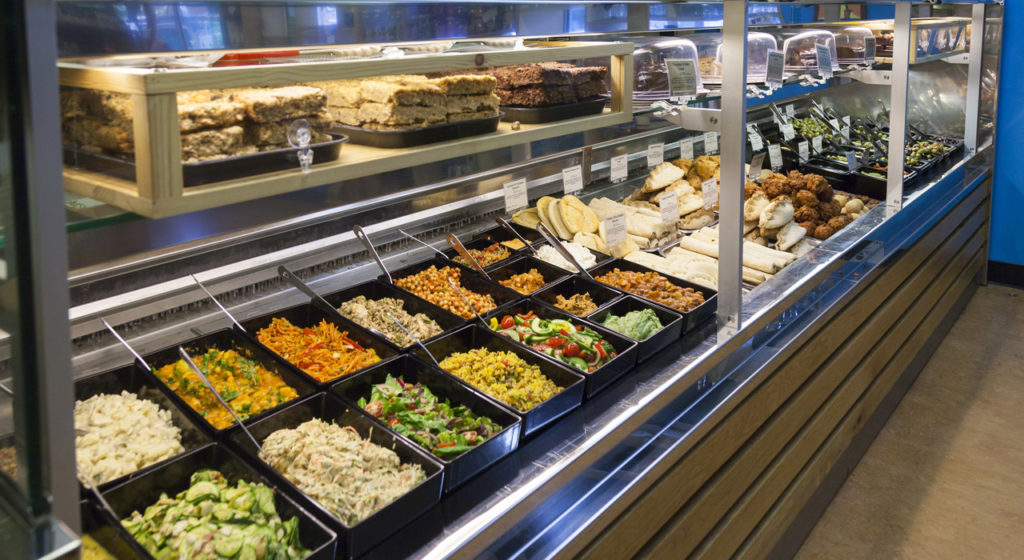
Credit: Unicorn Grocery Manchester
Most people discover that the bulk of their household plastic comes from three or four specific places. Food packaging, mainly from the weekly supermarket shop. Cleaning products and toiletries. Takeaway and food delivery containers. The occasional big category like nappies or cat litter.
Knowing which categories are your largest is what makes the next step manageable. There is no sense in obsessing over a single plastic toothbrush a month if the real volume in your bin is coming from grocery shopping. The categories are not all equal.
Keep it simple: for seven days, notice what you throw away and group it roughly. A mental audit is fine. A literal list in your phone is better.
Start with the one category that matters most in your house
Trying to switch everything at once is how almost everyone gives up. Behaviour-change research is consistent: adding one new habit at a time and letting it become automatic before adding the next is roughly twice as likely to stick than trying to overhaul multiple categories simultaneously.
Pick the category your week of noticing identified as largest. For most people that is one of three:
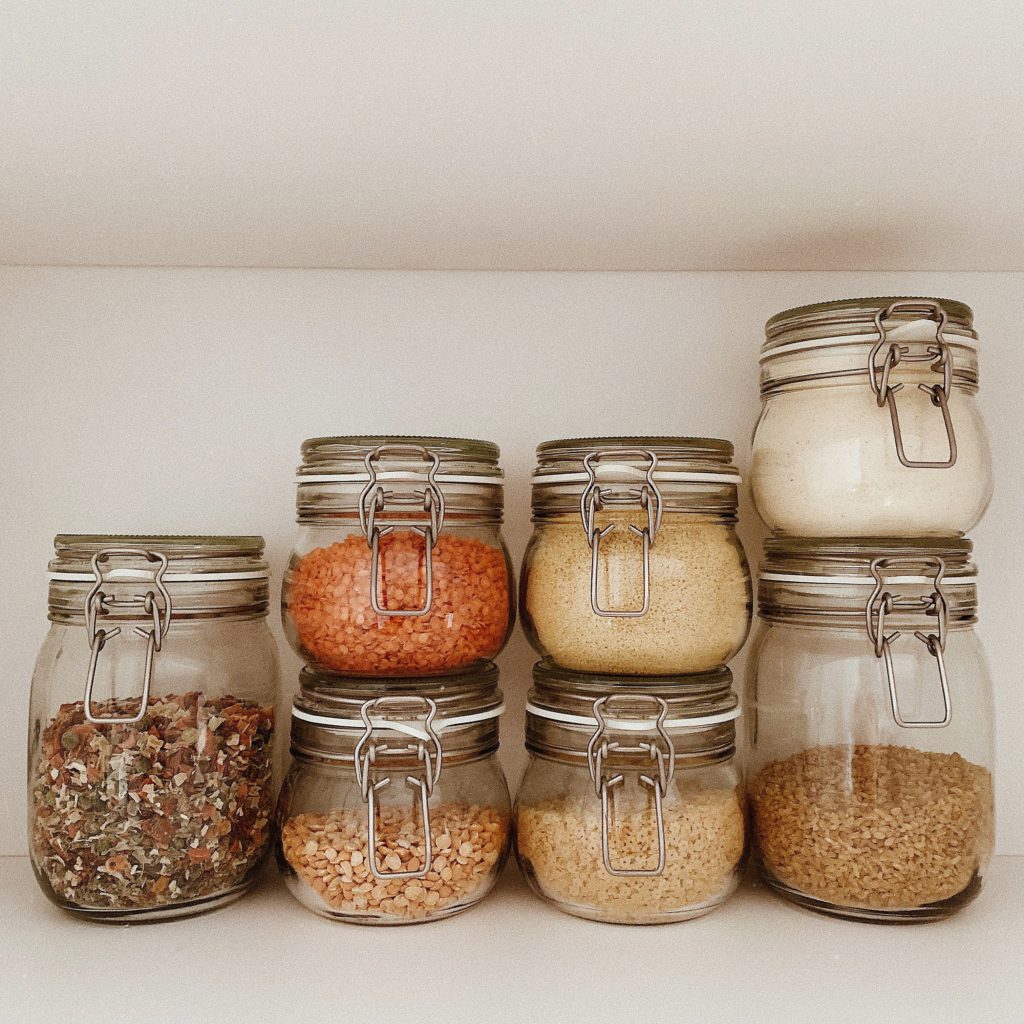
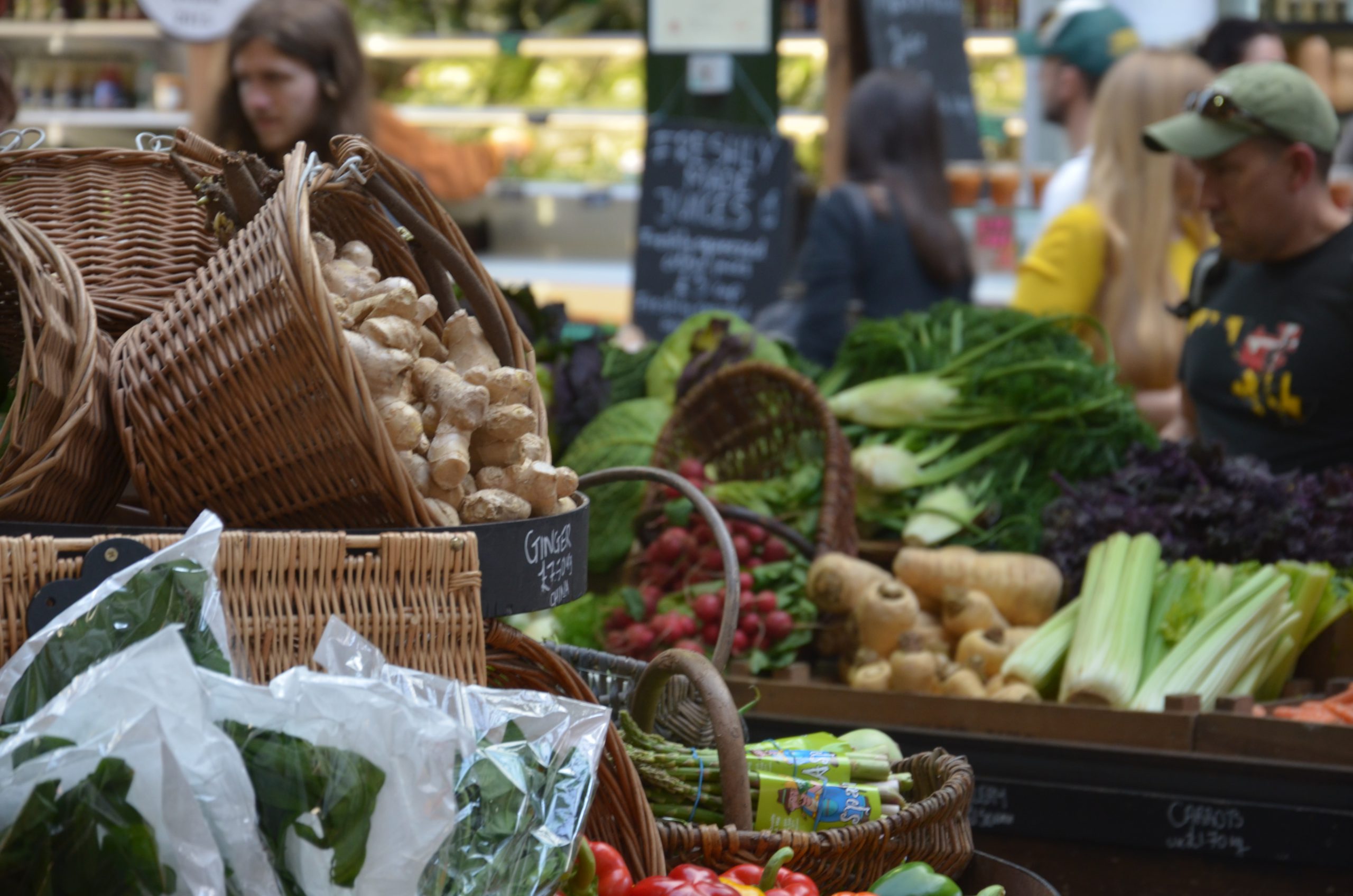
Food shopping. The shift here is buying loose rather than packaged where your supermarket allows it, taking your own bags and containers for the counters that will use them, and finding one or two local refill options for dry goods like pasta, rice, oats, and lentils. Most UK towns now have at least one refill shop. The Ethical Consumer directory lists them; so does a Google search for “refill shop [your town]”.
Cleaning products and toiletries. The refill shift is most developed here. Most major UK supermarkets now stock concentrated cleaning products (Ecover, Method, Smol) where you reuse one bottle and top up with water. Shampoo bars, conditioner bars and solid soaps replace plastic bottles one-for-one. Refillable aluminium deodorants replace plastic roll-ons. None of these require a research project. They just require buying the refill version the next time the current one runs out.
Water and drinks. A single reusable water bottle, used daily for a year, replaces hundreds of single-use bottles. A reusable coffee cup does the same for takeaway coffees. The carbon payback on both typically sits around twenty uses, which is a fortnight for most people.
Pick the category most relevant to your week’s audit. Commit to the swap for a month. Move on only when the first one is automatic.
Use what you already own before you buy new
Plastic containers you already own are not the enemy. The environmental cost of making them has been paid. Throwing them away to buy a “plastic-free” alternative is worse than keeping and reusing them.
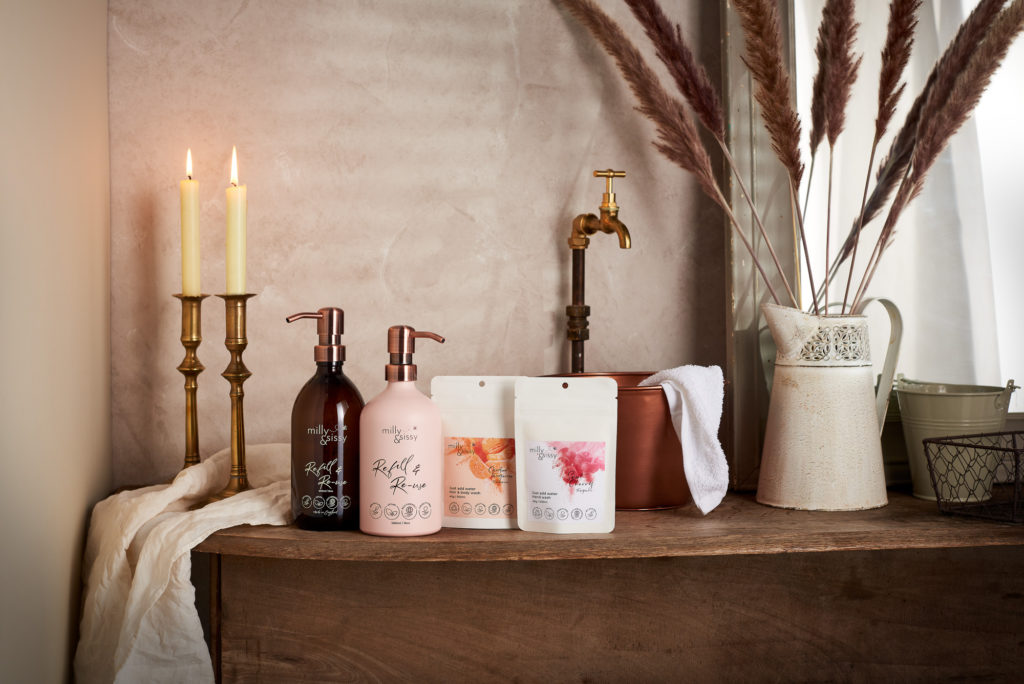
Credit: Milly & Sissy
A used ice cream tub is a free food-storage container. A passata jar with a good seal is a free spice jar. A shampoo bottle with a pump mechanism is a free refillable soap dispenser if you buy bulk hand soap. The Japanese concept of mottainai – the sense that it is a shame to waste the useful life in something – captures the principle better than most sustainability slogans.
The rule of thumb: only buy a purpose-made reusable when the thing it replaces is actually worn out, when you genuinely do not have a workable substitute, or when the new item will be used so often that the upfront cost pays back quickly. For most households, the reusable items that clearly meet this test are: one good water bottle, one good coffee cup, two or three cloth shopping bags, and a few beeswax food wraps. Everything else, use what you have.
Find one refill option locally, use it for a month
The single most effective habit-forming step is establishing one refill routine you actually maintain. For most households, that means locating a local refill shop – or a refill section at the local supermarket – and using it once for one product category.
The category matters less than the establishment of the routine. Washing-up liquid. Laundry detergent. Olive oil. Pasta. Lentils. Shampoo. Whichever you use most. Buy a bottle or container from the shop, or bring one from home, and do the refill once. Then bring it back next time.
DEFRA research on household waste shows that refill-based buying reduces household packaging waste by a meaningful margin, and that most people who start refilling for one category add others within six to twelve months. The second category is easier than the first. By the third, it is the default rather than the novelty.
Learn the plastic codes, but do not rely on them
The resin identification code on plastic packaging – the number from 1 to 7 inside the triangle of arrows – tells you which type of plastic it is. In theory this tells you what recycles and what does not. In practice, only two of the seven reliably recycle at UK scale.
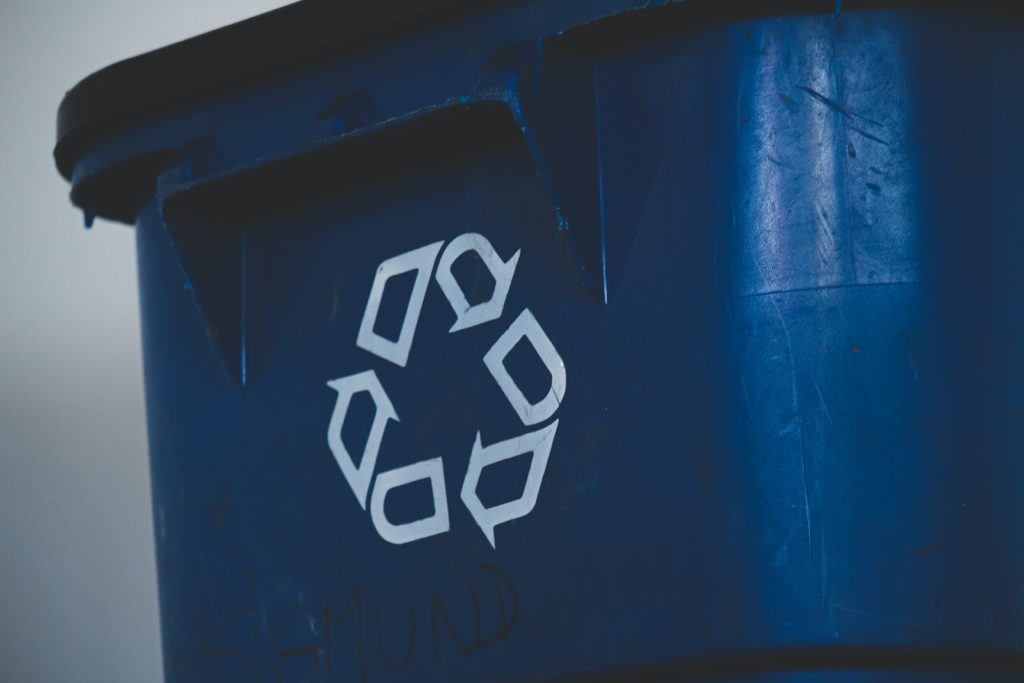
Credit: Sigmund
PET (code 1, drinks bottles, clear food packaging) recycles well. HDPE (code 2, milk bottles, detergent bottles) recycles well. Polypropylene (code 5) is increasingly collected kerbside but recycles less cleanly. The rest – PVC, LDPE, polystyrene, mixed plastics – almost never recycle in practice, according to the 2024 Big Plastic Count, run by Greenpeace UK and Everyday Plastic — the UK’s largest plastic waste survey, involving 225,000 participants across 77,000 households — which estimated that only around 17% of UK household plastic is actually recycled, with around 58% incinerated and the remainder landfilled or exported.
The practical upshot: when you do have to buy plastic, choose codes 1 or 2 where possible. But recognise that the recycling symbol on most other plastics is the manufacturer’s aspiration, not the council’s capability. For the longer explanation, see our biodegradable, compostable, recyclable guide.
What good looks like after a year
A realistic end state after twelve months of slow, non-dramatic change for most households:
A reusable water bottle, coffee cup, and three or four cloth shopping bags, used consistently. One local refill routine established and maintained – usually cleaning products, sometimes toiletries, occasionally dry food. Solid-bar replacements for a few of the bathroom products that used to come in bottles. A handful of food-shopping habits that cut the weekly plastic – buying loose fruit and veg where available, bringing containers to the butcher or cheese counter, skipping the thin produce bags.
Not zero plastic. Nowhere near it. But reliably 30 to 60% less plastic in the weekly bin, with no ongoing mental effort because the habits have settled into routines. That is the honest, sustainable version of plastic-free living.
Where to start on Ziracle
Every brand in our Refills and Reusables edit has been chosen for the same reason: the packaging is either designed to be used hundreds of times or designed to disappear cleanly at the end of life. Filter by Plastic Free for the zero-plastic options, Refillable for the systems that top up rather than replace, or Reusable for items built to last thousands of uses.
For the habit-level changes that extend this across other categories of household consumption, see our zero waste swaps guide.
If you are starting with the kitchen or bathroom, Clean Home is the goal page to bookmark for products that do not hide packaging problems behind marketing claims.
FAQs
Is reusable really better when you count the carbon cost of making it?
For almost every reusable item, yes, once you have used it a few dozen times. The carbon payback on a reusable cotton bag typically sits around twenty to forty uses versus a single-use plastic bag. A stainless steel water bottle pays back within a couple of weeks of regular use compared with buying bottled water. The exception is items you buy and barely use. A cupboard of unused reusables is worse than buying single-use, precisely because the manufacturing carbon was wasted. Buy only what you will actually use consistently.
What about bioplastics like PLA – are they better?
Sometimes, in narrow circumstances. Compostable plant-based plastics like PLA can return to soil in industrial composting facilities (at around 58°C), but not in a home compost or a general-waste bin. If your council collects food waste and accepts bioplastics in it, compostable packaging is a meaningful improvement. If it does not, the compostable plastic performs similarly to conventional plastic in the actual waste stream.
How do I handle people who make comments about my reusables?
You do not, mostly. The social friction around sustainable behaviour is usually imagined rather than real. A reusable coffee cup or water bottle is unremarkable in 2026. A refillable shampoo bottle raises no eyebrows at the supermarket. If anyone does comment, a brief factual answer and a subject change works fine. This is not a debate you need to win.
Can I really go fully plastic-free?
Almost nobody does, and the people who try usually burn out within six months. Fully plastic-free living in the UK in 2026 excludes most supermarkets, most pharmacies, and a significant fraction of the modern food supply. The productive target is reducing unnecessary plastic, which is usually 30 to 60% of what a household currently throws away. The last 40% is structural and mostly outside individual control. That is what collective action, producer-responsibility policy, and the extended producer responsibility reforms coming into force in 2025-27 are for.
Where should I start if I only change one thing?
A reusable water bottle, used daily in place of any single-use bottles you would otherwise buy. It is the single swap with the best ratio of easy-to-adopt to waste-reduced for most people, and the habit it builds (noticing when you are about to buy single-use and choosing not to) transfers to almost every other category.
Most eco swap guides treat the home as one undifferentiated problem. The house is not that. It’s a few high-impact rooms and a lot of noise, and if you don’t know the difference, you end up with a drawer full of bamboo cutlery and a cupboard still stacked with plastic bottles.
So here’s the honest version. Where the plastic actually comes from, which swaps shift the numbers, and which ones you can skip without losing sleep.
Where household plastic actually comes from
According to Greenpeace UK and Everyday Plastic’s 2024 Big Plastic Count — the UK’s largest plastic waste survey, involving 225,000 participants from 77,000 households — UK households throw away an average of 60 pieces of plastic packaging every week, equivalent to 1.7 billion pieces nationally and 90 billion a year. Just 17% of this is recycled in the UK, while 58% is incinerated. That isn’t forgotten bottles at the back of the recycling bin. That’s the packaging that cycles through the house week after week: cleaning sprays, laundry detergent, food wrap, bin liners.
Cleaning and laundry are where the opportunity lives. Both categories are almost entirely liquid, almost entirely plastic-packaged, and almost entirely replaceable with formats that work as well. The average household gets through dozens of spray bottles, detergent bottles, washing-up bottles, and fabric softener bottles a year, all of them single-use.
Most of them can’t be recycled in kerbside collection either. The trigger-spray mechanism on a kitchen cleaner combines several plastic types that can’t be separated at the recycling plant, which means the whole bottle tends to be down-cycled or landfilled. The kitchen and bathroom contribute the rest: food wrap, sponges, bin liners, cotton buds, miscellaneous single-use packaging. Some of that is hard to replace. Most of it isn’t.
The swaps that actually make a difference
Concentrated, refillable cleaning products: the biggest single win
Switching from ready-to-use spray cleaners to concentrated refillable formats is the most impactful swap in the house. Which?’s analysis of refillable and concentrated products confirms that concentrated formats use substantially less plastic and far less water than the standard ready-mixed equivalent, because you’re not shipping water in a bottle across the country — its independent lab testing also found that 11 of 12 popular refillable products worked out cheaper per ml than their original counterparts. Performance has caught up: concentrated cleaners from dedicated refillable brands clean as well as conventional products. Browse the Refillable Multi-Surface range for options.
The format worth looking for is a refillable glass or aluminium bottle plus concentrated tablets or drops that dissolve in water. One bottle, kept indefinitely. Refills ordered when you need them. The plastic is pulled out of the cycle almost entirely.
Laundry sheets and strips: yes
Laundry detergent bottles are bulky, heavy, and almost never made from easily recyclable plastic. Laundry sheets, which dissolve in the wash and come in cardboard, replace them cleanly. Performance has improved a lot from the first generation. They work in standard and high-efficiency machines, at all temperatures, and take up a fraction of the space. See the Refillable Laundry edit.
Washing-up liquid: switch to concentrate or a solid bar
One of the highest-turnover plastic items in most kitchens. Concentrated washing-up liquid diluted into a refillable bottle cuts the number of bottles dramatically. Solid washing-up bars, used with a wooden dish brush, remove plastic altogether. Both work. The bar asks for the most adjustment. The concentrate is the gentler switch. Browse the Refillable Washing Up range.
Kitchen sponges: swap immediately
Conventional synthetic sponges shed microplastics into wastewater with every wash-up and go in the bin within weeks. Research published in 2022 in Science of the Total Environment estimated that a single kitchen sponge can release millions of microplastic fibres over its lifetime. Compostable alternatives (loofah, wood-pulp cellulose sponges, natural sisal scourers) do the same job without the plastic. Low cost, immediate swap, no adjustment. You’ll find them in the Cleaning Tools edit.
Beeswax wrap and reusable food covers: yes for most uses
Cling film is one of the few plastic products that can’t be recycled by most UK councils. Beeswax wrap covers bowls, wraps sandwiches, and keeps cut vegetables fresh. It doesn’t work for raw meat, and it washes in cold water only. For most other uses it’s a direct replacement. Silicone stretch lids are the alternative for bowls and containers if beeswax isn’t practical.
Bin liners: trickier than it looks
Compostable liners are worth using for your food waste caddy, where they go into food waste collection and break down properly under the industrial composting conditions those facilities provide. For general waste bins the picture is messier. Compostable liners need the same industrial conditions to break down, which most UK councils don’t provide. Recycled-content plastic bin liners are the more honest swap for general waste until the infrastructure catches up.
Dishwasher tablets: switch to plastic-free packaging
Most dishwasher tablets come individually wrapped in plastic film inside a plastic tub. Plastic-free alternatives in cardboard boxes or compostable wrappers are widely available now and perform comparably. Simple swap, no adjustment. See the Refillable Washing Up range again for tablet options.
What doesn’t need changing
Most kitchen appliances, Storage & Most furniture. The home swap conversation focuses disproportionately on things that either aren’t plastic-heavy or can’t yet be replaced at equivalent quality. The cleaning and laundry aisle is where the wins are. Start there.
How to switch without replacing everything at once
The principle holds here too: the most sustainable product in the house is the one you already own. Use what you have. Replace with better when it runs out.
Cleaning products cycle through every few weeks, which makes them the fastest category to improve. Pick one item. The kitchen spray is a good place to start. When it’s empty, replace it with a refillable bottle and a concentrated refill. Then do the same for the next thing that runs out. Within a few months, most of the cleaning aisle sorts itself without a single bottle wasted.
The cleaning aisle is where most household plastic hides. It’s also where the alternatives work best.
Laundry is the next target. A box of sheets lasts as long as a bottle of liquid detergent and produces none of the packaging. After that, the kitchen: sponges, food wrap, washing-up liquid. By the time you’ve worked through those, the remaining plastic in the house is mostly packaging that came home with your food. That’s a supply-chain problem, not a consumer one. For the same approach applied to your bathroom, see our guide to eco swaps for beauty. For the kitchen specifically, the eco swaps for food and drink guide picks up where this one stops.
What to buy when something runs out
Every product in the Clean Home category on Ziracle has passed the same standard: effective, transparently formulated, plastic-free or refillable wherever that’s possible. For home cleaning specifically, that means biodegradable ingredients, refillable formats, and no misleading claims about what the packaging actually does to the environment. Many of the brands are certified B Corp or are Plastic Free.
The formats worth prioritising: concentrated cleaning tablets or drops with a refillable bottle, laundry sheets in cardboard, compostable sponges, washing-up concentrate. The brands that earn their place are the ones that have thought through the whole system, beyond the label on the front.
Next time a cleaning bottle runs empty, you know what to replace it with.
Ready to switch? Browse the Refillable edit and pick the first thing that runs out.
FAQ
What’s the single biggest eco swap I can make in my home?
Switch from conventional ready-to-use spray cleaners to concentrated, refillable alternatives. Which?’s testing found concentrated cleaners use substantially less plastic and water than ready-mixed sprays, because you’re not paying to ship water around the country, and that refillable formats are typically cheaper per ml than their original counterparts. One refillable bottle, kept indefinitely, plus tablets or drops that dissolve in tap water. Performance is comparable to conventional cleaners.
Do laundry sheets actually work as well as liquid detergent?
For most households, yes. Modern laundry sheets dissolve fully in both standard and high-efficiency machines, work at all temperatures, and clean comparably to liquid detergents for everyday loads. They struggle more with heavily soiled items or stains that need pre-treating. For households with small children or sports kits, a liquid detergent refill may still be the better fit. For the average weekly wash, sheets are a clean swap.
Are compostable bin liners worth using?
For the food waste caddy, yes. Food waste goes to industrial composting facilities where compostable liners break down as designed. For general waste bins, compostable liners rarely get the industrial conditions they need and end up behaving much like plastic in landfill. Recycled-content plastic liners are the more honest swap for general waste until kerbside infrastructure catches up.
How bad are conventional kitchen sponges?
Bad enough to swap. A 2022 study in Science of the Total Environment estimated that each synthetic kitchen sponge releases millions of microplastic fibres across its lifetime, mostly into wastewater during washing-up. Compostable alternatives (loofah, cellulose, natural sisal) do the same job and go on the compost heap when they wear out. Low cost, no adjustment period. Swap when the current one wears out.
Where should I start if I only want to change one thing?
The kitchen spray cleaner. It’s the item that cycles fastest, the format where refills work best, and the swap that compounds most quickly as you replace each bottle. When it runs out, order a refillable bottle and a concentrate refill. Next time something else runs out, repeat.
The bathroom cabinet is the easiest place to cut plastic out of your life. It’s also the place where most eco swap advice falls apart, which is why so many people have a half-empty shampoo bar sulking at the back of a drawer.
Shampoo bars that refuse to lather. Deodorants that tap out by 11am. Swaps that feel like a downgrade dressed up as virtue. This isn’t that list. Here’s what’s worth switching, what to expect, and how to do it without throwing out half a shelf of products you’ve already paid for.
Why the bathroom is the right place to start
The British Beauty Council reports that the beauty industry produces over 120 billion units of packaging each year, and most of it never gets recycled. Only 14% of that packaging makes it to a recycling plant, and just 9% is actually recycled in the UK — the rest goes straight to landfill, where single-use plastic packaging can take up to 450 years to break down.
That’s the problem worth solving, and the bathroom is the obvious place to solve it. Bathroom products are among the most repeatable purchases most people make. Shampoo every few weeks. Moisturiser every couple of months. Change the format of one of those, and the impact compounds with every reorder.
In the UK, around 520 million shampoo bottles are thrown away every year, according to research commissioned by packaging firm DS Smith. That single category, changed, would be a meaningful shift. And shampoo is where this usually starts.
The swaps that work. And the ones that don’t.
Shampoo bars: yes, if you buy the right one
A well-made shampoo bar replaces two to three bottles of liquid shampoo and produces zero plastic waste. The environmental case is clear. The performance case took a while to catch up, but it’s caught up. One bar lasts longer per wash, weighs less to ship, and lives quite happily on a soap dish. You can find pH-balanced bars in our Shampoo edit.
The caveat matters. Not all shampoo bars are equal. Plenty of the first-wave bars used saponified soap bases with a high pH that roughed up the hair cuticle, left residue, and caused the lather problems that put people off the whole category. pH-balanced syndet bars, made with mild synthetic detergents rather than soap, behave far more like a conventional shampoo. According to a 2014 review in the International Journal of Trichology, syndet cleansers are gentler on both hair and scalp than traditional soap formulas.
Look for the distinction when you buy. Give any new bar three to four washes before you judge it. The scalp adjusts.
Conditioner bars: yes
Easier transition than shampoo. Conditioner bars melt on contact with warm water and distribute much like a liquid conditioner. Less adjustment, same plastic saving. Browse the Conditioner range.
Solid soap and body wash bars: yes, and easy
The lowest-friction swap in the bathroom. A good soap bar with moisturising oils performs about as well as most liquid body washes, produces no plastic waste, and lasts longer. No adjustment period. Start here if you’ve never swapped anything before. The Soaps and Cleansers edit is a good first port of call.
Refillable deodorant: yes
The category has come on considerably. Refillable aluminium deodorants with cardboard or pulp refill inserts now perform as well as conventional roll-ons for most people. The upfront cost is higher and the ongoing cost is lower. See the Refillable Deodorant range.
Natural deodorant: worth trying, with care
Aluminium-free natural deodorants work for many people but not everyone. If sweating is a concern, test during a quieter week rather than committing on a high-stakes one. The switch usually takes two to three weeks as the body adjusts. A refillable conventional deodorant is the better answer if the natural version doesn’t hold up for you.
Reusable cotton pads: yes, immediately
Single-use cotton pads are a small but constant source of waste. Reusable cloth rounds wash in with the normal laundry and replace the disposable version entirely. One pack of ten lasts years. The shortest payback period on the list.
Bamboo toothbrushes: yes
The NHS recommends changing your toothbrush, or electric toothbrush head, every three months, or sooner if the bristles are frayed. That’s a lot of plastic across a population. Bamboo handles with nylon bristles are the practical swap — browse the Oral Care edit for options. The bristles still go in general waste, but the handle composts. Fully compostable bristles exist but don’t clean as well, which is a trade-off worth knowing about.
Refillable skincare: prioritise this over format swaps
For moisturisers, serums and cleansers, refillable schemes tend to land a bigger win than switching format entirely. A glass jar refilled ten times is a better outcome than ten compostable single-use alternatives. Look for brands running active refill programmes rather than brands that simply use recycled packaging. The Refillable Skincare edit curates these.
What doesn’t work yet
Mascara, most foundations, and complex multi-component products. The packaging problem on these hasn’t been solved at scale. TerraCycle runs collection schemes for some brands, which is currently the best option. Buying less, buying better, and using products fully before replacing them does more here than any packaging swap.
How to switch without wasting what you’ve already got
The most sustainable thing in your bathroom cabinet is a product you’ve already bought.
Use it up first. The manufacturing cost is already sunk, and chucking a half-full bottle to replace it with something greener is the wrong maths. When a product runs out, replace it with the better version. Start with the things that cycle fastest: shampoo, body wash, soap, cotton pads. Most repetitions, fastest payback. For a similar approach applied to your wardrobe, see our beginner’s fashion guide.
Keep a list. When something runs low, check whether there’s a better format or brand before you reorder the same thing on autopilot. That pause is where most of the change actually happens.
What to buy when the time comes
Every product in the Beauty and Self-Care category on Ziracle has passed the same bar: kind to skin, honest about ingredients, and made with the planet in mind. For eco beauty specifically, that means plastic-free or refillable packaging, formulations without unnecessary synthetics, and brands that are transparent about their supply chain. We also prioritise brands certified Cruelty Free and products made with Organic ingredients where relevant.
The formats to look for: solid bars for hair and body, refillable deodorant, reusable cotton rounds, and skincare brands with active refill schemes. If you want to keep going down this rabbit hole, read our guide to eco swaps for home next, or our rundown of the best zero waste beauty brands.
You now know which swaps are worth making and which ones aren’t ready yet. Next time something runs out, you know exactly what to replace it with.Ready to shop? Browse our edit of Refillable beauty to find products that have already passed the standard.
FAQ
Do shampoo bars actually work as well as liquid shampoo?
Modern pH-balanced syndet bars perform comparably to liquid shampoo for most hair types. The earlier generation of soap-based bars had a high pH that roughed up the hair cuticle, which is where the reputation for poor performance came from. Give a good syndet bar three to four washes before you judge it. The scalp needs a little time to adjust.
Are refillable deodorants worth the higher price?
Yes, over time. The upfront cost of a refillable aluminium case is higher than a conventional plastic deodorant, but the refill inserts are cheaper than buying new roll-ons each time, and the plastic saving is significant over a year. Performance is comparable for most people. Natural aluminium-free versions are worth trying separately, but expect a two to three week adjustment period.
What should I do with half-used products when I switch?
Use them up. Binning a half-full bottle to replace it with something greener makes the manufacturing cost a sunk loss and buys you zero environmental benefit. The right time to swap is when the product runs out. Keep a running list so you remember to reorder the better version rather than the old one on autopilot.
Which eco beauty swap has the biggest impact?
Shampoo, because it’s the most repeatable. Around 520 million shampoo bottles are discarded in the UK each year. Switching a product you buy every few weeks compounds the saving fast. Body wash, soap, and cotton pads come next for the same reason. Mascara and foundation are further down the list because the packaging problem hasn’t been solved at scale yet.
Minimalism: for some people it’s the path to a calmer life, for others it’s a luxury only a few can afford to think about. Whatever you make of the label, most of us can agree on one thing. Our homes carry a lot of stuff. The question isn’t really whether you should own less. It’s whether the things you already own are being used well, and what happens to the things you decide to let go of.
It’s worth being specific about why this matters. A 2010 study by Saxbe and Repetti, published in Personality and Social Psychology Bulletin, found that people who described their homes as cluttered had higher levels of cortisol, the body’s main stress hormone, across the day than those who described their homes as restorative. Follow-up research by Vartanian, Kernan and Wansink, published in 2017 in Environment and Behavior, showed that a chaotic kitchen environment led people to eat substantially more sweet snacks than people in a tidy one. Clutter isn’t only a visual problem. It changes how you feel and how you behave.
The problem with decluttering is that it can become a wasteful practice in its own right. In the rush to that clean-space feeling, we throw out things that could have been used, worn, passed on or repaired. A sustainable declutter doesn’t mean filling a bin bag and feeling lighter. It means finding the route for each item that keeps it out of landfill for as long as possible. Here’s how to work through the three rooms where clutter tends to stack up fastest.
Bedroom and wardrobe
Credit: Thom Bradley
A wardrobe reset is often the first thing people reach for when they want a clean-out. The instinct is right. The execution matters. Throwing fast-fashion pieces straight into a bin bag, whether for waste or for the local charity shop, isn’t the answer it feels like.
A 2025 investigation by Unearthed and Greenpeace Africa found garments from UK high-street brands including Next, George at Asda, Marks & Spencer, Zara, and H&M inside internationally protected wetlands in Ghana — home to rare birds and three species of endangered turtles. In 2024, the UK exported more clothing waste to Ghana than any other country — approximately 57,000 metric tonnes — with Ghana’s Kantamanto market receiving an estimated 1,500 tonnes of secondhand clothing every week, of which nearly half a million garments become waste. Sending clothes ‘away’ usually means sending them somewhere else’s problem.
A better order of operations.
First, repair. Anything still wearable that only needs a button, a seam or a zip should go to a separate repair pile and then to a local tailor, cobbler or community repair cafe.
Second, pass on directly. Clothing swaps with friends and family, Depop, Vinted, eBay and local selling groups move clothes to people who want them, without going through the charity-shop sort.
Third, donate with care. If you’re giving to a charity shop, be honest about condition. Good-quality, clean, fully functional pieces are useful. Pilled fast-fashion basics usually aren’t. Look into specialist charities for work clothing, winter coats and maternity wear where the donation goes directly to someone who needs it.
Finally, textile recycling as a last resort. If a piece is truly beyond repair, textile recycling banks or brand take-back schemes are better than the general waste bin.
If you do need to replace pieces, that’s where the deeper principles of slow fashion kick in: buy less, buy better, and choose pieces you’ll wear for years. For the full argument, see our guide to what slow fashion actually is.
Sending clothes ‘away’ usually means sending them somewhere else’s problem.
Bathroom and beauty products
Credit: Annie Spratt
Beauty cabinets accumulate quickly. A trend you tried once, a gift that wasn’t quite right, a moisturiser you meant to finish. Throwing half-full bottles into the bin doesn’t clear clutter so much as move it, from your shelf into a landfill.
A more useful split.
The UK government’s cosmetic product safety regulations require products with a shelf life of more than 30 months to display a Period After Opening (PAO) symbol — the open-jar icon showing how long a product is safe once opened. Using skincare past this window is a genuine risk: bacterial contamination increases significantly once preservatives break down, and expired cosmetics should not be passed on.
If it’s unopened or lightly used and you know you won’t reach for it, give it away. A friend, a family member, a local women’s shelter or a community swap event will often take unopened products. Beauty Banks specifically distributes unused toiletries to people experiencing hygiene poverty in the UK. Some retailers also run take-back programmes for empty packaging. Check the brand before you bin.
If it’s something you originally bought for a reason and just stopped reaching for, use it. Rotate it to the front of the cabinet for a month and see whether it earns a place. If it doesn’t, you’ve at least finished it rather than wasted it.
When the time comes to restock, clean, cruelty-free and lower-waste replacements are easier to find than they used to be. Our guide to eco swaps for beauty is a useful starting point.
Kitchen and pantry
Credit: Nadia Pimenova
Zero-waste kitchen organisation is one of the most photogenic corners of the internet, and one of the easiest to get wrong. Matching glass jars, woven baskets and a labelled everything look clean on a phone screen. Buying them all in one sweep isn’t particularly clean for the planet.
The more useful version of the same instinct: work with what you have. The Tupperware in the back of the cupboard, the jam jars with labels still on, the takeaway containers you washed out. All of it is already in your house and already paid for. Pool them, sort them, label them clearly. Your pantry won’t look Pinterest-perfect. It’ll work just as well, and you won’t have added a new haul of containers to the world to hold the same amount of food.
The pattern is the same in every kitchen drawer. Before you buy a new version of something, check whether an existing version could do the job. The sustainable answer is almost always the one you already own. If you genuinely do need new storage (glass jars for bulk-bought grains, for instance), browse the Kitchen Storage edit for options made to last.
The sustainable declutter, in one line
Decluttering sustainably isn’t about getting rid of everything you own. It’s about using what you have more fully, finding careful next homes for the things you can’t, and being honest with yourself about what you actually need to replace. Fewer things bought badly. More things used well.
Every brand in the Home and Sanctuary and Beauty and Self-Care categories on Ziracle has passed the same standard: built to last, transparent about materials and supply chain, and designed around longevity rather than disposability. Filter by Refillable across both departments to find products that don’t add to the stack you’re trying to clear.
Ready to shop? Browse the Clean Home edit for the things you will use and finish.
FAQs
Is decluttering really worth it, beyond aesthetics?
Yes, measurably. A 2010 study in Personality and Social Psychology Bulletin found that people who described their homes as cluttered had higher cortisol levels throughout the day than people who described their homes as restorative. Follow-up research in Environment and Behavior linked chaotic kitchen environments to meaningfully higher snack intake. The effect isn’t huge in any single moment, but it compounds over the hours you spend at home each week. A calmer space isn’t vanity. It’s measurable stress reduction.
What’s wrong with just donating everything to a charity shop?
Charity shops are overwhelmed, particularly with low-quality fast-fashion donations. A significant share of what doesn’t sell on the shop floor gets baled up and exported to countries in East Africa and elsewhere, where it often ends up in landfills, rivers or wetlands. Greenpeace’s 2023 investigation documented this route clearly. Donation isn’t wrong. Indiscriminate donation is. Sort honestly: good quality, clean, fully functional pieces are genuinely useful to charity shops. Pilled fast-fashion basics usually aren’t.
Where can I pass on clothes that are too worn for charity shops?
Textile recycling banks (usually at supermarket car parks or recycling centres), brand take-back schemes, H&M’s garment collecting programme, and online marketplaces like Vinted and eBay for anything still wearable. Some local councils also run fabric recycling collections. The general waste bin should be the genuine last resort, not the default.
What do I do with expired beauty products?
Bin the product itself, but recycle the packaging where you can. Most empty plastic bottles with a recycling symbol go in your kerbside recycling. Some brands (including MAC, Kiehl’s, and L’Occitane) run take-back programmes for their own empty packaging. TerraCycle runs collection schemes for harder-to-recycle items like mascara tubes and lipstick bullets. If the product is unopened and in date, Beauty Banks distributes unused toiletries to people experiencing hygiene poverty in the UK, and the British Beauty Council’s interactive recycling map helps you locate drop-off points for hard-to-recycle beauty packaging near you.
How often should I declutter, realistically?
Less often than Instagram suggests. A full wardrobe and bathroom audit once or twice a year is plenty for most people. More useful is a running one-in, one-out habit: when you buy something new, pass on something already in the wardrobe or cupboard. That stops the accumulation in the first place, which is a better problem to solve than the declutter it would otherwise require.
You’ve switched the shampoo bar. You’ve swapped the kitchen spray. The bathroom cabinet looks different, the cupboard under the sink looks different, and yet the recycling bin is still full every week, still mostly plastic, still mostly from food. That’s not a failure of effort. It’s where the problem actually lives.
So here’s what’s worth changing in the food aisle, what’s genuinely difficult, and why the hardest parts aren’t yours to fix.
Why food and drink is where most household plastic starts
The 2024 Big Plastic Count, run by Greenpeace UK and Everyday Plastic with academic support from the University of Portsmouth — the UK’s largest household plastic survey, involving 225,000 participants from 77,000 households — found that 81% of the plastic counted came from food and drink packaging, consistent with the 83% recorded in the first count in 2022. That isn’t shampoo bottles or cleaning products. That’s the packaging your food arrives in, week after week, from the supermarket.
The two largest categories within that: snack packaging and fruit and veg packaging. Between them they make up most of what the average household throws away. WRAP estimates that fresh fruit and vegetables alone generate tens of thousands of tonnes of hard-to-recycle plastic each year, and most of it is film. Soft plastic film is one of the hardest consumer materials to recycle at scale, and the vast majority of it in UK households ends up in general waste.
This matters for how you approach the food aisle. The cleaning and beauty swaps covered elsewhere in this series sit largely within your control. You choose the format, you swap the product. Food packaging is different. Some of it you can change. Some of it is a supermarket and supply-chain problem wearing a consumer-choice costume.
The swaps that are actually within reach
Buy loose fruit and veg where you can
The single most impactful food swap on the list. WRAP’s 2022 research found that removing plastic packaging from a handful of the most commonly bought fruit and vegetable items could prevent around 100,000 tonnes of food and plastic waste each year in the UK, in part by letting people buy only what they need rather than being forced into a pre-weighed pack. The plastic on most pre-packed fresh produce is film, which is rarely kerbside-recyclable and usually ends up incinerated.
Most supermarkets now offer at least some loose options. Bring a paper bag or a reusable produce bag. Where loose isn’t available, go for cardboard or paper over plastic film where there’s a choice. It isn’t always possible. When it is, it’s the highest-return swap in the food aisle.
Switch to a reusable bottle and cup
A reusable water bottle removes the most avoidable category of single-use plastic from most people’s days. The same applies to a reusable coffee cup if you buy coffee on the go. Both are low-cost, immediate, and ask for no adjustment once the habit lands. Browse the Water Bottles edit and Reusable Coffee Cups edit.
Choose glass, cardboard or aluminium over plastic where the product is identical
For pantry staples: passata in a carton rather than a plastic bottle, tinned tomatoes rather than plastic pouches, glass jars of nut butter rather than plastic tubs. The product inside is identical. The packaging choice isn’t. This is the kind of swap that costs no extra effort at the point of purchase and compounds across dozens of items a year. See The Pantry range for staples already packaged well.
Buy in bulk where you use something reliably
A large bag of oats produces less packaging per portion than five small ones. Same with rice, lentils, flour, and most dried goods. Buying the largest practical size of products you’ll definitely get through is one of the lower-effort packaging reductions available. Many independent shops and zero-waste retailers now offer loose options for dried goods, coffee, and oils.
Reusable produce bags
Swapping the single-use plastic bags in the fruit and veg aisle for lightweight mesh or cotton reusables is a small but consistent win. They wash easily and last for years. Not transformative on their own, but they add up alongside the other changes.
What’s harder than it looks, and why it’s not your fault
Some of it you can change. Some of it is a supermarket and supply-chain problem wearing a consumer-choice costume.
Crisps, biscuits, cereal bars, confectionery. The hardest food category to improve. Almost all of it is plastic film or foil-laminate. Neither is collected by most UK councils. Neither has a widely available plastic-free alternative that performs comparably at the supermarket scale. TerraCycle runs collection schemes for some brands, but these require dropping packaging at specific points rather than putting it in the kerbside bin.
Ready meals, deli packaging, pre-marinated meat trays fall into the same category. The plastic trays and film lids are rarely recyclable at home. Alternatives exist in some supermarkets (paper-based trays, cardboard sleeves) but they’re inconsistent and not always clearly labelled.
Plastic film on multipacks: the wrap holding together a four-pack of tinned tomatoes or a six-pack of yoghurt pots is almost never recyclable at home. According to WRAP’s 2025 report, Circular Films: Pathways to Scalable Recycling, consumer plastic film and flexible packaging makes up more than a quarter of all plastic packaging placed on the UK market, yet only 7% of it is currently recycled. Under the government’s Simpler Recycling reforms, mandatory kerbside collection of plastic films is due to begin across England by March 2027 — until then, the larger supermarkets have installed soft-plastic collection points in many stores. Using these is worth doing. Relying on them as the main solution is not.
The honest position: a lot of food packaging waste isn’t within the consumer’s control at current supermarket infrastructure. Buying better where you can, supporting refill and loose options where they exist, and accepting that the rest is a supply-chain problem is the most realistic stance. Every choice adds up. But not every choice is yours to make. For the same approach applied to your bathroom and home, see our guides to eco swaps for beauty and eco swaps for home.
What to buy when you’re shopping well
Every product in the Food and Drink category on Ziracle has passed the same standard: good food, responsibly sourced, packaged with as little unnecessary plastic as possible. For this category specifically, that means Organic where it matters, minimal or plastic-free packaging, and brands that are transparent about what’s in the product and where it came from. Many carry Fair Trade certification for supply-chain transparency beyond the packaging question.
The formats worth looking for: glass jars, cardboard, aluminium, and brands with refillable or return schemes. The brands that earn their place are the ones where the food itself is worth buying and the packaging is a considered choice rather than an afterthought.
You now know where most of the plastic in your kitchen actually comes from, which swaps are worth making, and which ones are beyond what any single shopper can solve. Which means the next supermarket trip looks a bit different.Ready to switch?
Browse the Plastic Free edit and start with one item at a time.
FAQs
What percentage of household plastic comes from food and drink?
According to the 2024 Big Plastic Count, run by Greenpeace UK and Everyday Plastic across 225,000 UK participants, food and drink packaging accounted for 81% of the plastic items counted in the average household’s weekly waste — broadly consistent with the 83% recorded in the first count in 2022. That’s why the food aisle is where the biggest opportunity sits, even after you’ve switched cleaning and beauty products.
Is buying loose fruit and vegetables actually worth the effort?
Yes. WRAP’s 2022 research found that removing plastic from a small handful of the most-bought fresh items could prevent around 100,000 tonnes of food and plastic waste a year in the UK, in part because loose produce lets people buy only what they need rather than being forced into pre-weighed packs that often go off. Bring a paper bag or a reusable mesh produce bag.
Can I recycle the plastic film on multipacks or fresh produce?
Rarely at home. Soft plastic film is one of the hardest consumer materials to recycle at scale —WRAP’s 2025 Circular Films report found only 7% of it is currently recycled in the UK, though mandatory kerbside collection is due across England by March 2027 under the government’s Simpler Recycling reforms. Many larger supermarkets (Tesco, Sainsbury’s, Co-op) now have in-store soft plastic collection points. Use them where you can. Don’t count on them as the main solution.
Are reusable water bottles really a meaningful swap?
For single-use plastic bottles specifically, yes. It removes one of the most avoidable categories of daily plastic. The environmental payback depends on the material (a stainless steel bottle takes a few months of regular use to break even against single-use plastic, a glass one longer), but once you’re past that threshold the maths works. Same applies to a reusable coffee cup if you buy coffee out.
What about snacks and biscuits?
The hardest category. Almost all mainstream snack packaging is plastic film or foil-laminate, neither of which is typically recyclable at home. TerraCycle runs collection schemes for some brands, and supermarket soft plastic bins accept some types. Beyond that, buying fewer individually wrapped items and choosing brands that use cardboard or paper where possible is the realistic stance. Much of it isn’t a consumer problem to solve alone.
Household food waste in the UK runs at around 6 million tonnes a year, of which 4.4 million tonnes is edible food thrown away, according to WRAP’s 2022 Household Food and Drink Waste report. That comes to roughly 210 kilos per household, and a financial cost of around £1,000 per year for a family of four. The emissions cost is about 16 million tonnes of CO2 equivalent, which is more than some small countries’ total annual output.
The point of this statistic is not to make you feel bad. It is that the single highest-leverage sustainability intervention most UK households can make – higher than switching to a green tariff, higher than cutting car journeys, higher than almost any specific eco-swap you could name – is wasting less of the food they already buy. The environmental saving is real. The financial saving is substantial. And the behaviour change required is smaller than people expect.
This is a guide to the grocery shop that makes that shift happen in practice. Not a new diet. Not a shopping list of unfamiliar products. Just the specific habits that WRAP’s own research consistently finds separate households that waste a lot of food from households that waste very little.
The single fact that matters most
Nearly 40% of edible food wasted in UK homes is thrown away because it was not used in time, according to WRAP’s research. Another quarter is because people cooked, prepared or served too much. A further 22% is waste because people decided they did not want to eat something.
None of that is primarily a product problem. All of it is a planning problem. The bread goes stale, the salad wilts, the second half of the yogurt pot times out, the ambitious Thursday dinner does not actually get cooked. What happens in the kitchen is downstream of what happened at the shop. The shop is where most of this gets fixed.
Six steps, applied in order, do most of the work.
Step one: shop your kitchen before you shop the shop
Fifteen minutes at home before you write a list. Open the fridge, the freezer, the dry-goods cupboard, the fruit bowl. Note what is about to turn. Note what is already there. Build the week’s meals around using those things first.
Credit: Toa Heftiba
This step alone prevents duplicate buying, catches the food about to expire, and puts the ingredients you already own at the front of the week rather than at the back. A half-onion, a wilting pepper, and a handful of frozen peas become the base of a curry on Monday rather than bin contents on Sunday.
The mental shift: search for recipes that use what you have, not recipes that require you to buy everything. A quick search on any recipe site, or the BBC Good Food “what’s in your cupboard” function, will turn up four or five options for almost any combination of leftovers.
Step two: plan seven days on paper
Fifteen more minutes with a piece of paper. Breakfast, lunch, dinner, for seven days. Not elaborate. Beans on toast counts. Jacket potato counts. A repeat of Tuesday’s dinner on Wednesday with the leftovers counts.
Credit: Ella Olsson
Assume two meals will go off-plan (unexpected takeaway, dinner at a friend’s, a rushed Tuesday when you grab a sandwich at work). Build five or six meals into the plan rather than seven. The flex matters. A rigid seven-meal plan that collapses on Thursday leaves ingredients stranded.
From this plan, write your shopping list. This single habit – planning meals before writing the list – is what WRAP research repeatedly identifies as the largest behavioural lever on household food waste.
Step three: buy only what you can actually store
The family-pack temptation is the biggest single driver of supermarket over-buying. A five-pack of peppers at a 20% discount is only a saving if you eat all five. For a household of two, it usually is not.
Credit: Nadia Pimenova
The rule that works: buy the quantity your meal plan calls for, plus a small buffer for sandwiches or breakfast. Not a discount-triggered quantity. Not a “might-need-it” quantity. The supermarket’s per-unit discount is often worse value than the smaller pack you will actually finish, once spoilage is factored in.
Good storage extends what you do buy. Glass jars for dry goods let you see what you have and how much is left. A fridge with clear containers at the front, rather than a drawer of opaque Tupperware at the bottom, means food you meant to eat gets eaten. The best storage tends to be clear, airtight, and visible. Most of it does not have to be new: repurposed jam jars and takeaway containers work as well as anything sold for the purpose.
Step four: take bags, and containers, to the shop
The UK’s plastic bag charge — introduced at 5p in 2015 and extended to 10p across all retailers in 2021 — has significantly reduced single-use carrier bag sales. According to DEFRA’s most recent carrier bag charge data (2024–25), sales by major retailers in England are down 79% since the first full year of reporting in 2016–17, equivalent to approximately 8 bags per person per year compared to an estimated 140 bags per person before the charge was introduced — a reduction of nearly 94% from the pre-charge baseline. Since its introduction, the charge has raised over £1.3 billion, most of which retailers have donated to good causes. Most households now have a small collection of reusable bags. The question is whether you remember to bring them.
Credit: Gaelle Marcel
The habit that works: keep a rolled-up tote bag in every coat pocket, handbag, and glove compartment you use. The single thing that breaks this habit is leaving the bags at home. Store them where they will be picked up automatically rather than where they have to be remembered.
For the next step up, bring reusable containers for counter services: butcher, deli, fishmonger, bakery. Many counter staff will happily tare your container on the scales. Some supermarkets now accept the same at their fresh counters. The small friction of asking disappears after two or three tries.
Step five: shop loose where you can, local where it works
Loose fruit and vegetables are usually cheaper than the pre-packed versions. The packaging accounts for a meaningful part of the supermarket price, and buying loose lets you take exactly the quantity you need. Most UK supermarkets now offer loose variants for common items. The selection expands every year.
Credit: Tim Mossholder
Local greengrocers, market stalls and farmers’ markets tend to stock loose produce as the default, often at prices below supermarket pre-packed equivalents. They are also useful for the things supermarkets do badly: properly ripe fruit, seasonal vegetables, bread with a short ingredient list.
Not everything has to shift. A weekly supermarket shop for the majority of your groceries, plus one weekly visit to a greengrocer or market for fresh produce, is a realistic split for most urban households. For the broader category of refillable and reusable groceries, our plastic-free living guide covers the household-wide version of this habit.
Step six: buy versatile, cook repeatedly
The single biggest predictor of whether a specialist ingredient gets used is whether it appears in more than one recipe you cook regularly. The fancy jar of miso, the unfamiliar grain, the single-recipe sauce – these are the items most likely to sit in the cupboard for a year and then be thrown out.
Credit: Syd Wachs
Stock versatile staples. Tinned tomatoes. Dried lentils and beans. Rice, pasta, oats. Onions, garlic, ginger. Olive oil, stock cubes, a small selection of dried herbs and spices you use often rather than a large selection you use rarely. These cover hundreds of meals between them.
Treat the specialist ingredient differently. Either buy the smallest quantity available (many spice shops and zero-waste shops sell spices by the gram), or commit to cooking the dish that uses it at least twice within a month. The second-cook principle converts most single-recipe buys into regular-pantry items.
What this looks like after six weeks
The honest end-state for most households who adopt these six steps is:
Shopping trips are slightly shorter because the list is specific and the store layout is familiar. The weekly bill is typically 15 to 25% lower, because the over-buying has stopped. The bin of edible food thrown away at the end of the week has dropped substantially. The fridge, at the point of the next shop, is empty rather than stacked with things to be rushed through. The occasional genuinely ambitious meal – the Sunday roast, the birthday dinner – still happens, but on top of a steady rhythm of simpler weeknight meals rather than in place of them.
This is not a lifestyle. It is a slightly better version of something you already do every week. The environmental benefit is a side effect of the fact that shopping with a plan is also cheaper, calmer, and quicker.
Where to start on Ziracle
Every brand in our Food and Drink edit has been assessed against the same standard: honest ingredients, transparent sourcing, and packaging that earns its place rather than only its marketing. Filter by Organic for produce and pantry staples certified to proper standards, or by Plastic Free for the items where the packaging is as considered as the contents.
For the storage side of the shift, Refills and Reusables covers containers, bags, wraps and the other small items that make the rest of this guide easier to maintain.
For the wider argument about how grocery shopping fits into household consumption overall, see our guide to what is conscious consumerism.
If food is where you are starting your broader sustainability shift, Eat Well is the goal page to bookmark.
FAQs
How much money can meal planning actually save?
WRAP’s estimate is that UK households of four waste around £1,000 of food a year on average. A meal plan that cuts that waste in half saves roughly £500, which is more than most people save through any single other sustainable-living change. The bigger saving often comes from shopping to a list, which reliably reduces impulse purchases by a significant margin across most households.
Isn’t cooking from scratch more expensive than ready meals?
Per-meal, almost never. Staples bought in reasonable quantities – rice, pasta, pulses, onions, tinned tomatoes, a few vegetables – make meals at under £2 per person that compete with the cheapest end of ready meals. The gap grows as you move up the ready-meal price range. The argument against cooking from scratch is almost always time rather than money, and batch-cooking (cooking once, eating twice) closes most of that gap too.
Are loose vegetables actually cheaper than pre-packaged?
Usually yes, by 10-30% on unit price, because you are not paying for the plastic wrap and the portion decision is yours. There are exceptions – some multi-buy offers on pre-packed items beat loose prices – but in general, loose is the better default. Check per-kilo prices rather than pack prices if you want to be sure.
What should I do with food that’s about to go off?
The core techniques are batch cooking, freezing, and casual improvisation. Wilting vegetables become soup. Stale bread becomes croutons, breadcrumbs or French toast. Yoghurt approaching its date works in marinades, baking and smoothies. The Love Food Hate Waste website has sections on “what can I do with” specific ingredients if improvisation is not your strength. Freezing is dramatically underused: most things freeze well if bagged properly, and the freezer is where your edible food waste largely stops being waste.
Is the environmental impact of food waste really that large?
Yes, substantially. WRAP estimates that UK household food waste alone produces the equivalent of around 16 million tonnes of CO2 a year, partly from the emissions embedded in producing the food and partly from methane when it rots in landfill. Globally, food waste accounts for an estimated 8 to 10% of greenhouse gas emissions. Reducing food waste is genuinely one of the highest-leverage household interventions on the climate side as well as the financial side.