Sustainable fashion usually comes with a higher price tag than fast fashion when you compare the sticker prices side by side. Look past that, and the numbers tell a different story.
Ethical fashion brands are committed to safe working conditions and fair wages for garment workers. They use higher-quality materials and design pieces to last. That costs more than clothing made in exploitative conditions with poor fabrics and finishes. What feels expensive at checkout is often cheaper over the life of the garment. The maths is worth doing properly once.
What fast fashion prices actually hide
A £20 fast fashion dress isn’t a fair benchmark for what a dress costs to make. The 2023 Fashion Transparency Index, published by Fashion Revolution, found that only 1% of the 250 major brands reviewed disclosed the number of workers in their supply chain being paid a living wage. The low price on the tag is subsidised by someone, somewhere in the supply chain, absorbing the real cost.
Sustainable fashion prices are closer to what clothing costs when the people making it are paid properly and the materials are chosen for durability rather than the lowest possible unit cost. That doesn’t make fast fashion affordable. It makes fast fashion artificially cheap.
The most sustainable clothing is what you already own
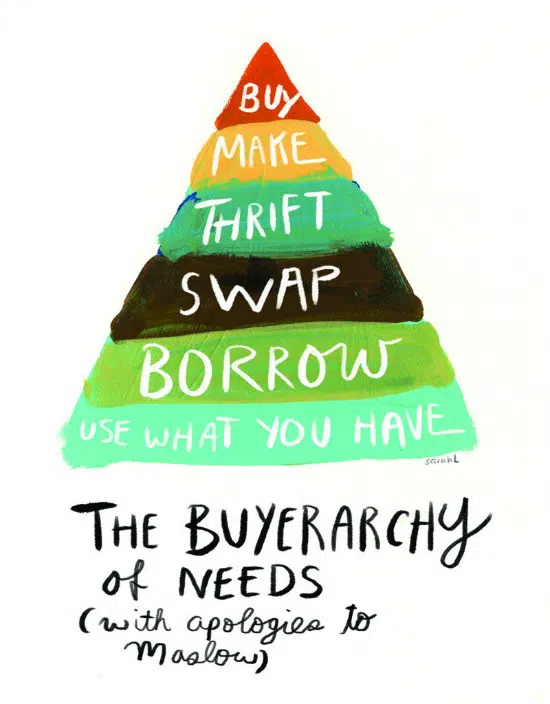
Before buying anything new, there’s a hierarchy worth working through. Artist Sarah Lazarovic’s Buyerarchy of Needs sets it out in order: use what you have, then borrow, then swap, then buy secondhand, then make, and only then buy new. The point isn’t to guilt anyone out of buying. It’s to remind us that the most sustainable garment is usually one that already exists.
Sometimes buying new is necessary. Clothes wear out. Bodies change. Circumstances shift. The useful question isn’t whether to buy new. It’s what to buy, how often, and from whom.
Cost per wear: the real maths
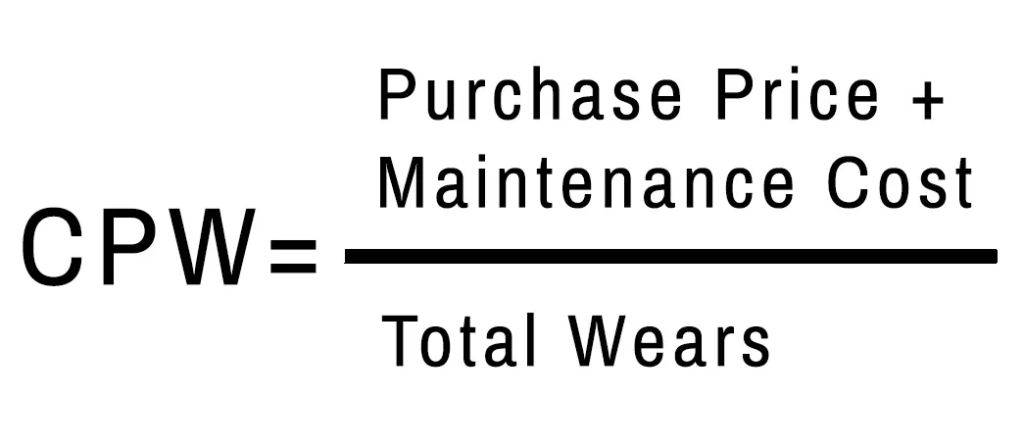
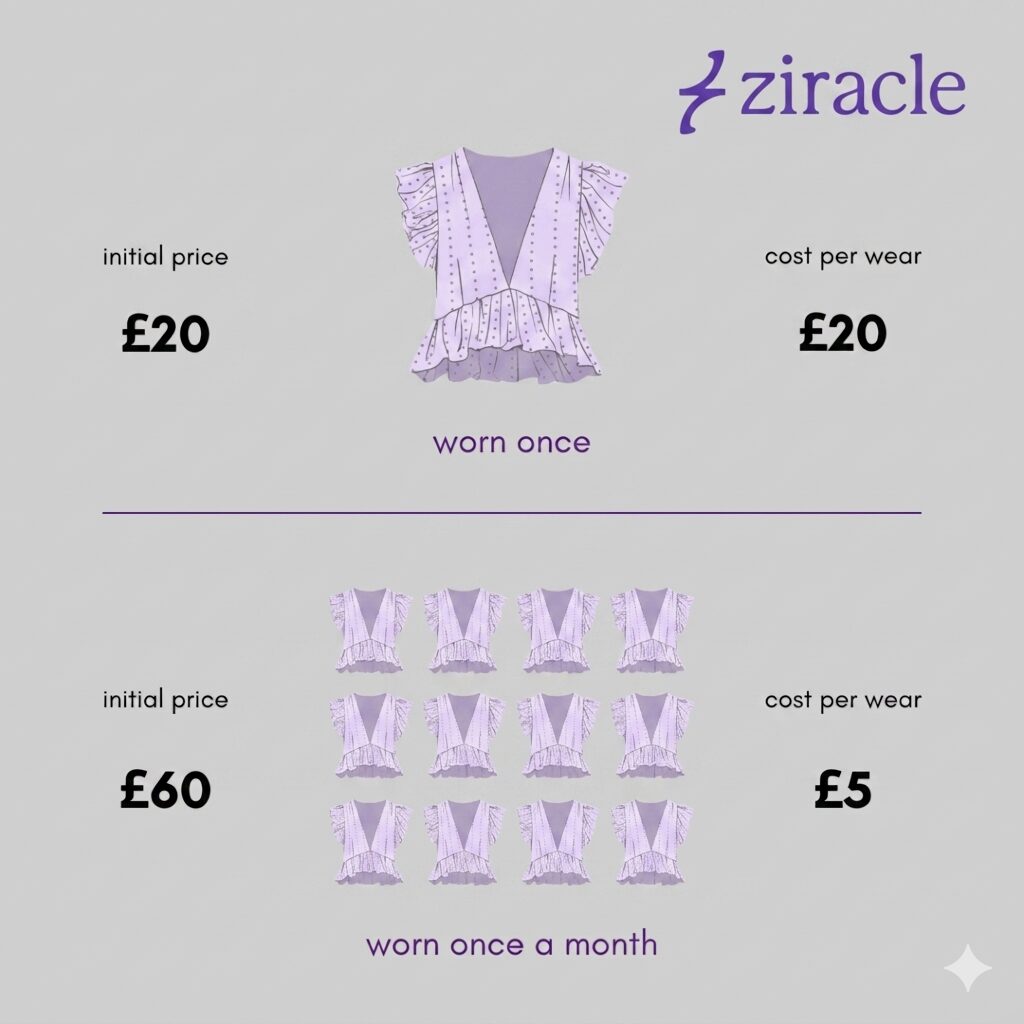
Cost per wear is simple: price divided by number of times worn. The Ellen MacArthur Foundation’s 2017 New Textiles Economy report found that the average piece of clothing is worn far fewer times before being thrown away than it was a generation ago, with the report estimating that clothing utilisation (the number of times a garment is worn before disposal) has dropped by around 36% compared with 15 years earlier. Globally, the report estimated one garbage truck of textiles is landfilled or incinerated every second.
That £20 high-street dress worn seven times costs nearly £3 per wear. A well-made £80 equivalent worn 80 times costs £1 per wear. Over the full life of both garments, the cheaper one is the more expensive one. It also produces more waste, causes more harm, and leaves you with less of a wardrobe at the end.
The calculation only works if clothes actually get worn. A £200 coat worn twice is worse value than a £30 coat worn 50 times. Durability matters, but so does fit, style, and whether the item is something you reach for on a Tuesday rather than saving for a wedding. Sustainable doesn’t mean wearable by default.
“Buy less, choose well, make it last.” Vivienne Westwood’s line has done more work than most essays on the subject, which is why it keeps getting repeated.
Finding your own style, not the trend cycle’s
Fast fashion, and fast homeware behind it, has trained us to believe in a false narrative of micro-trends. What you buy and love one week is aesthetically outdated by the next. A 2022 WRAP study found that around 26% of adult wardrobes in the UK contain items that haven’t been worn for at least a year. The trend cycle is designed to move faster than your wardrobe can keep up with. The only way to keep buying is to keep discarding.
The way out is to know your own style well enough that the trend cycle stops dictating it. That takes time. It also reduces spending and waste without requiring any conscious effort. You just stop buying things that won’t last you past the month.
What to do when buying new
Buy from brands that have earned the price. Look for Fair Trade or equivalent certification, transparent supply chains, natural or certified recycled fibres, and brands that publish where their factories are. For a deeper look at what to check, see our beginner’s fashion guide and our list of the best sustainable clothing brands.
Match reduced consumption with better consumption. Sustainability isn’t a permission slip to buy more expensive versions of the same volume. It’s a shift in how often you buy, not a replacement of the fast-fashion cadence at higher price points. Browse the Clothing edit when something does need replacing.
Progress, not perfection
Nobody buys sustainably all of the time. Nobody needs to. The point is to shift the direction of travel, not to hit a perfect score. Start small and pick one category to change first, not the whole wardrobe. Do your own research where claims feel vague. Hold brands to the standard they advertise. Remember that any step in the right direction is worth more than a perfect plan you never start.
Sustainable fashion costs more at the till for reasons that make sense: the people making it are paid properly, the materials are chosen to last, and the price reflects what clothing actually costs when nothing is being hidden from view. Cost per wear brings the maths back into balance. Next time something needs replacing, you know how to think about the price.Ready to shop? Browse the Apparel and Style edit and filter by the certifications that matter to you. Brands carrying B Corp status are a good place to start.
FAQs
Why is sustainable fashion always so expensive?
Because the price reflects what clothing costs to make when garment workers are paid a living wage, materials are chosen for durability, and the supply chain is transparent. The 2023 Fashion Transparency Index found that only 1% of major brands disclosed paying a living wage across their supply chain. Fast fashion prices are only possible because those costs are being absorbed somewhere else, usually by the people making the clothes. Sustainable brands aren’t overcharging. Fast fashion is undercharging.
Is cost per wear really a fair way to compare prices?
For most clothing categories, yes. If a £20 dress falls apart after seven wears and an £80 equivalent lasts 80, the £80 version is cheaper per wear and produces less waste. Cost per wear stops working when the expensive item sits unworn in a wardrobe. It’s a framework that rewards actually wearing what you buy, which is why it aligns with the environmental argument too.
Should I throw out my fast fashion clothes to buy sustainable ones?
No. The most sustainable item in your wardrobe is the one you already own, whatever it’s made of. The environmental cost of manufacturing is already sunk. Throwing away wearable clothing to replace it with greener versions is counterproductive. Wear what you have until it wears out. Replace with better when it does.
Are there affordable sustainable fashion options?
Yes, once you reframe “affordable.” Secondhand is the most genuinely affordable sustainable option, and the UK market is deep across Vinted, Depop, eBay, and charity shops. Renting for occasion wear costs less than buying and produces no additional manufacturing footprint. For new purchases, buying less frequently but better is usually the affordable path, because you’re amortising a higher upfront cost across many more wears.
What should I look for when buying new?
Named certifications (GOTS for organic, OEKO-TEX for chemical safety, Fair Trade for supply-chain fairness, B Corp for whole-business standards), brands that publish the factories they work with, natural or certified recycled fibres, and a repair or take-back programme. Brands with a handful of those signals are doing more than brands with none.
Most jewellery marketed as sustainable isn’t. The word has become so loosely applied that “ethical”, “responsible” and “conscious” now sit on product pages for pieces whose origins nobody has traced. Most high-street buyers have no practical way to know whether the gold in a ring came from a regulated Canadian mine or a flooded pit in the Peruvian Amazon. The supply chain is genuinely complex. The ambiguity is genuinely convenient for the industry.
This guide cuts through it. Start with the argument underneath: the only meaningful difference between performative sustainability and real sustainability in jewellery is traceability. Once you know what to look for, the choice gets simpler. You do not need to memorise every certification. You need to understand what the certifications exist to solve, and which brands have taken that seriously enough to prove it.
What follows is the practical map. What mining actually costs. What fast-fashion jewellery does to that cost. Which certifications are worth knowing. And what “buy less, choose well” looks like in practice for a category that is built, more than most, on the assumption that you will keep buying.
Why jewellery sits at the harder end of sustainable shopping
Jewellery is different from clothing and food because the supply chain starts underground. Gold, silver, diamonds and coloured stones are extracted before they are transformed, which means every piece carries the environmental and human cost of that extraction whether or not the brand mentions it.
The scale is significant. The global jewellery industry generates around $300 billion in annual revenue, according to Human Rights Watch’s 2018 report The Hidden Cost of Jewelry, which investigated the supply-chain practices of thirteen leading global brands. The report found that most companies still fell short of basic international human-rights standards, and that many were over-reliant on voluntary industry certifications with weak enforcement.
Consumer appetite has shifted faster than the industry has. A 2021 Tracemark report on sustainable luxury found that 94% of jewellery buyers believe brands should be more transparent about where raw materials come from. The same study found that 71% would actively choose a piece for traceability, and 77.5% would pay more for it. The market is ready. The industry, with a few exceptions, is still catching up.
The gap between what people want and what the market offers is the gap this guide is trying to help you close.
What mining actually costs, in plain terms
Large-scale industrial mining is energy-intensive and disruptive. Acid mine drainage can contaminate rivers for decades. Tailings dams occasionally fail, catastrophically. Forests are cleared, topsoil removed, waterways redirected. The environmental damage compounds over time and is expensive, or impossible, to reverse.
The smaller and less regulated end of the industry is worse.
Artisanal and small-scale gold mining (ASGM) is the single largest source of mercury pollution in the world. The United Nations Environment Programme estimates that small-scale gold mining releases over 2,000 tonnes of mercury into the environment each year and accounts for roughly 37% of all human-caused mercury emissions globally. The US Environmental Protection Agency puts the figure at 38%. The mechanism is simple: miners use mercury to bind gold particles from sediment, then burn off the mercury with a torch, releasing vapour that lodges in water, soil and the food chain. Up to 20 million people work in ASGM globally, including an estimated 4 to 5 million women and children.
Mercury does not break down. Once it enters a waterway, it bioaccumulates in fish, then in the people who eat them. There is no safe exposure level. The people most harmed by this system are the ones least compensated for their labour.
The Human Rights Watch investigation documented child labour, unsafe working conditions, and supply-chain opacity at scale. Juliane Kippenberg, Associate Director of the Children’s Rights Division at Human Rights Watch and a lead author of the report, has been explicit about where the industry’s defences fail. Too many companies, she has argued, treat membership of the Responsible Jewellery Council as proof of clean sourcing, when this is not enough to truly ensure it.
That is the gap worth paying attention to. Certification without verification is marketing.
Why fast-fashion jewellery is worse than it looks
Walk into any high-street fashion retailer and you will find jewellery priced below the cost of a coffee. A thin layer of plated metal over a cheap alloy base, set with glass or plastic “stones”, assembled in a factory that does not appear anywhere on the brand’s website. The plating wears off within months. Skin stains green. Clasps break. The piece ends up in a bin, on a path to landfill, contributing to a category of waste that barely shows up in most sustainability conversations because each individual piece is so small.
The business model depends on you replacing it. Margins are thin, so volume must be high. The brand wants you to buy five pieces a year, not one that lasts ten. Every design choice, from the quality of the clasp to the thickness of the plating, supports that cycle.
This is the single category in jewellery where sustainability, quality and value align perfectly. A £5 chain you replace three times a year costs more than a £120 recycled-silver chain you wear for a decade, and produces vastly more waste. The maths is not subtle. It just requires you to stop treating jewellery as disposable.
For the wider argument on why well-made things cost more, see our guide to why sustainable fashion costs what it does.
The materials worth knowing
Four material categories matter most when you shop.
Recycled precious metals. Most gold and silver on the market can be recycled without any loss of quality, because these metals do not degrade. Recycled gold uses around 99% less energy than newly mined gold and carries no fresh mining impact. A recycled-gold ring is indistinguishable from a newly mined one. The only difference is the supply chain.
Fairtrade or Fairmined gold. This is the category to know if you want small-scale mining that actually supports the communities doing it. Fairtrade Gold certifies artisanal miners who meet standards on fair wages, safe working conditions, environmental management and restrictions on mercury use. Fairmined, the parallel standard run by the Alliance for Responsible Mining, does similar work. Both cost more than generic gold. Both are traceable to named mines. The UK has one of the most developed Fairtrade Gold markets in the world.
Lab-grown diamonds and coloured stones. Physically and chemically identical to mined stones. Graded on the same scale. Typically cost 30 to 60% less. No extraction, no displacement, no ecosystem damage. The main reason to choose a mined stone over a lab-grown one is sentimental attachment to the category, not material quality. The lab-grown market has matured considerably in the last five years.
Solid sterling silver and vermeil (gold-plated sterling silver). Both last, if the plating on vermeil is thick (the usual standard is 2.5 microns minimum). Base-metal plated pieces are a different category entirely: the plating is thinner, wears off within months, and the metal underneath is usually the problem.
Skip anything labelled “gold-coloured”, “gold-tone” or “mixed metal” without specifics. The vagueness is doing work.
Certifications that are worth something
Three matter most in practice.
Fair Trade certification on jewellery means the miners or artisans received fair wages and worked in conditions the certification audits. It applies to gold, silver and, increasingly, gemstones. Fairtrade Gold specifically requires traceability back to named small-scale mines.
B Corp status applies to the brand rather than the material. It signals that a company has committed to and been independently audited against environmental, social and governance standards across its whole operation. It is not material-specific, but B Corp jewellery brands tend to have thought seriously about sourcing.
The Responsible Jewellery Council (RJC) is the industry’s own certification body, with over 1,000 members. Human Rights Watch has been explicit about its limitations: RJC membership can certify companies whose supply chains still contain documented abuses, because the standards and auditing practices have historically been weak. Treat RJC certification as a floor, not a ceiling. A brand relying on it alone is telling you they have done the minimum.
No certification is perfect. The point is not perfection but evidence. A brand that has paid for third-party verification has chosen to be held accountable in a way that most haven’t.
What to ask before you spend
Five questions, applied to any piece over about £50, sort genuine from performative quickly.
Where was the metal sourced? A brand that knows the answer will tell you. A brand that does not is worth questioning.
Where was the piece made? Handmade in a small studio beats assembled in an unnamed factory. The country alone is not enough. “Handmade in Italy” can mean a master goldsmith or a factory; ask which.
Who made it? Some of the best small brands have decade-long relationships with their workshops and will name them. Silence on this question, after you ask, is information.
What is the repair and resizing policy? A brand that stands behind its pieces offers to service them. A brand that does not expects you to replace them.
What happens when you are finished with it? Brands that offer take-back, resale or buy-back schemes keep pieces in circulation. These programmes are new and still rare in jewellery, and they are a strong signal when they exist.
None of these questions require specialist knowledge. They require the patience to ask and the willingness to walk away if the answers are vague.
What “buy less, choose well, make it last” actually looks like
Vivienne Westwood’s three-word instruction — “Buy less, choose well, make it last” — applies to jewellery more cleanly than to most categories. A piece of recycled-silver or Fairtrade-gold jewellery, well-designed, can be worn daily for decades. The piece your grandmother wore, brought in for a resize and a polish, is worth more than a dozen trend-led pieces you will have forgotten about by next summer.
The practical version of the instruction:
Choose pieces that work with most of what you own, not the item you saw once and had to have. Simplicity ages better than trend. A plain necklace in a metal that suits your skin tone will outlast any statement piece.
Spend more per piece and buy fewer pieces. One considered ring beats ten impulse buys, for your wardrobe, your wallet and the planet.
Maintain what you have. Take it to a jeweller once a year. Get clasps checked, prongs tightened, metal polished. The piece will last three times longer for a fraction of the replacement cost.
Sell or gift what you no longer wear rather than letting it sit in a drawer. Vintage jewellery is a genuinely circular category, and the secondhand market for good pieces is strong.
For the personalised-piece version of this argument, initial jewellery and birthstone pieces are among the formats most likely to be kept and passed on, according to auction-house data on heirloom jewellery.
Where to start on Ziracle
Every brand in our Apparel and Style edit has been assessed against the same standard: does it do what it claims, is it made the way the brand says, and is the brand honest about both. The Jewellery and Accessories range is where to start for pieces built to last, and Watches for timepieces that hold their value.
For integrated support across everyday choices, Reduce Stress is the goal page we most often point people to when they say the homework of conscious shopping feels overwhelming.
The honest promise behind this guide: once you know what to ask, shopping for jewellery stops being a research project and starts feeling like the ordinary, quiet decision it should be.
FAQs
Is recycled gold really as good as new gold?
Yes. Gold is an elemental metal that does not degrade through recycling. A recycled-gold ring is physically and chemically identical to a newly mined one and carries none of the fresh-mining impact. The main constraints are supply (recycled gold is in high demand) and price (it can cost fractionally more than freshly mined gold). Both are worth it. Look for the Responsible Jewellery Council’s Chain of Custody certification for recycled gold, which is the strongest documentary evidence you can get.
Are lab-grown diamonds as valuable as mined ones?
Physically, yes. Financially, less so. Lab-grown diamonds have the same crystal structure, hardness and optical properties as mined diamonds and are graded on the same 4Cs scale. They typically cost 30 to 60% less at purchase. Their resale value is lower than mined diamonds, because the market for secondhand lab-grown stones is still immature. If you are buying a piece to wear and keep, rather than as a financial asset, lab-grown offers considerably better value and no mining impact.
What is the difference between Fairtrade Gold and Fairmined gold?
Both certify artisanal and small-scale gold mining against standards covering fair wages, safe working conditions and restrictions on mercury use. Fairtrade Gold is run by the Fairtrade Foundation, the same body that certifies coffee, cocoa and bananas. Fairmined is run by the Alliance for Responsible Mining, a separate non-profit. The standards are broadly comparable. In the UK, Fairtrade Gold is the more commonly seen label at the consumer end. Both are genuinely meaningful. Neither is perfect.
Is the Responsible Jewellery Council a meaningful certification?
Treat it as a minimum rather than a guarantee. Human Rights Watch’s 2018 investigation found that the RJC’s standards and auditing practices have historically allowed members to be certified despite documented human-rights risks in their supply chains. A brand whose only sustainability credential is RJC membership is telling you they have done the minimum the industry requires. Look for brands that layer additional certifications (Fairtrade Gold, B Corp) or, better, publish named mines and workshops for their supply chain.
How do I tell if a brand’s “ethical” claims are real or marketing?
Ask three questions. Can they name the mine, refinery or workshop? Do they publish a list of suppliers rather than a vague country of origin? Do they offer repair, resize or buy-back services? Brands making genuine commitments tend to answer all three easily, because they have already done the work. Brands hiding behind the word “ethical” tend to give country names without mine names, origin claims without documentation, and replacement offers rather than repair offers.
A pair of jeans is a strange object when you think about it. The fabric was invented for labourers in the 1800s. It’s been worn by miners, sailors, farmers, then teenagers, rebels, rock stars, and pretty much everyone in between. It shows up in photographs of every decade of the twentieth century. It carries more cultural weight than almost any other garment in your wardrobe, and the average person in the UK owns seven pairs of them.
It is also one of the single most resource-intensive garments ever produced. Around five to six billion pairs are manufactured globally every year, according to European Trade Union Institute research and ILO-linked studies. Each pair, on a full lifecycle basis, consumes thousands of litres of water. The cotton behind the fabric uses a disproportionate share of the world’s insecticides. The finishing processes that give jeans their faded, worn look have killed factory workers.
None of this is secret. The data has been public for a decade. But the gap between what the industry knows and what the shopper sees is still enormous. This guide is the map across that gap: what denim actually costs, where the damage lives, and how to buy a pair worth keeping.
The cultural weight of a work garment
Denim started as serge de Nîmes, a durable cotton twill made in southern France in the 17th century. The word “jean” is thought to come from Genoa, the Italian port where sailors wore a similar fabric. Indigo, the dye that gives denim its colour, is one of the oldest natural dyes in human history, used for thousands of years across cultures.
Levi Strauss didn’t invent jeans. He patented, with Jacob Davis in 1873, the rivet reinforcement at stress points that made them genuinely built for heavy work. The 501 was a worker’s garment before it was anything else. After the Second World War, American soldiers wore them home. Hollywood put them on Marlon Brando and James Dean. Teenagers claimed them. Hippies, punks, then grunge, then everyone. By the 1990s denim had stopped meaning anything specific and started meaning everything. The universal garment.
That universality is the problem. When five billion pairs a year is the normal number, the per-pair footprint compounds into something the planet cannot absorb.
What a single pair of jeans actually costs
The most rigorous public data on the environmental cost of jeans comes from Levi Strauss itself. The company conducted the apparel industry’s first full lifecycle assessment in 2007, then expanded it in 2015, covering a pair of 501 jeans from cotton field to landfill.
The 2015 Levi Strauss lifecycle assessment found that a single pair of jeans uses 3,781 litres of water across its full life, and produces 33.4 kg of CO2 equivalent. The water breakdown is the more revealing figure. Cotton cultivation accounts for 68% of that water. Consumer care, meaning your washing and drying habits over the life of the jeans, accounts for 23%. Actual manufacturing, including dyeing and finishing, is just 9%.
This changes where the conversation should go. The story that sustainable fashion tells, which is that factories are the problem, is partly right but largely incomplete. The biggest single lever you have as a shopper is not where your jeans were made. It is what they are made of, and how you wash them.
The cotton problem
Cotton is one of the most chemically demanding crops on earth. The Pesticide Action Network UK reports that cotton cultivation covers roughly 2.5% of the world’s agricultural land but accounts for somewhere between 8% and 16% of worldwide insecticide use, depending on the dataset. In developing countries where most cotton is grown, that share climbs higher.
The human cost of this falls most heavily on small farmers. In parts of India, particularly the Vidarbha region, high debt loads from genetically modified cotton seed, fertiliser and pesticide packages have been linked to a well-documented crisis of farmer suicides since the early 2000s. Researchers are careful to note that the causal mix is complex, involving drought, debt cycles, seed monopoly pricing and pesticide exposure rather than any single factor. But the underlying pattern is clear: the cheapest cotton in the world is produced in conditions that concentrate financial and health risk on the people growing it.
Organic cotton, certified to the Global Organic Textile Standard (GOTS), removes the synthetic pesticides, synthetic fertilisers and genetically modified seeds from the equation. It also, according to Textile Exchange’s 2014 lifecycle assessment, uses substantially less water than conventional cotton at the farm stage. The 91% water-reduction figure you sometimes see cited is contested by later analyses because most comparisons pit rain-fed organic against irrigated conventional. Even with that caveat, organic cotton at the farm stage is meaningfully less damaging than conventional. Whether it is 91% or a more conservative figure, it is less.
Indigo, sandblasting, and what happened to the workers
The dyeing and finishing stages of denim production account for only 9% of lifetime water use, but they account for a disproportionate share of the human harm.
Synthetic indigo, which has replaced natural indigo in almost all commercial denim, is produced with a set of chemical processes that generate wastewater containing aniline and other industrial compounds. In the worst factories, this wastewater is discharged untreated into rivers. Reporting from denim-producing regions in China, Bangladesh and Pakistan has documented waterways turned blue by mill discharge. Better factories treat their water before discharge, but the industry’s record on this is uneven.
The sharper case is sandblasting. To give jeans the worn, faded look that became popular in the 2000s, factories blasted fine silica sand at the fabric at high pressure. The sand particles lodged in workers’ lungs. The result was an epidemic of silicosis -a permanent, progressive, incurable lung disease -among young denim workers, most visibly in Turkey in the mid-2000s.
Turkish researchers from Atatürk University in Erzurum first documented the link in 2005. A 2008 study found radiological evidence of silicosis in 53% of the 145 former sandblasters surveyed. Turkey banned denim sandblasting by national legislation in 2009. A 2016 paper in The Lancet Respiratory Medicine called it “deadly denim” and documented that the practice had not ended but relocated, principally to Bangladesh and China, where enforcement is weaker.
This is the part of the denim story most shoppers have never heard. The faded, “vintage” finish on jeans priced at £30 is, in many cases, still achieved by processes that kill the people who do the work.
Alternatives exist. Laser fading, ozone treatments and chemical methods (themselves not without cost) replicate the look without crystalline silica exposure. Major brands have publicly committed to ending sandblasting in their supply chains. Clean Clothes Campaign’s investigations suggest that those commitments are only as strong as the audit systems behind them.
Orsola de Castro on what’s worth keeping
Orsola de Castro, co-founder of Fashion Revolution and a leading UK voice on clothing ethics, has spent two decades arguing that the single most powerful act a consumer can perform is to keep their clothes for longer. The slogan she is most associated with -that it is the clothes we love and repair, not the ones we abandon -applies to denim more precisely than to almost any other category. A well-made pair of jeans can last decades. A cheap pair loses its shape in months.
The reason most jeans don’t last is not that denim itself has gone downhill. It’s that the construction standards on mass-market jeans have collapsed. Single-stitched seams replace chain-stitched. Cheap fusible interfacing replaces properly sewn waistbands. Thin synthetic blends replace heavyweight cotton. The hardware is nickel-plated base metal rather than solid brass. Every one of those choices saves a few pence in production and shortens the life of the garment by years.
What a pair worth keeping actually looks like
Six things separate denim built to last from denim built to replace.
Fabric weight. Measured in ounces per square yard. Most mass-market jeans are 9 to 11 oz. Genuine durable denim starts at 12 oz. Heavyweight workwear denim runs 14 to 16 oz or more. The difference is noticeable in hand and dramatic in lifespan.
100% cotton, or close to it. A tiny amount of elastane (1% to 2%) is acceptable for comfort and fit recovery. Anything more is a sign the fabric will bag out at the knees, lose shape, and degrade faster. Avoid polyester blends in jeans.
Chain-stitched seams at the hem and inseam. Chain stitch is the traditional construction for jeans and produces the twisted rope-like fade along the seam that indicates a pair has aged well. It’s also more durable than single-stitch. You can see it on the inside of the garment.
Reinforced stress points. Rivets at pocket corners (the original Levi innovation), bar tacks at belt loops, and a properly sewn yoke. A pair that skips these details is a pair that will fail at them.
Selvedge, where affordable. Selvedge denim is woven on old-fashioned shuttle looms that produce a tight, self-finished edge. It’s typically heavier, usually made of better cotton, and almost always constructed more carefully. It costs more. It lasts longer.
Honest sourcing claims. A brand that can tell you where the cotton was grown, where the fabric was woven and where the jeans were sewn is a brand that has done the work. A brand that can’t is a brand that doesn’t know or doesn’t want you to.
The brands in our denim edit
Ziracle’s denim selection is narrow by design. Komodo has made denim in organic and recycled cotton since the 1990s, out of an original commitment to ethical manufacturing that predates the current sustainability conversation by decades. Flax and Loom works in natural, undyed and plant-dyed fabrics with a focus on longevity rather than trend.
Both treat denim as a garment to keep, not a garment to cycle through. Both sit comfortably at the price point you should expect for denim built to last: noticeably more than supermarket jeans, noticeably less than designer denim, and priced honestly against what the production actually costs.
How to make the pair you already own last longer
The sustainable pair of jeans is almost always the one in your wardrobe already. Three practices extend the life of most denim by years.
Wash less. This is the single biggest lever. The 2015 Levi lifecycle assessment found that wearing jeans ten times between washes rather than the typical two to three times reduces water and climate impact by up to 77% in the UK and United States. It also dramatically extends the life of the fabric. Dark denim fades faster from washing than from wearing.
Wash cold, air dry. Hot water accelerates dye loss, shrinks cotton, and weakens fibres. Tumble drying does all three. Cold wash, hang to dry, and your jeans will hold their shape and colour for significantly longer.
Repair rather than replace. Small wear at the crotch or knee is fixable by any decent tailor for a fraction of the replacement cost. Many good denim brands run their own repair services, and standalone denim repair specialists operate in most UK cities.
Where to start on Ziracle
Every brand in our Apparel and Style edit has been assessed against the same standard: does it do what it claims, is it made the way the brand says, and is the brand honest about both. The Bottoms section is where to find denim and other trousers built to last, filtered by Organic, Fair Trade, or B Corp as suits you.
For integrated support when the homework feels overwhelming, Reduce Stress is the goal page we most often point people to.
Vivienne Westwood’s line, “Buy less, choose well, make it last”, applies to denim more cleanly than to almost any other category. One well-made pair of jeans, kept and repaired, is worth ten in the discard pile. That is the honest case, and it’s the only one this guide is making.
FAQs
How much water does a pair of jeans really use?
The most rigorous public figure comes from Levi Strauss’s 2015 lifecycle assessment of its 501 jeans, which found a full-lifecycle water use of 3,781 litres per pair. Cotton cultivation accounted for 68% of that, consumer washing for 23%, and manufacturing for 9%. Per-pair figures vary considerably by cotton origin, finishing method and care habits, so treat 3,781 litres as an indicative average rather than a universal number. The takeaway: the single biggest reduction lever for most people is washing their jeans less often.
What’s the difference between organic denim and regular denim?
Organic denim is woven from cotton grown without synthetic pesticides, synthetic fertilisers or genetically modified seeds, usually certified to the Global Organic Textile Standard (GOTS). The fabric feels similar once finished, but the agricultural impact is substantially lower, and workers on certified organic farms are not exposed to the chemicals used on conventional cotton. Look for GOTS on the label rather than vague “natural” or “eco” claims.
Are cheap jeans still made using sandblasting?
Turkey banned sandblasting in 2009, and major international brands including Levi’s, H&M, and others have publicly committed to ending it in their supply chains. A 2012 Clean Clothes Campaign investigation, and later reporting, found that the practice had relocated to Bangladesh and China where enforcement is weaker. Some factories have switched to laser fading or ozone treatments, which remove the silicosis risk. The honest answer is that faded jeans at the lower end of the market may still be finished by methods that harm workers, and brand claims are only as reliable as their audit trails.
How long should a good pair of jeans last?
A well-made pair, in heavy cotton, worn a few times a week and washed sparingly, will typically last five to ten years before needing meaningful repair, and can last considerably longer with periodic mending. The limiting factors are usually the crotch seam and inner thigh, both of which are fixable. A £15 high-street pair is usually finished within 18 to 24 months. The cost-per-wear maths strongly favours spending more upfront.
Is recycled denim as good as organic denim?
Both are genuinely better choices than conventional cotton, and they solve different problems. Organic cotton avoids the pesticide burden at the farm stage. Recycled denim reduces demand for new cotton, cuts water and energy use, and diverts existing garments from landfill. The best brands are increasingly using both: organic cotton fibre blended with recycled cotton from post-consumer or post-industrial sources. Either is a meaningful improvement over conventional.
The fashion industry has a long way to go on sustainability. A collective addiction to rock-bottom prices and fleeting trends has produced a fast fashion culture that’s damaging the planet at an alarming rate, and the people making the clothes alongside it.
The numbers are hard to argue with. A 2019 UK Parliament Environmental Audit Committee report, titled Fixing Fashion, set out the scale of the industry’s impact on carbon emissions, water use and waste, and called for urgent policy intervention. You can make a case for the positive role fast fashion plays in making clothes accessible at lower incomes. What you can’t do is pretend the net balance is positive.
Each year around Fashion Revolution Week, the industry is held up to the light. Fashion Revolution was founded in response to the Rana Plaza garment factory collapse in 2013, which killed over 1,100 workers and injured thousands more. Over a decade on, fashion brands are still profiting from practices that go largely unregulated. During the pandemic, many major brands refused to pay garment factories for cancelled orders to reduce their own losses, which left workers unemployed and triggered the global #PayUp campaign run by Remake.
More people are thinking about what their fashion choices actually do to workers, communities and the climate. The good news is that meaningful change doesn’t require a wardrobe overhaul. It needs a handful of habit shifts. Five practical ways to buy less, choose well, and make it last.
01. Stop following trends and develop your own style
Most of the appeal of fast fashion comes from being able to wear the same trend as your friends, your favourite celebrity or an influencer. Emulating people you admire can feel empowering, especially when the likes start rolling in. But the confidence that comes from a unique look you’ve built yourself doesn’t disappear with the next drop.
Developing your own style delivers two things at once. You feel more comfortable in what you wear, and you stop spending money on clothes you’ll throw away the moment the trend has moved on. A strong personal style is a natural hedge against the churn of the trend cycle. It also tends to lead to more interesting outfits than anything a fast fashion shelf can offer.
02. Seek out high-quality, versatile pieces
Credit: Veo
When it comes to making better fashion choices, you essentially have two options. You can spend your money on lots of low-quality pieces that are on-trend right now but cheap enough to discard once they’ve been photographed. Or you can spend a similar amount on fewer, better pieces that go with almost everything and last for years.
It’s tempting to feel like you’ve won at shopping when you walk out with a long list of cheap items. Most of those pieces end up at the back of the wardrobe within weeks. The real value is a wardrobe you can mix and match, that produces classic outfits you wear again and again, with each piece earning its place over years of wear. Browse the Clothing edit for pieces designed to last.
The materials in your clothes matter enormously. According to WWF, it takes around 2,700 litres of water to produce a single conventional cotton t-shirt, roughly the amount one person drinks in two and a half years. That’s before you factor in the pesticides, synthetic fertilisers and labour conditions involved in conventional cotton production.
Avoid conventional cotton, polyester, acrylic, nylon and viscose where you can. They’re difficult to recycle, draw heavily on water and fossil fuels, and release hazardous dyes and microplastics into the environment every time you wash them. Look instead for certified Organic alternatives like organic cotton, organic hemp and organic linen, or recycled options like recycled cotton and recycled polyester (rPET). Recycled polyester is made from plastic bottles and helps keep waste out of landfill rather than generating new virgin fibre.
New biomaterials are appearing every year. Piñatex is made from pineapple leaf waste. Cactus leather is made from nopal. Wine leather is made from the skins and stalks left over from winemaking. They aren’t perfect yet, but they represent a far better direction of travel than fossil-fuel-based synthetics. For a deeper look at leather alternatives specifically, see our can leather be sustainable guide.
One cotton t-shirt takes the same amount of water to produce as one person drinks in two and a half years.
04. Take better care of the clothes you have
Credit: Bruno Nascimento
Even if you can’t replace everything in your wardrobe with eco-friendly fabrics, one thing you can always do is take better care of what you already own. Simple habits make a real difference over time.
Check the care instructions on the label and actually follow them. Wash clothes less often. Over-washing fades dyes, breaks down fibres, and releases more microplastics and detergent residues into waterways. A 2020 study in the Philosophical Transactions of the Royal Society B found that washing synthetic textiles is one of the largest sources of microplastic pollution in the ocean. Hang things to dry rather than tumbling them. Spot-clean where you can. Store clothes properly: fold knitwear rather than hanging it, use cedar instead of mothballs, rotate what you pull out of your drawers so the same pieces aren’t wearing through first.
Learn a few basic repairs. Sewing on a button, fixing a small rip, or replacing a zip are all things you can learn on YouTube in under ten minutes. If you don’t want to do it yourself, a local tailor or alterations service can extend the life of a garment for a fraction of the replacement cost. Repair should be the default, not a last resort.
05. If you must buy fast fashion, buy it second-hand
Credit: Ivana Cajina
Ideally we’d all avoid fast fashion altogether. Realistically, the transition takes time. Sustainable brands can be less accessible depending on where you live, what your budget is, and what sizes and styles you need. So if you do end up buying something from a fast fashion label, avoid creating additional demand by shopping it second-hand.
There’s now a huge range of platforms for buying and reselling used clothes, from Depop and Vinted to eBay and local consignment stores. Shopping second-hand keeps products in circulation for longer, supports a circular economy, and costs less than buying new. It’s one of the easiest switches to make, and one of the highest-impact.
Progress, not perfection
Buying less and choosing well isn’t a lifestyle overhaul. It’s a handful of small habits applied consistently. Develop your own style so you’re not chasing trends. Buy fewer, better pieces. Choose materials that aren’t actively damaging. Take care of what you own. Go second-hand before you go new. Five shifts, done over time, add up to a very different wardrobe and a much smaller footprint.
Every brand in the Apparel and Style category on Ziracle has passed the same standard: kind to the people making the clothes, transparent about materials and supply chain, built to last longer than a season. For brands whose materials and supply chains hold up to scrutiny, filter by Fair Trade or B Corp.
Ready to shop? Start with pieces you’ll wear at least thirty times.
FAQs
What’s the single most impactful change I can make to my wardrobe?
Wear what you already own for longer. WRAP’s research consistently finds that extending the active life of clothing by nine months reduces its carbon, water and waste footprints by 20 to 30%. That single change outperforms switching brands, because most of a garment’s impact is baked in at manufacture. The next most impactful shift is buying second-hand before new when something does need replacing.
How do I develop my own style so I stop buying into trends?
Start by auditing what you already own. Note the pieces you reach for most often, and what they have in common: the fit, the fabric, the colour palette, the formality. Your existing favourites are a direct map of what works on you. Build from there, and treat new purchases as additions to that core rather than departures from it. It sounds simple, but most people never actually do it, and the ones who do stop buying into trends almost by accident.
Is recycled polyester actually better than regular polyester?
Somewhat. Recycled polyester (rPET) uses less energy and water to produce than virgin polyester, and diverts plastic bottles from landfill. It still sheds microfibres in the wash and isn’t biodegradable. The honest framing: rPET is better than virgin polyester for any given use case, but natural fibres or Tencel are usually better than either. For activewear where synthetic properties are genuinely needed, rPET is the sensible compromise.
What’s the 2,700 litres figure about cotton t-shirts?
WWF’s estimate that one conventional cotton t-shirt requires around 2,700 litres of water to produce across its full supply chain (growing, dyeing, finishing). That’s roughly equivalent to the water one person drinks over two and a half years. Organic cotton requires meaningfully less water than conventional cotton because it’s usually rain-fed rather than irrigated. Linen and hemp need even less.
How do I tell if a brand is genuinely ethical or just marketing?
Look for specifics, not slogans. Named factories with addresses, published supply chain information, certifications you can verify (GOTS, Fair Trade, OEKO-TEX, B Corp), repair or take-back programmes, and smaller collection volumes with longer release cycles. Brands that describe themselves as ‘sustainable’ or ‘conscious’ without backing it up with documentation usually aren’t. The 2023 Fashion Transparency Index from Fashion Revolution is a useful reference for how the major brands currently score.
Sustainable fashion has a vocabulary problem. Slow fashion, ethical fashion, conscious fashion, eco fashion – all of them gesture at something real, but none of them tell you what to actually do differently. Here is the practical version.
If you have ever read about sustainable fashion and come away feeling vaguely guilty but no more informed, that is not your fault. Most of the content in this space either preaches or sells.
Here is the practical version: what slow fashion actually means, why fast fashion is so difficult to resist, and how to build a different relationship with clothes without starting over.
What slow fashion actually means (and what it does not)
The term was coined by Kate Fletcher, now Professor at the Centre for Sustainable Fashion at London College of Fashion, in an article titled “Slow Fashion” published in The Ecologist in September 2007. She defined slow fashion as quality-based rather than time-based – not simply about slowing down, but about designing, producing and consuming differently.
The framing she used then still holds. Slow fashion is not the opposite of fast fashion the way slow food is the opposite of fast food. A matter of values, not speed.
Fast fashion treats clothing as disposable. Slow fashion treats it as something worth keeping. Fast fashion profits from volume. Slow fashion profits from quality. Fast fashion obscures its supply chain. Slow fashion makes it legible.
What slow fashion is not: a specific aesthetic. Neutrals and linen and minimalism have stuck as associations, but the concept was never about any of them. Nor is it a price bracket. A secondhand coat bought for £15 is slow fashion. A £300 coat worn twice is not.
Slow is not the opposite of fast – there is no dualism – but a different approach where designers, buyers, retailers, and consumers are more aware of the impacts products have on workers, communities, and ecosystems. – Kate Fletcher, Slow Fashion: An Invitation for Systems Change, Fashion Practice (2010)
Why fast fashion is designed to be hard to resist
Feeling tempted by fast fashion is not a character flaw. The temptation is the intended outcome of a system that has spent decades optimising for exactly that response.
Fast fashion brands rotate stock constantly, in some cases weekly, to create the perception that items are scarce and temporary. Research into consumer behaviour confirms that scarcity cues – “only two left in stock” warnings, countdown timers – trigger fear of missing out and reduce the time people spend evaluating whether they actually want something. The purchase becomes emotional rather than considered. That is the design.
Low prices reinforce it. When something costs £12, the mental calculation shifts: the potential loss of missing out feels greater than the cost of buying. The item goes in the basket without the question most people would ask about a £120 equivalent: do I actually need this? Will I actually wear it?
The store layout, the social media feed, the influencer haul, the flash sale notification – none of these are accidents. They are a carefully engineered system for bypassing the pause between impulse and purchase. Knowing this does not make the impulse go away. But it does change what you do with it.
What questions should you ask before you buy anything?
Slow fashion in practice is mostly a set of questions rather than a set of rules. Three are worth building into the habit.
Will I wear this at least 30 times? The simplest test for whether a purchase makes sense on any measure, financial or environmental. Be honest. Not aspirational-honest, where you imagine the version of yourself who wears it constantly. Actually honest. If the answer is probably not, put it back.
Do I know who made it, and in what conditions? This does not require a deep investigation for every purchase. Brands that are transparent about their supply chain make the information easy to find: named factories, published audits, third-party certification. Brands that are not transparent make it impossible to find. The difference tells you something.
Am I buying this because I want it, or because I was told I might miss it? Harder in the moment. Easier with practice. The trick is to add time. Leaving something in a basket for 48 hours and checking whether you still want it removes the scarcity pressure and lets the actual desire, or lack of it, surface.
None of these questions require becoming an expert in supply chains or textiles. They require slowing down by about 90 seconds before clicking buy.
How to build a wardrobe you actually wear
WRAP’s 2022 Clothing Longevity and Circular Business Models Receptivity in the UK report found that the average UK adult has 118 items of clothing in their wardrobe, of which around 26% (31 items) have not been worn for at least a year. Before buying anything new, the single most useful exercise is to work out what you already own and actually wear. Most people find they reach for the same 20 or 30 items repeatedly, regardless of how much else is in the wardrobe.
Start there. The clothes you already wear are the foundation. Everything else is either filling a genuine gap or filling space.
Genuine gaps are things you reach for but do not have: a coat that works for work and weekends, a pair of trousers that fits properly, a dress that is not too formal and not too casual. These are worth buying well. Not necessarily expensive, but considered – secondhand first, then new from a brand worth supporting.
Space-filling purchases are the ones that seemed like a good idea in the shop and never quite worked once you got them home. Fast fashion excels at producing these, because the combination of low prices and high trend-turnover makes space-filling feel rational in the moment. It is not.
A wardrobe that works is one where most things go with most other things, where there are no items that require a specific other item to function, and where you could get dressed on a bad day and still look like yourself. That is not a capsule wardrobe prescription. That is a practical description of what clothes are for.
Where to find brands worth buying from
When you are ready to buy new, here is how to tell the difference between a brand that means it and one that does not.
Named factories and published supply chain information. Any brand committed to ethical production can tell you where its clothes are made and who makes them. If that information does not exist on the website, the information does not exist.
Third-party certification.Fair Trade, B Corp, GOTS (Global Organic Textile Standard), and OEKO-TEX Standard 100 are the most meaningful certifications in this space. They verify different things: labour standards, environmental practices, chemical safety. None of them is a guarantee of perfection, but all of them require external verification rather than self-declaration.
Fewer, slower collections. Brands that produce two or three collections a year are building around quality and longevity. Brands that produce new drops every week are building around volume. The production model tells you something about the values behind it.
Every brand in the Apparel and Style category on Ziracle has been assessed against these same criteria: kind to the people making the clothes, transparent about materials and production, built to last. For the specific brands we have verified, start with our guide to the best sustainable clothing brands.
You now know what slow fashion actually means, why the system makes it hard to behave that way, and what questions change how you shop. Which means the next time you are about to buy something, you have a different set of tools for deciding whether to. Browse Apparel and Style to see every brand that has already passed the Ziracle standard on materials, production and ethics.
FAQ
What is the difference between slow fashion, sustainable fashion and ethical fashion?
The terms overlap but are not identical. Slow fashion is the oldest, coined by Kate Fletcher in 2007, and focuses on quality, durability and the pace of production. Sustainable fashion is the broadest term and typically refers to environmental impact across the garment lifecycle. Ethical fashion usually foregrounds labour conditions and fair wages. A brand that does all three well will describe itself with whichever term fits the audience. The label matters less than what is actually being done.
Is secondhand always better than buying new?
In environmental terms, almost always yes, because the production cost has already been paid. The more interesting question is what to do when secondhand does not work for the specific piece you need. Buying one well-made garment from a transparent brand, then wearing it for a decade, sits comfortably alongside buying secondhand as an honest answer.
Will I wear this 30 times? Why that specific number?
The 30-wears test was popularised by the campaigner Livia Firth as a simple rule of thumb for distinguishing a real purchase from an impulse. It is not based on a specific environmental calculation, but it maps well onto cost per wear and onto whether the garment earns its place in the wardrobe. If the honest answer is no, the purchase probably does not make sense on any other measure either.
What certifications should I look for when buying sustainable clothes?
Fair Trade for labour standards, B Corp for whole-business accountability, GOTS for organic textile processing, and OEKO-TEX Standard 100 for chemical safety. None of them is perfect, but all of them require external audit. Brands that hold two or more of these, and that name their factories publicly, are doing more than most.
How do I resist fast fashion without feeling restrictive?
Stop framing it as restriction. The premise of slow fashion is that a smaller, better-considered wardrobe produces more satisfaction than a larger, fast-turnover one. The practical version: add 48 hours between wanting something and buying it, unfollow the accounts that make you want things you did not know existed, and give yourself permission to buy fewer, better things. Restriction frames the change as loss. It is not.
The sustainable fashion conversation tends to go one of two ways. Either it’s a guilt trip about fast fashion, or it’s a very expensive list of ethical brands most people can’t afford. Neither is particularly useful. This is the practical version.
Here’s where fashion’s impact actually comes from, why cost per wear changes the maths entirely, and which swaps do the real work.
Why fashion is worth taking seriously as an environmental problem
The fashion industry is responsible for roughly 10% of global CO2 emissions, according to the UN Environment Programme, which is more than international aviation and shipping combined. Separate research from the Ellen MacArthur Foundation estimates that around half a million tonnes of synthetic microfibres end up in the ocean each year from washing clothes, making textiles a significant share of primary microplastic pollution.
The UK numbers make it concrete. According to a 2022 WRAP report, the average UK household owns around £4,000 worth of clothes, and around 26% of adult wardrobes have items that haven’t been worn for at least a year. The most sustainable wardrobe isn’t a more ethical one. It’s a smaller one, used properly.
This matters because the framing of “eco swaps for fashion” is slightly misleading. The biggest lever isn’t which brand you buy. It’s how many things you buy, and how long you keep them.
The case for cost per wear
Cost per wear is simple: price divided by number of wears. A £15 fast fashion top worn five times costs £3 per wear. A £90 well-made equivalent worn 90 times costs £1 per wear. Over time, the cheaper item is the more expensive one.
The environmental logic mirrors the financial one. A 2024 study published in Communications Earth and Environment found that an item worn 200 times produces a fraction of the per-wear carbon footprint of one worn only a handful of times before disposal, with the differential running into an order of magnitude across the lifecycle. The difference isn’t mostly about materials. It’s about how many times something gets worn before it’s discarded. Wear something twice as often and you halve its per-wear footprint, regardless of what it’s made from.
WRAP’s research has consistently found that extending the active life of clothing by just nine months reduces its carbon, water and waste footprints by around 20 to 30%. Nine months. Not a wardrobe overhaul. Not a switch to a certified organic brand. Just wearing what you already own for slightly longer.
The most sustainable wardrobe isn’t a more ethical one. It’s a smaller one, used properly.
The practical implication is a question: before buying anything new, will it get at least 30 wears? If the answer is no, it’s probably not worth buying, on any measure.
What’s in your activewear, and what you can actually do about it
You may have read that polyester leggings are toxic. The reality is more complicated than the coverage suggests. Still worth knowing.
Testing reported by Environmental Health News in 2022, using an EPA-certified laboratory, found that around one in four popular leggings and yoga pants had detectable levels of fluorine, which is a strong indicator of PFAS. PFAS are synthetic chemicals used to create water-resistance and moisture-wicking in performance fabrics. According to the US EPA, they accumulate in the body and the environment and have been linked to cancer, thyroid disruption and reproductive issues at higher-exposure levels. Three in four pairs in the same testing showed no detectable fluorine.
The Environmental Working Group has noted that it’s still unclear how much PFAS in clothing specifically contributes to overall human exposure compared with other routes like drinking water or food packaging. Skin absorption from fabric is plausible and under active study, but it isn’t yet established. The concern is real. The certainty is not.
What is established: synthetic activewear sheds microplastics into wastewater with every wash, regardless of PFAS content. The coatings that create moisture-wicking properties are also where PFAS are most commonly added.
The sensible response isn’t to bin your current leggings. It’s to look for OEKO-TEX Standard 100 certification on any new activewear purchase, which screens for harmful substances including PFAS indicators. Natural fibre alternatives exist for lower-intensity exercise: organic cotton, TENCEL, merino wool. For those activities the moisture-wicking argument for synthetics is less pressing. For high-performance sport, OEKO-TEX is the clearest signal currently available. Browse the Activewear edit for options.
The other swaps that move the needle
Buy secondhand first
Secondhand clothing has essentially no manufacturing footprint beyond transport. For most everyday items (jeans, knitwear, outerwear, basics) the UK secondhand market is deep and well-supplied. Vinted, Depop, eBay, local charity shops. All viable first stops before buying new. The habit shift is small. The impact is real. For thinking through which new brands are worth the money when you do buy, see our guide to the best sustainable clothing brands.
Wash less, wash cooler
A life-cycle analysis by WRAP found that the use phase (washing, drying, ironing) accounts for a meaningful share of a garment’s total lifetime carbon footprint. Washing at 30 degrees instead of 40, line-drying instead of tumble-drying, and washing synthetics less often all measurably reduce the ongoing footprint of clothes you already own. Washing synthetics less also means less microplastic shedding.
A microfibre filter bag for your washing machine
Guppyfriend bags and similar filter pouches catch the synthetic fibres that shed from activewear and other synthetics during washing. They don’t solve the problem at source, but they measurably reduce how much ends up in wastewater. Low cost, immediate, no change to routine.
When buying new, buy once and buy well
Look for natural or certified recycled fibres, OEKO-TEX or GOTS certification, brands with named factories and published supply-chain information, and products with a repair or take-back programme. These are the signals that a brand has thought beyond the label. For more on what to look for, see our beginner’s fashion guide.
Care for what you have
Loose buttons, split seams, worn heels. Most of the reasons clothes get discarded are fixable. Basic repairs, or a trip to a local cobbler or tailor, extend the life of clothes that are otherwise fine. The environmental case matches the financial one. The item already exists. Stocked in the Clothing edit: pieces that hold up to repair.
The brands worth buying from
Every brand in the Apparel and Style category on Ziracle has passed the same standard: kind to the people making the clothes, transparent about materials and supply chain, built to last longer than a season. For fashion specifically, that means Fair Trade or equivalent certification, transparency about factories, and no materials that can’t be accounted for. Many of the brands also carry B Corp certification for verified social and environmental performance across the whole business.
The brands that earn their place are the ones where the clothing is good enough that you’d want to wear it regardless of the ethics. The ethics are the confirmation that it’s worth the price, not the reason to buy something you wouldn’t otherwise choose.
You now know where fashion’s real impact comes from, why cost per wear reframes the whole conversation, and which swaps are worth making first. Next time something needs replacing, you know how to think about it.
Ready to buy something you’ll wear 200 times? Browse the Apparel and Style edit.
FAQs
What’s the single biggest change I can make to my wardrobe’s environmental impact?
Wear what you already own for longer. WRAP’s research consistently finds that extending the active life of clothing by nine months reduces its carbon, water and waste footprints by around 20 to 30%. That single change outperforms switching brands, because most of a garment’s impact is baked in at manufacture. Wearing something twice as long halves its effective per-wear footprint.
Are polyester leggings really dangerous to wear?
The honest answer is that the evidence is mixed. 2022 testing reported by Environmental Health News found PFAS indicators in around one in four pairs of popular leggings. Three in four showed none. It’s also unclear how much PFAS exposure comes from wearing clothing compared with drinking water or food packaging. The practical response is to look for OEKO-TEX Standard 100 certification on new activewear, which screens for PFAS, rather than to throw out the leggings you already own.
Is fast fashion always worse than sustainable fashion per garment?
On a per-wear basis, yes, but the gap comes mostly from how many times each is worn. A 2024 paper in Communications Earth and Environment found that a garment worn 200 times has a dramatically smaller per-wear carbon footprint than one worn only a handful of times before disposal. The materials matter. Wear count matters more. A secondhand synthetic top worn 300 times can easily beat a brand-new organic one worn twice.
What’s the best certification to look for when buying new?
It depends on what you’re buying. GOTS (Global Organic Textile Standard) is the clearest signal for organic natural fibres. OEKO-TEX Standard 100 screens for harmful chemicals including PFAS indicators. Fair Trade certification covers supply-chain fairness. B Corp is a business-level certification that covers the whole company rather than a specific product. A brand carrying a combination of these is doing more than a brand with only one.

Does secondhand really count as a sustainable option?
Yes, and it’s often the most impactful choice. A secondhand garment has essentially no additional manufacturing footprint beyond transport and washing. For most everyday categories (denim, knitwear, outerwear, basics) the UK secondhand market is deep enough to furnish an entire wardrobe. Buying secondhand first, then buying new only for items you can’t find used, is usually the lowest-impact approach.
Most eco swap guides treat the home as one undifferentiated problem. The house is not that. It’s a few high-impact rooms and a lot of noise, and if you don’t know the difference, you end up with a drawer full of bamboo cutlery and a cupboard still stacked with plastic bottles.
So here’s the honest version. Where the plastic actually comes from, which swaps shift the numbers, and which ones you can skip without losing sleep.
Where household plastic actually comes from
According to a 2022 Greenpeace study, UK households throw away an average of 66 pieces of plastic packaging every week. That isn’t forgotten bottles at the back of the recycling bin. That’s the packaging that cycles through the house week after week: cleaning sprays, laundry detergent, food wrap, bin liners.
Cleaning and laundry are where the opportunity lives. Both categories are almost entirely liquid, almost entirely plastic-packaged, and almost entirely replaceable with formats that work as well. The average household gets through dozens of spray bottles, detergent bottles, washing-up bottles, and fabric softener bottles a year, all of them single-use.
Most of them can’t be recycled in kerbside collection either. The trigger-spray mechanism on a kitchen cleaner combines several plastic types that can’t be separated at the recycling plant, which means the whole bottle tends to be down-cycled or landfilled. The kitchen and bathroom contribute the rest: food wrap, sponges, bin liners, cotton buds, miscellaneous single-use packaging. Some of that is hard to replace. Most of it isn’t.
The swaps that actually make a difference
Concentrated, refillable cleaning products: the biggest single win
Switching from ready-to-use spray cleaners to concentrated refillable formats is the most impactful swap in the house. Which? tested concentrated cleaning products in 2023 and found they use substantially less plastic and far less water than the standard ready-mixed equivalent, because you’re not shipping water in a bottle across the country. Performance has caught up: concentrated cleaners from dedicated refillable brands clean as well as conventional products. Browse the Refillable Multi-Surface range for options.
The format worth looking for is a refillable glass or aluminium bottle plus concentrated tablets or drops that dissolve in water. One bottle, kept indefinitely. Refills ordered when you need them. The plastic is pulled out of the cycle almost entirely.
Laundry sheets and strips: yes
Laundry detergent bottles are bulky, heavy, and almost never made from easily recyclable plastic. Laundry sheets, which dissolve in the wash and come in cardboard, replace them cleanly. Performance has improved a lot from the first generation. They work in standard and high-efficiency machines, at all temperatures, and take up a fraction of the space. See the Refillable Laundry edit.
Washing-up liquid: switch to concentrate or a solid bar
One of the highest-turnover plastic items in most kitchens. Concentrated washing-up liquid diluted into a refillable bottle cuts the number of bottles dramatically. Solid washing-up bars, used with a wooden dish brush, remove plastic altogether. Both work. The bar asks for the most adjustment. The concentrate is the gentler switch. Browse the Refillable Washing Up range.
Kitchen sponges: swap immediately
Conventional synthetic sponges shed microplastics into wastewater with every wash-up and go in the bin within weeks. Research published in 2022 in Science of the Total Environment estimated that a single kitchen sponge can release millions of microplastic fibres over its lifetime. Compostable alternatives (loofah, wood-pulp cellulose sponges, natural sisal scourers) do the same job without the plastic. Low cost, immediate swap, no adjustment. You’ll find them in the Cleaning Tools edit.
Beeswax wrap and reusable food covers: yes for most uses
Cling film is one of the few plastic products that can’t be recycled by most UK councils. Beeswax wrap covers bowls, wraps sandwiches, and keeps cut vegetables fresh. It doesn’t work for raw meat, and it washes in cold water only. For most other uses it’s a direct replacement. Silicone stretch lids are the alternative for bowls and containers if beeswax isn’t practical.
Bin liners: trickier than it looks
Compostable liners are worth using for your food waste caddy, where they go into food waste collection and break down properly under the industrial composting conditions those facilities provide. For general waste bins the picture is messier. Compostable liners need the same industrial conditions to break down, which most UK councils don’t provide. Recycled-content plastic bin liners are the more honest swap for general waste until the infrastructure catches up.
Dishwasher tablets: switch to plastic-free packaging
Most dishwasher tablets come individually wrapped in plastic film inside a plastic tub. Plastic-free alternatives in cardboard boxes or compostable wrappers are widely available now and perform comparably. Simple swap, no adjustment. See the Refillable Washing Up range again for tablet options.
What doesn’t need changing
Most kitchen appliances, Storage & Most furniture. The home swap conversation focuses disproportionately on things that either aren’t plastic-heavy or can’t yet be replaced at equivalent quality. The cleaning and laundry aisle is where the wins are. Start there.
How to switch without replacing everything at once
The principle holds here too: the most sustainable product in the house is the one you already own. Use what you have. Replace with better when it runs out.
Cleaning products cycle through every few weeks, which makes them the fastest category to improve. Pick one item. The kitchen spray is a good place to start. When it’s empty, replace it with a refillable bottle and a concentrated refill. Then do the same for the next thing that runs out. Within a few months, most of the cleaning aisle sorts itself without a single bottle wasted.
The cleaning aisle is where most household plastic hides. It’s also where the alternatives work best.
Laundry is the next target. A box of sheets lasts as long as a bottle of liquid detergent and produces none of the packaging. After that, the kitchen: sponges, food wrap, washing-up liquid. By the time you’ve worked through those, the remaining plastic in the house is mostly packaging that came home with your food. That’s a supply-chain problem, not a consumer one. For the same approach applied to your bathroom, see our guide to eco swaps for beauty. For the kitchen specifically, the eco swaps for food and drink guide picks up where this one stops.
What to buy when something runs out
Every product in the Clean Home category on Ziracle has passed the same standard: effective, transparently formulated, plastic-free or refillable wherever that’s possible. For home cleaning specifically, that means biodegradable ingredients, refillable formats, and no misleading claims about what the packaging actually does to the environment. Many of the brands are certified B Corp or are Plastic Free.
The formats worth prioritising: concentrated cleaning tablets or drops with a refillable bottle, laundry sheets in cardboard, compostable sponges, washing-up concentrate. The brands that earn their place are the ones that have thought through the whole system, beyond the label on the front.
Next time a cleaning bottle runs empty, you know what to replace it with.
Ready to switch? Browse the Refillable edit and pick the first thing that runs out.
FAQ
What’s the single biggest eco swap I can make in my home?
Switch from conventional ready-to-use spray cleaners to concentrated, refillable alternatives. Which?’s 2023 testing found concentrated cleaners use substantially less plastic and water than ready-mixed sprays, because you’re not paying to ship water around the country. One refillable bottle, kept indefinitely, plus tablets or drops that dissolve in tap water. Performance is comparable to conventional cleaners.
Do laundry sheets actually work as well as liquid detergent?
For most households, yes. Modern laundry sheets dissolve fully in both standard and high-efficiency machines, work at all temperatures, and clean comparably to liquid detergents for everyday loads. They struggle more with heavily soiled items or stains that need pre-treating. For households with small children or sports kits, a liquid detergent refill may still be the better fit. For the average weekly wash, sheets are a clean swap.
Are compostable bin liners worth using?
For the food waste caddy, yes. Food waste goes to industrial composting facilities where compostable liners break down as designed. For general waste bins, compostable liners rarely get the industrial conditions they need and end up behaving much like plastic in landfill. Recycled-content plastic liners are the more honest swap for general waste until kerbside infrastructure catches up.
How bad are conventional kitchen sponges?
Bad enough to swap. A 2022 study in Science of the Total Environment estimated that each synthetic kitchen sponge releases millions of microplastic fibres across its lifetime, mostly into wastewater during washing-up. Compostable alternatives (loofah, cellulose, natural sisal) do the same job and go on the compost heap when they wear out. Low cost, no adjustment period. Swap when the current one wears out.
Where should I start if I only want to change one thing?
The kitchen spray cleaner. It’s the item that cycles fastest, the format where refills work best, and the swap that compounds most quickly as you replace each bottle. When it runs out, order a refillable bottle and a concentrate refill. Next time something else runs out, repeat.
Shopping with your values used to feel like homework. Twenty years ago, finding a pair of jeans that wasn’t made in a sweatshop required hours of digging and usually ended in a frustrated compromise. Now the landscape has shifted. Labels tell you more. Certifications exist. Entire marketplaces have been built around the question.
What has not shifted is the time most people have to spend on it. If conscious consumerism means researching every brand before every purchase, nobody does it for long. Burnout is real, and the shopping-as-homework model is how sustainable intentions die in month three.
This guide is about the opposite approach. Conscious consumerism done well is a set of mental shortcuts, not a research project. A handful of questions you learn to ask, a few certifications that do the verification for you, and a willingness to choose imperfect-but-better over paralysed-by-perfection. Done this way, it stops feeling like effort and starts feeling like ordinary shopping, just pointed in a slightly better direction.
Tiago P. Zanetic’s Tweet of a ‘Nature is Healing’ meme
The honest starting point
Conscious consumerism is not about moral perfection. Nobody shops ethically across every category all the time. Budget, time, access, and life all constrain what is possible in any given week. Setting the bar at total consistency is the surest way to give up the whole project within a year.
The better framing: every purchase is information. You are telling companies, quietly and cumulatively, which practices you support and which you do not. The aggregate of millions of people making slightly better choices is what has pushed the B Corp movement past 9,000 certified companies globally, shifted the high-street response to fair pay, and moved organic from speciality to supermarket aisle. Your individual purchase does not save the world. Your pattern of purchases, multiplied by millions, is what changes the market.
This frees you from the perfection trap. Done is better than perfect, in this as in most things.
The five questions that do most of the work
Five questions, asked of any product you are about to buy, will sort most of the genuinely-better options from the genuinely-worse ones in under a minute.
Where was this made, and by whom? A specific factory in a named city beats “imported” every time. A named workshop is better still.
Were the people who made it paid fairly? You usually cannot verify this directly. What you can verify is whether the brand participates in a fair-pay certification that audits it.
What is it made of, and where did the raw material come from? Cotton from a GOTS-certified farm is different from cotton whose origin the brand cannot trace. Recycled aluminium is different from newly mined.
Was any animal harmed in production or testing? For cosmetics, this is the cruelty-free question. For clothing, it is whether any animal-derived materials came from certified welfare-standard operations.
Is there a certification backing the brand’s claims, or is it marketing? This is the meta-question. A brand that has paid for independent verification has agreed to be held accountable to a named standard. A brand that has not is asking you to trust them on their own word.
Most of the time, the fifth question answers the first four at once.
The four certifications that do the most work
Four certifications are worth learning. They are the shorthand that removes most of the research burden.
Fair Trade certification, run in the UK by the Fairtrade Foundation, audits for minimum prices, a community premium paid on top, safe working conditions, and restrictions on the worst agrochemicals. It applies across coffee, cocoa, bananas, cotton, gold, and a growing list of other commodities. A Fairtrade mark on a product means the producer was paid above a defined floor, regardless of what the open market did that season.
Organic certification (in the UK, this is usually the Soil Association, and for textiles specifically, GOTS -the Global Organic Textile Standard) means the crop was grown without synthetic pesticides, synthetic fertilisers or genetically modified seeds. GOTS goes further on textiles and covers the manufacturing process as well.
Cruelty Free certification (Leaping Bunny is the internationally recognised mark) means no animal testing occurred at any stage of the supply chain, including by third-party suppliers. “Not tested on animals” as an unverified claim is weaker: it often applies only to the final product, not the ingredients.
B Corp status applies to the whole business rather than a specific product. It signals that a company has been independently audited against standards on environmental impact, worker welfare, community engagement and governance. Over 9,000 businesses globally hold it. It is not material-specific, but B Corp brands tend to take sourcing seriously as a matter of course.
None of these certifications is perfect. All require ongoing independent scrutiny. But a brand that carries several of them has chosen to be held accountable in ways that a brand with none has not.
The buy-less-but-better principle, without the moralising
The single most effective thing most people can do, across almost every category, is consume less and keep what they do buy for longer. This is not a new insight. What is often missing from it is the cost-per-wear maths that makes it work.
A £12 T-shirt you wear five times before it loses shape costs £2.40 per wear. A £45 organic-cotton T-shirt you wear forty times costs £1.13 per wear. The second option is better for your wardrobe, better for your wallet, and considerably better for the people and land involved in making it. The cheap item feels cheaper. It is not.
The same maths applies to a £9 face cream that lasts three weeks versus a £28 one that lasts three months. To a £15 pair of earrings that tarnishes in a summer versus a £60 pair in recycled silver worn for a decade. To a £20 cushion cover that fades in six months versus a £45 organic-cotton one that holds up for years.
The habit that matters is doing the maths before the purchase rather than after the disappointment.
The food question, and why small shifts matter more than big gestures
Food is where conscious consumerism scales fastest, because most people eat three times a day. A single purchase decision times 1,000 repetitions is a meaningful footprint change without requiring any single moment of heroic commitment.
The Veganuary movement -which recorded roughly 25.8 million global participants across 20+ countries in January 2025 -has made the point that reducing rather than eliminating is the more achievable path for most people. Veganuary’s own participant survey for 2025 found that 81% of participants who were not already vegan planned to at least halve their animal-product intake permanently after the month ended. The interesting finding is not that everyone becomes vegan, but that most people stay somewhere on the spectrum between where they started and where they finished.
The smaller shifts are the reliable ones. A few meat-free dinners a week. A weekly vegetable box from a local grower. Cooking slightly more and eating out slightly less. Buying loose rather than packaged where your supermarket allows it. Eat Well is the goal page to bookmark if food is where you want to start.
Why small system changes beat individual willpower
The UK’s 5p plastic bag charge, introduced in October 2015 and extended to 10p across all retailers in May 2021, is the case study worth learning from. According to DEFRA, single-use carrier bag sales in England’s major supermarkets dropped by over 95% since the charge was introduced, with average household use falling from around 140 bags a year in 2014 to around four.
One small policy change shifted behaviour across millions of people without requiring any individual effort of willpower. That pattern is worth internalising. Systems that remove the path of least resistance do more than moral persuasion ever will.
The consumer version of this principle: make the better choice the default. Keep a reusable bag in every coat pocket. Keep a refillable water bottle in the kitchen and the car. Set up a weekly box delivery rather than trying to shop ethically on a rushed Thursday. Most consistent sustainable behaviour comes from designing the system, not from remembering the intention.
Where to start
Pick one category. Food, clothing, personal care, or home cleaning. Try one swap in that category for a month. A reusable water bottle. One Fairtrade brand of coffee. One GOTS-certified item of underwear. A compostable or refillable version of something you already buy.
Live with it for four weeks. Notice whether it works for your life. If it does, keep it and move to the next category. If it does not, try a different version of the same swap before giving up. The second attempt almost always works better than the first, because you have learned something about what matters to you in practice.
The categories compound. By year two, the shift that felt like effort in month one has become the default. By year three, you stop noticing you are doing it. That is the point at which conscious consumerism becomes ordinary consumerism, done slightly more thoughtfully, with less time spent thinking about it.
Where to start on Ziracle
Every brand in the Ziracle edit has been assessed against the same four-part question: does it do what it claims, is it made the way the brand says, is the brand honest about both, and is there independent verification to back it up. You can browse by value – Fair Trade, Organic, Cruelty Free, or B Corp – to filter the edit according to what matters most to you.
For the longer argument about why well-made basics hold up over time, our sustainable denim guide works through the maths on a single category. For the packaging side of the same argument, the plastic-free living guide covers practical, habit-level changes at home.
The honest summary of this entire guide: conscious consumerism is not about self-denial or moral purity. It is about a few mental shortcuts, a handful of certifications worth knowing, and the willingness to let imperfect-but-better be good enough.
FAQs
Isn’t conscious consumerism just expensive consumerism with better PR?
Sometimes, yes. There are plenty of “ethical” products priced well above what their actual sourcing justifies, and plenty of mass-market brands that produce well-sourced basics at competitive prices. The defence is the certification question. A £45 T-shirt with no independent verification is a premium. A £45 T-shirt with GOTS and Fairtrade certification is paying for those audits. Price alone does not signal ethics. Paid-for third-party verification does.
What’s the one certification I should pay attention to if I only learn one?
B Corp, if you want the broadest signal. B Corp applies to the whole business and covers environmental, social, governance and worker-welfare standards. It does not replace specific material certifications (like GOTS for organic textile or Fairtrade for coffee) but it does mean the business behind the product has agreed to be independently audited against a broad standard.
Can I shop consciously on a tight budget?
Yes, with a different approach. The entry points for tight-budget conscious shopping are not premium brands. They are buying less, buying secondhand, using what you own for longer, cooking more from basic ingredients, and picking one or two categories where paying slightly more is worth it. Most genuinely sustainable behaviour is not about expensive purchases. It is about fewer purchases, and the things you already own lasting longer.
How do I avoid greenwashing?
Two quick tests. Does the brand name its specific certifications (with licence numbers where applicable), or does it use vague terms like “eco-friendly,” “natural,” or “green”? And is the claim specific and measurable (this cotton is GOTS-certified), or is it aspirational (we care about the planet)? The first type is verifiable. The second is marketing.
What’s the single most impactful swap I can make?
Statistically, if you eat meat daily, moving to meat a few times a week is the biggest single environmental swap most people can make. If you already eat little meat, the biggest single swap is usually buying fewer clothes and keeping them longer. Both apply to most people. Either is a reasonable place to start.
Convenience now sits at your fingertips. You can order a jacket online tonight and have it draped over your shoulders by tomorrow evening. With that kind of ease, it’s no surprise that people are buying more clothes than ever, often without needing them.
Great choice brings great responsibility. And responsibility is what the slow fashion movement is asking us to take seriously. Shopping fast has a real cost: environmental, ethical and economic. Shopping slowly is the practical alternative, built around quality, longevity and the people making the clothes in the first place.
Here’s what fast fashion actually does to the planet and to garment workers, what slow fashion is as a response, and how to shift your own wardrobe without giving up style or affordability.
What fast fashion is
Fast fashion is inexpensive, on-trend clothing designed to move quickly from catwalk or celebrity inspiration to store shelves. Manufacturers mass-produce popular garments at lightning speed and for very low cost, targeting trend cycles that now turn over in weeks rather than seasons.
Commercially it’s been a runaway success. The speed and price point come at a cost. To make the numbers work, environmental corners get cut, labour standards get compressed, and quality gets stripped out of the finished garment. The result is a supply chain that has an enormous impact on the planet and on the people inside it.
How fast fashion affects the environment
To keep up with flash-in-the-pan trends and churn out the sheer volume of clothes required, fast fashion brands rely on cheap textile dyes. According to a 2019 UN Environment Programme briefing, the fashion industry is responsible for around 20% of global wastewater and generates around 10% of global carbon emissions, more than all international flights and maritime shipping combined. Dye runoff from textile manufacturing contaminates rivers and drinking water in many of the countries where clothes are produced.
If clothes are being sold for very little, the quality is low too. Polyester is one of the most widely used fabrics in fast fashion, and its environmental footprint is severe. A 2022 report from the Ellen MacArthur Foundation noted that polyester is derived from fossil fuels and sheds microfibres every time it goes through a wash cycle, adding directly to the rising levels of microplastics in our oceans.
Cotton is also a major offender. The global cotton supply chain is complicated, and fast fashion has pushed cotton farmers to the bottom of it. They’re largely invisible to the consumer and have almost no power to negotiate fair prices with traders. The Fashion Transparency Index 2023 from Fashion Revolution found that only 1% of major fashion brands disclosed paying a living wage to workers across their supply chain. That lack of power has real-world consequences.
How fast is fashion really moving?
The speed at which garments are produced is matched by how quickly they get thrown away. A surprising share of the clothes in most wardrobes are never worn at all. WRAP’s 2022 Textiles Market Situation Report found that around 26% of adult wardrobes in the UK contain items that haven’t been worn for at least a year. That represents around £4,000 worth of clothing per household, much of it sitting unused.
That creates an enormous textile waste problem. WRAP’s Valuing Our Clothes research estimated that hundreds of thousands of tonnes of UK clothing end up in landfill every year, with the ‘wear it once’ culture driving increasing volumes of nearly-new garments into the bin. Even when clothes are donated, a sizeable share can’t find a second home and ends up exported, incinerated or dumped.
Around a quarter of adult wardrobes in the UK contain clothes that haven’t been worn for over a year.
The people who pay the price
Alongside the environmental cost is an ethical one. Fast fashion brands rely heavily on garment workers in lower-income countries who are paid low wages and often work without basic rights like safe conditions, clean water, regulated hours, or the ability to organise. Most consumers making a quick purchase online have no visibility into that side of the supply chain at all.
As the harms of fast fashion have become more widely reported, a growing number of activists, researchers, petitioners and brands have stepped in to raise awareness and direct shoppers towards a more considered way of buying. That push is what gave rise to the slow fashion movement.
What slow fashion is
Slow fashion is sustainability in a single unified movement, conscious and considered by design. The term was coined by researcher Kate Fletcher in a 2007 article for The Ecologist, which drew a direct parallel with the slow food movement. Fletcher, based at the Centre for Sustainable Fashion at London College of Fashion, argued that speed itself was a core driver of the industry’s damage. Slowing it down wasn’t about nostalgia. It was about aligning production and consumption with the realities of supply chains, resources and human labour.
Slow fashion is the direct opposite of fast fashion. It stands for designing, making and buying garments for quality and longevity. It favours slower production schedules, fair wages, lower carbon footprints and, ideally, zero waste. Designers working in a slow fashion model create timeless pieces built to last, and they consider the full product life cycle: the materials used, the human labour involved, and the intended life of the garment on the wearer’s back.
Like slow living, slow fashion is holistic. It focuses on purpose rather than pace. It pushes back against the default cultural settings of ‘more is more’ and ‘faster and cheaper are better’ and asks a harder question: what does this piece need to do, and how long should it last?
How to shop more slowly
Slow fashion is less about rules and more about habits. Six practical shifts that make a real difference to how a wardrobe behaves over time.
The 30 wears test
The slow fashion movement is about getting the most out of your wardrobe: wearing pieces in different ways, time and again. One of the simplest ways to adopt the mindset is the 30 wears test, launched by Livia Firth through her Eco-Age consultancy. The #30wears campaign proposes a single question to ask before any new purchase: will I wear this at least 30 times?
The campaign isn’t an instruction to stop buying clothes. It’s a nudge to think about clothes as investments rather than disposable entertainment. That single mental check filters out an enormous amount of impulse buying before it happens, and it directly reduces landfill waste and carbon footprint.
Donate your unwanted clothes
One person’s clear-out is another person’s wardrobe addition. Donating clothes to family, friends or a local charity shop gives items a second life and keeps them out of landfill. It also scratches the ‘something new’ itch without adding to the supply of virgin clothing.
A useful habit is one-in, one-out: every time you buy something new, donate or pass on something already in your wardrobe. It keeps the volume of what you own steady and forces you to think twice before each purchase.
Look after your clothes so they last longer
A piece from a slow fashion brand usually costs more, and that price tag tends to make you care for it more carefully. It’s also likely to be higher quality, made from better materials, in a workplace where employees are treated well. Engineered to last decades if you let it.
How you treat your clothes is the single biggest factor in how long they last. Cashmere can last a lifetime if you store and wash it properly. Denim keeps its colour longer if you wash it inside out and less frequently. A little effort on care routines pays off in years of extra wear.
Buy the right materials
If you’re unsure what to buy, stick to natural fabrics you’ve heard of: wool, silk, linen, organic cotton and hemp. Synthetic fabrics are produced in labs using chemicals derived from petroleum. They’re not biodegradable, and they shed microfibres every time you wash them, sending plastic directly into rivers and oceans.
Tencel and other closed-loop cellulose fibres are the exception worth knowing about. They’re semi-synthetic, made from wood pulp, and they perform well without the fossil fuel footprint of polyester or nylon.
Shop vintage
Vintage clothes are stylish, affordable and often more interesting than anything in a current high street rail. If you want to shop more slowly, a vintage or second-hand shop is one of the lowest-impact places to start. Every new item of clothing has a substantial carbon footprint attached to its manufacturing, while the energy needed to produce vintage clothing is effectively zero. Vintage plays a real role in reducing the industry’s reliance on new fibre production, dyeing and bleaching.
Mend and make do
In the 1940s, the Make Do and Mend campaign encouraged people to repair their clothes when they ripped or when buttons came loose. That was a wartime rationing measure, but the underlying idea translates directly to slow fashion. A small tear or a missing button is almost always fixable.
If you don’t have the time or the skills for a sewing machine, pay a professional to do it. A local tailor or alterations service can extend the life of a garment for a tiny fraction of the cost of replacing it. Repairing should be the default move, not a fallback.
Progress, not perfection
Slow fashion isn’t a set of commandments. It’s a way of relating to your wardrobe that treats clothes as things worth caring about. Buy less. Buy better. Wear things for longer. Mend what you can. Donate what you don’t wear. Shop vintage when you need something new. None of it requires a complete lifestyle overhaul.
Every brand in the Apparel and Style category on Ziracle has passed the same standard: kind to the people making the clothes, transparent about materials and supply chain, built to last longer than a season. For brands with verified ethical and environmental credentials, filter by Fair Trade or B Corp.
Ready to shop? Browse the Clothing edit and pick pieces you’ll wear at least thirty times.
FAQs
What’s the real difference between fast fashion and slow fashion?
Speed, cost and lifespan. Fast fashion is designed to move from catwalk idea to wardrobe in weeks, at the lowest possible cost, with trend turnover measured in weeks rather than seasons. Slow fashion reverses all three variables: longer design cycles, higher unit costs that reflect fair wages and better materials, and pieces designed to be worn for years. The trade-off is that slow fashion items cost more at checkout. The pay-off is a lower cost per wear, less landfill waste, and better supply chain practices.
Is slow fashion just about buying expensive clothes?
No. Vintage, secondhand, rental and extending the life of clothes you already own are all part of slow fashion, and all are often cheaper than fast fashion over the lifetime of the wardrobe. The core principle is ‘buy less, wear more,’ not ‘buy premium.’ A thirty-wear shift in how often you use what you already own does more for both your wallet and the environment than upgrading every item to a certified ethical brand.
How do I know if a brand is actually slow fashion or just greenwashing?
Look for specifics, not slogans. Named factories, published supply chains, certifications you can verify (GOTS, Fair Trade, B Corp, OEKO-TEX), smaller collection sizes with longer lead times, and repair or take-back programmes. Brands that publish where their clothes are made, pay a documented living wage, and release fewer collections per year are doing the work. Brands that describe themselves as ‘conscious’ or ‘eco’ without backing it up with specifics usually aren’t.
What’s the 30 wears test?
A single question to ask before any new purchase: will I wear this at least 30 times? Launched by Livia Firth through Eco-Age, it’s designed to filter out impulse buying and reframe clothing as an investment rather than entertainment. The thirty-wear threshold is low enough to be realistic for most wardrobe pieces and high enough to rule out trend-driven items that will be dated within a season. If you can’t picture yourself wearing it thirty times, it’s probably not worth buying.
What are the most sustainable fabrics to buy?
Certified organic cotton, linen, hemp and Tencel sit at the top of most fibre assessments for their combination of durability, low water use (in the case of linen and hemp), and absence of pesticides or heavy chemical processing. Recycled wool and recycled cotton avoid the environmental cost of new fibre production. Avoid virgin polyester, nylon and acrylic where possible: they’re fossil-fuel-derived and shed microplastics in every wash.