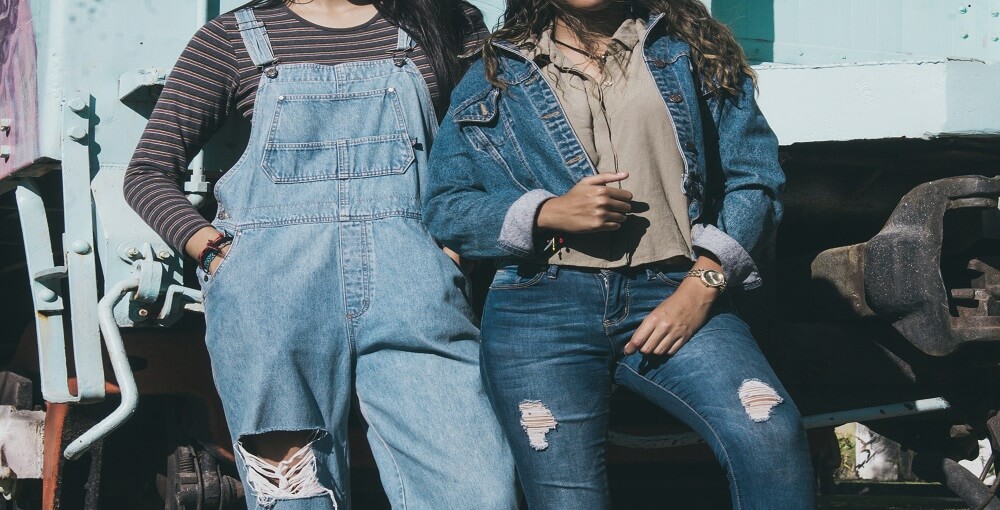
A pair of jeans is a strange object when you think about it. The fabric was invented for labourers in the 1800s. It’s been worn by miners, sailors, farmers, then teenagers, rebels, rock stars, and pretty much everyone in between. It shows up in photographs of every decade of the twentieth century. It carries more cultural weight than almost any other garment in your wardrobe, and the average person in the UK owns seven pairs of them.
It is also one of the single most resource-intensive garments ever produced. Around five to six billion pairs are manufactured globally every year, according to European Trade Union Institute research and ILO-linked studies. Each pair, on a full lifecycle basis, consumes thousands of litres of water. The cotton behind the fabric uses a disproportionate share of the world’s insecticides. The finishing processes that give jeans their faded, worn look have killed factory workers.
None of this is secret. The data has been public for a decade. But the gap between what the industry knows and what the shopper sees is still enormous. This guide is the map across that gap: what denim actually costs, where the damage lives, and how to buy a pair worth keeping.
The cultural weight of a work garment
Denim started as serge de Nîmes, a durable cotton twill made in southern France in the 17th century. The word “jean” is thought to come from Genoa, the Italian port where sailors wore a similar fabric. Indigo, the dye that gives denim its colour, is one of the oldest natural dyes in human history, used for thousands of years across cultures.
Levi Strauss didn’t invent jeans. He patented, with Jacob Davis in 1873, the rivet reinforcement at stress points that made them genuinely built for heavy work. The 501 was a worker’s garment before it was anything else. After the Second World War, American soldiers wore them home. Hollywood put them on Marlon Brando and James Dean. Teenagers claimed them. Hippies, punks, then grunge, then everyone. By the 1990s denim had stopped meaning anything specific and started meaning everything. The universal garment.
That universality is the problem. When five billion pairs a year is the normal number, the per-pair footprint compounds into something the planet cannot absorb.
What a single pair of jeans actually costs
The most rigorous public data on the environmental cost of jeans comes from Levi Strauss itself. The company conducted the apparel industry’s first full lifecycle assessment in 2007, then expanded it in 2015, covering a pair of 501 jeans from cotton field to landfill.
The 2015 Levi Strauss lifecycle assessment found that a single pair of jeans uses 3,781 litres of water across its full life, and produces 33.4 kg of CO2 equivalent. The water breakdown is the more revealing figure. Cotton cultivation accounts for 68% of that water. Consumer care, meaning your washing and drying habits over the life of the jeans, accounts for 23%. Actual manufacturing, including dyeing and finishing, is just 9%.
This changes where the conversation should go. The story that sustainable fashion tells, which is that factories are the problem, is partly right but largely incomplete. The biggest single lever you have as a shopper is not where your jeans were made. It is what they are made of, and how you wash them.
The cotton problem
Cotton is one of the most chemically demanding crops on earth. The Pesticide Action Network UK reports that cotton cultivation covers roughly 2.5% of the world’s agricultural land but accounts for somewhere between 8% and 16% of worldwide insecticide use, depending on the dataset. In developing countries where most cotton is grown, that share climbs higher.
The human cost of this falls most heavily on small farmers. In parts of India, particularly the Vidarbha region, high debt loads from genetically modified cotton seed, fertiliser and pesticide packages have been linked to a well-documented crisis of farmer suicides since the early 2000s. Researchers are careful to note that the causal mix is complex, involving drought, debt cycles, seed monopoly pricing and pesticide exposure rather than any single factor. But the underlying pattern is clear: the cheapest cotton in the world is produced in conditions that concentrate financial and health risk on the people growing it.
Organic cotton, certified to the Global Organic Textile Standard (GOTS), removes the synthetic pesticides, synthetic fertilisers and genetically modified seeds from the equation. It also, according to Textile Exchange’s 2014 lifecycle assessment, uses substantially less water than conventional cotton at the farm stage. The 91% water-reduction figure you sometimes see cited is contested by later analyses because most comparisons pit rain-fed organic against irrigated conventional. Even with that caveat, organic cotton at the farm stage is meaningfully less damaging than conventional. Whether it is 91% or a more conservative figure, it is less.
Indigo, sandblasting, and what happened to the workers
The dyeing and finishing stages of denim production account for only 9% of lifetime water use, but they account for a disproportionate share of the human harm.
Synthetic indigo, which has replaced natural indigo in almost all commercial denim, is produced with a set of chemical processes that generate wastewater containing aniline and other industrial compounds. In the worst factories, this wastewater is discharged untreated into rivers. Reporting from denim-producing regions in China, Bangladesh and Pakistan has documented waterways turned blue by mill discharge. Better factories treat their water before discharge, but the industry’s record on this is uneven.
The sharper case is sandblasting. To give jeans the worn, faded look that became popular in the 2000s, factories blasted fine silica sand at the fabric at high pressure. The sand particles lodged in workers’ lungs. The result was an epidemic of silicosis -a permanent, progressive, incurable lung disease -among young denim workers, most visibly in Turkey in the mid-2000s.
Turkish researchers from Atatürk University in Erzurum first documented the link in 2005. A 2008 study found radiological evidence of silicosis in 53% of the 145 former sandblasters surveyed. Turkey banned denim sandblasting by national legislation in 2009. A 2016 paper in The Lancet Respiratory Medicine called it “deadly denim” and documented that the practice had not ended but relocated, principally to Bangladesh and China, where enforcement is weaker.
This is the part of the denim story most shoppers have never heard. The faded, “vintage” finish on jeans priced at £30 is, in many cases, still achieved by processes that kill the people who do the work.
Alternatives exist. Laser fading, ozone treatments and chemical methods (themselves not without cost) replicate the look without crystalline silica exposure. Major brands have publicly committed to ending sandblasting in their supply chains. Clean Clothes Campaign’s investigations suggest that those commitments are only as strong as the audit systems behind them.
Orsola de Castro on what’s worth keeping
Orsola de Castro, co-founder of Fashion Revolution and a leading UK voice on clothing ethics, has spent two decades arguing that the single most powerful act a consumer can perform is to keep their clothes for longer. The slogan she is most associated with -that it is the clothes we love and repair, not the ones we abandon -applies to denim more precisely than to almost any other category. A well-made pair of jeans can last decades. A cheap pair loses its shape in months.
The reason most jeans don’t last is not that denim itself has gone downhill. It’s that the construction standards on mass-market jeans have collapsed. Single-stitched seams replace chain-stitched. Cheap fusible interfacing replaces properly sewn waistbands. Thin synthetic blends replace heavyweight cotton. The hardware is nickel-plated base metal rather than solid brass. Every one of those choices saves a few pence in production and shortens the life of the garment by years.
What a pair worth keeping actually looks like
Six things separate denim built to last from denim built to replace.
Fabric weight. Measured in ounces per square yard. Most mass-market jeans are 9 to 11 oz. Genuine durable denim starts at 12 oz. Heavyweight workwear denim runs 14 to 16 oz or more. The difference is noticeable in hand and dramatic in lifespan.
100% cotton, or close to it. A tiny amount of elastane (1% to 2%) is acceptable for comfort and fit recovery. Anything more is a sign the fabric will bag out at the knees, lose shape, and degrade faster. Avoid polyester blends in jeans.
Chain-stitched seams at the hem and inseam. Chain stitch is the traditional construction for jeans and produces the twisted rope-like fade along the seam that indicates a pair has aged well. It’s also more durable than single-stitch. You can see it on the inside of the garment.
Reinforced stress points. Rivets at pocket corners (the original Levi innovation), bar tacks at belt loops, and a properly sewn yoke. A pair that skips these details is a pair that will fail at them.
Selvedge, where affordable. Selvedge denim is woven on old-fashioned shuttle looms that produce a tight, self-finished edge. It’s typically heavier, usually made of better cotton, and almost always constructed more carefully. It costs more. It lasts longer.
Honest sourcing claims. A brand that can tell you where the cotton was grown, where the fabric was woven and where the jeans were sewn is a brand that has done the work. A brand that can’t is a brand that doesn’t know or doesn’t want you to.
The brands in our denim edit
Ziracle’s denim selection is narrow by design. Komodo has made denim in organic and recycled cotton since the 1990s, out of an original commitment to ethical manufacturing that predates the current sustainability conversation by decades.
They treat denim as a garment to keep, not a garment to cycle through. Both sit comfortably at the price point you should expect for denim built to last: noticeably more than supermarket jeans, noticeably less than designer denim, and priced honestly against what the production actually costs.
How to make the pair you already own last longer
The sustainable pair of jeans is almost always the one in your wardrobe already. Three practices extend the life of most denim by years.
Wash less. This is the single biggest lever. The 2015 Levi lifecycle assessment found that wearing jeans ten times between washes rather than the typical two to three times reduces water and climate impact by up to 77% in the UK and United States. It also dramatically extends the life of the fabric. Dark denim fades faster from washing than from wearing.
Wash cold, air dry. Hot water accelerates dye loss, shrinks cotton, and weakens fibres. Tumble drying does all three. Cold wash, hang to dry, and your jeans will hold their shape and colour for significantly longer.
Repair rather than replace. Small wear at the crotch or knee is fixable by any decent tailor for a fraction of the replacement cost. Many good denim brands run their own repair services, and standalone denim repair specialists operate in most UK cities.
Where to start on Ziracle
Every brand in our Apparel and Style edit has been assessed against the same standard: does it do what it claims, is it made the way the brand says, and is the brand honest about both. The Bottoms section is where to find denim and other trousers built to last, filtered by Organic, Fair Trade, or B Corp as suits you.
For the wider conversation about shopping this way, our beginner’s guide to sustainable fashion is the place to start. For how the same principles apply to the other basics, see our sustainable underwear and sustainable jewellery guides.
For integrated support when the homework feels overwhelming, Reduce Stress is the goal page we most often point people to.
Vivienne Westwood’s line, “Buy less, choose well, make it last”, applies to denim more cleanly than to almost any other category. One well-made pair of jeans, kept and repaired, is worth ten in the discard pile. That is the honest case, and it’s the only one this guide is making.
FAQs
The most rigorous public figure comes from Levi Strauss’s 2015 lifecycle assessment of its 501 jeans, which found a full-lifecycle water use of 3,781 litres per pair. Cotton cultivation accounted for 68% of that, consumer washing for 23%, and manufacturing for 9%. Per-pair figures vary considerably by cotton origin, finishing method and care habits, so treat 3,781 litres as an indicative average rather than a universal number. The takeaway: the single biggest reduction lever for most people is washing their jeans less often.
Organic denim is woven from cotton grown without synthetic pesticides, synthetic fertilisers or genetically modified seeds, usually certified to the Global Organic Textile Standard (GOTS). The fabric feels similar once finished, but the agricultural impact is substantially lower, and workers on certified organic farms are not exposed to the chemicals used on conventional cotton. Look for GOTS on the label rather than vague “natural” or “eco” claims.
Turkey banned sandblasting in 2009, and major international brands including Levi’s, H&M, and others have publicly committed to ending it in their supply chains. A 2012 Clean Clothes Campaign investigation, and later reporting, found that the practice had relocated to Bangladesh and China where enforcement is weaker. Some factories have switched to laser fading or ozone treatments, which remove the silicosis risk. The honest answer is that faded jeans at the lower end of the market may still be finished by methods that harm workers, and brand claims are only as reliable as their audit trails.
A well-made pair, in heavy cotton, worn a few times a week and washed sparingly, will typically last five to ten years before needing meaningful repair, and can last considerably longer with periodic mending. The limiting factors are usually the crotch seam and inner thigh, both of which are fixable. A £15 high-street pair is usually finished within 18 to 24 months. The cost-per-wear maths strongly favours spending more upfront.
Both are genuinely better choices than conventional cotton, and they solve different problems. Organic cotton avoids the pesticide burden at the farm stage. Recycled denim reduces demand for new cotton, cuts water and energy use, and diverts existing garments from landfill. The best brands are increasingly using both: organic cotton fibre blended with recycled cotton from post-consumer or post-industrial sources. Either is a meaningful improvement over conventional.