
Veo and Wearth are now Ziracle. Same mission, better platform. See what's new

Biodegradable, Compostable, Recyclable: What these Words Actually Mean

Compostable vs Biodegradable vs Recycling||||Plastic bottles

Biodegradable. Compostable. Recyclable. They sit next to each other on packaging, with similar leaf-green logos and similar implicit promises, and they do not mean the same thing. The words describe three different processes, with different timelines, different conditions, and different outcomes for what actually happens to the item after you throw it away.

Marketing departments rely on that confusion. When most people read “biodegradable” on a plastic bottle, they picture it quietly dissolving into soil. What it usually means, in practice, is that it fragments into microplastics that persist in the environment for decades or centuries. The gap between the promise and the practice is where greenwashing lives, and closing it is the main point of this guide.

None of what follows requires a science degree. It requires five minutes of reading the label instead of the logo.

Biodegradable: the weakest claim

Biodegradable, as a word, means capable of being broken down by microorganisms. In practice it has no legally binding timeline, no test for what the material becomes, and no requirement for the residue to be harmless. Which means it is, on its own, almost meaningless as a consumer signal.

Paper is biodegradable. So is cotton, wool, and most untreated plant fibre. Those biodegrade into the same constituents they came from, within months, in normal conditions.

Then there is “biodegradable plastic.” This is the label that does the most damage. In most cases, it refers to plastic that has been chemically engineered to fragment faster than conventional plastic, or blended with additives that speed that fragmentation. What it becomes as it “biodegrades” is smaller and smaller pieces of plastic -microplastics, then nanoplastics -which do not meaningfully return to nature. They persist, they enter the food chain, and they end up in human blood.

The useful question to ask when you see the word is not “does it break down?” but “what does it break down into?” Paper, plant fibres, and certified compostable materials give a clean answer. Plastic labelled biodegradable usually does not.

Compostable: the precise claim

Compostable is the term that actually means something, because it is tied to a testable standard. In Europe, that standard is EN 13432, published by the European Committee for Standardization in 2000 and adopted by national bodies including the British Standards Institution. In the UK you will often see it as BS EN 13432.

The standard requires four things. The material must disintegrate, meaning fragment to pieces smaller than 2 mm, within 12 weeks in industrial composting conditions. It must fully biodegrade, meaning at least 90% of its organic carbon converts to carbon dioxide within six months, according to the European Bioplastics association. The residue must not harm the compost or the plants grown in it. And it must contain only trace amounts of heavy metals.

Crucially, EN 13432 certifies industrial compostability. Industrial composting runs at around 58°C for several weeks. A home compost heap typically runs at 20 to 30°C, takes much longer, and will not break down most EN 13432-certified materials in any reasonable timeframe. If you want compostable material that also breaks down in a garden compost, look for the separate “OK Compost Home” certification, which tests for 12 months at ambient temperature.

The honest version of the claim is therefore: a certified compostable item will break down completely, in the right facility, without leaving harmful residue. A compostable item in a landfill or your kitchen bin just sits there.

Recyclable: the word that has done the most harm

Recyclable means a material can, in principle, be reprocessed into something new. It does not mean it will be. The gap between those two is the entire problem.

The UK government’s official figures for 2024 show a plastic packaging recycling rate of between 51 and 53.7%, according to DEFRA’s waste statistics, based on data submitted by accredited reprocessors and exporters. That includes plastic exported to other countries for processing, not all of which reaches a reprocessor.

Independent surveys suggest the real-world number for household plastic is considerably lower. The Big Plastic Count 2024, a citizen-science survey of 225,000 UK households run by Greenpeace UK and Everyday Plastic, estimated that only around 17% of UK household plastic waste is actually recycled. Around 58% is incinerated, most of the rest landfilled or exported. The gap between the two figures reflects what counts as “recycled” in official statistics versus what actually becomes new material.

The practical rule is this: of the seven plastic types identified by the resin identification code on packaging, only two recycle reliably at scale. PET (code 1, used for drinks bottles) and HDPE (code 2, used for milk bottles and detergent containers). Polypropylene (code 5) is recyclable in principle and increasingly in UK kerbside schemes, but recovery rates are lower. Polystyrene (code 6), PVC (code 3), and mixed plastics (code 7) almost never recycle in practice. Once you colour a plastic, add a film layer, or combine two types into a composite, the cost of separating them usually exceeds the value of the recovered material.

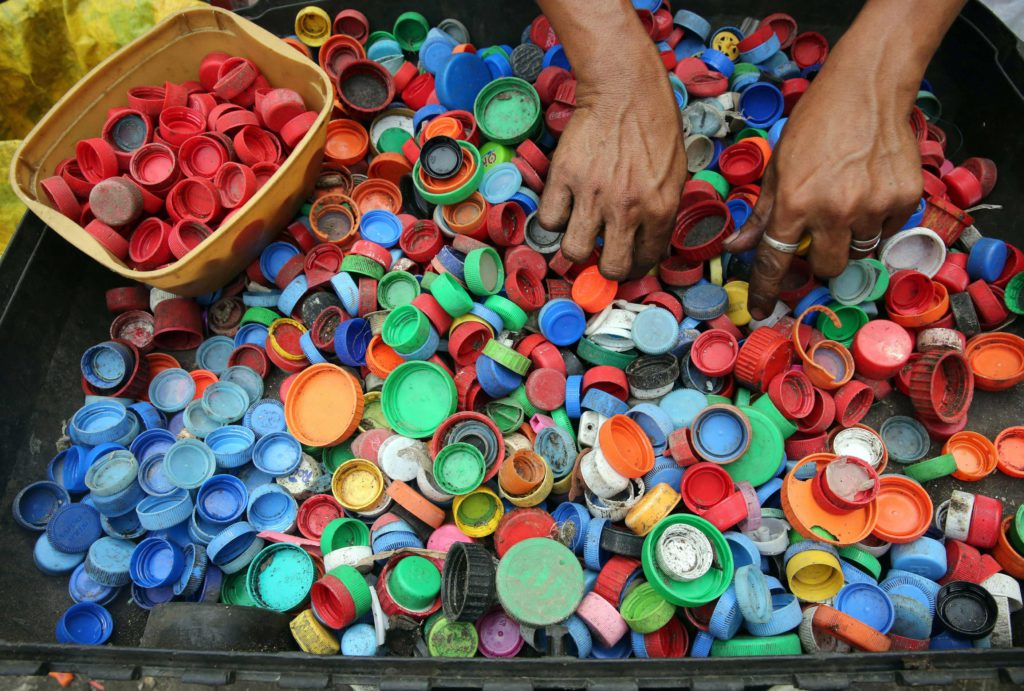
Hands sorting though hundreds of multi coloured bottle caps.
Credit: Krizjohn Rosales

Black plastic ready-meal trays, crisp packets, toothpaste tubes, squeezable sauce bottles, coffee cup lids -these carry the recycling symbol because they contain recyclable polymer, but the sorting infrastructure does not recover them. The symbol is the manufacturer’s aspiration, not the council’s capability.

The downcycling problem

Even when plastic is recycled, it usually comes out lower-quality than it went in. Contaminants accumulate. Polymer chains shorten. A plastic bottle becomes fibre for a fleece jacket, which then becomes filling for upholstery, which then becomes landfill. The material has been recycled, technically, but the recycling has delayed the landfill trip rather than prevented it.

Glass, metal and paper downcycle far less. Aluminium is the standout: it can be recycled indefinitely with minimal quality loss, and around 75% of all aluminium ever produced is still in circulation. Glass behaves similarly. This is one reason many circular-economy efforts prioritise these materials over recyclable plastic.

The hierarchy that actually works

Put these three words in order of real-world impact and they invert almost entirely from the marketing.

Reuse beats recycling, every time. A glass jar used a hundred times, a metal water bottle, a refillable aluminium deodorant case -these remove the disposal question from the equation rather than trying to solve it after the fact. Reusable formats carry an initial carbon cost from manufacturing, but that cost is amortised across hundreds or thousands of uses rather than one. Any WRAP analysis of consumer packaging consistently shows reuse as the dominant lever.

Compostable is second best, in the narrow case where there is a certified industrial composting route and the material is certified for it. For most UK households, that means looking for the Seedling logo from Din Certco or the TÜV Austria “OK Compost” mark, and checking whether your local authority collects food waste (this is becoming mandatory across England by March 2026 under the Simpler Recycling reforms).

Recyclable is third best, and only within the plastic types and local infrastructure that actually recycle. The recycling symbol alone is not enough.

Biodegradable, without a specific standard attached, should be treated as a marketing term.

How to shop around this

Four practical rules hold up against almost any “eco-friendly” claim.

Ask what it becomes. Paper and certified compostable items become soil. Aluminium, glass and PET become themselves again. Most plastics become something lower-grade. Biodegradable plastics often become microplastics.

Favour reusable over single-use, even when the single-use is labelled eco. The carbon maths almost always works out after ten to twenty uses, and most reusable containers last for thousands.

Read the small print on “compostable” claims. Industrial-compostable only (which is most of them) is useful only if you have the collection route. Home-compostable items are genuinely compostable in an ordinary garden heap.

Distrust “biodegradable plastic” as a category. If it matters to you that the item returns to nature rather than fragmenting into pollution, choose paper, cardboard, certified compostable plant-based fibres, or a reusable alternative.

Where to start on Ziracle

Every brand in our Refills and Reusables edit has been chosen for the same reason: the packaging is either designed to be used hundreds of times or designed to disappear cleanly at end of life. Filter by Plastic Free for the zero-plastic options, or by Refillable for the refill systems that work across years rather than months.

For the broader strategy, see our plastic-free living guide and zero waste swaps for everyday life for practical, habit-level changes that make the next purchase easier.

If your starting point is your kitchen or bathroom, Clean Home is the goal page to bookmark.

FAQs

Can I put a compostable coffee cup in my home compost?

Almost certainly not. Most compostable cups and packaging are certified to EN 13432 for industrial composting only, which runs at around 58°C. A home compost runs at 20 to 30°C and will not break the material down in any reasonable timeframe. Look for the separate “OK Compost Home” certification if home composting matters to you. Otherwise, the compostable cup needs to go into a council food-waste collection where your area has one, or it acts like any other landfill waste.

What happens to recyclable plastic that isn’t actually recycled?

The majority is incinerated for energy recovery in the UK, which means it’s burned in waste-to-energy plants. DEFRA’s figures show this share has grown significantly over the past decade as exports have become harder. The remainder is landfilled or exported to countries with weaker recycling infrastructure. Incineration is less harmful than landfill in narrow carbon-accounting terms but produces local air pollution and releases the carbon embodied in the plastic rather than sequestering it.

Which plastic types actually recycle in the UK?

PET (code 1) and HDPE (code 2) recycle reliably and are collected by almost every UK council. Polypropylene (code 5) is increasingly collected as the Simpler Recycling reforms roll out, but the recycled material has lower quality. Polystyrene (code 6), PVC (code 3), LDPE film (code 4), and composite plastics (code 7) rarely recycle in household streams. From March 2027 plastic film will be collected at kerbside across England, which will improve the picture for some categories but not all.

Is biodegradable plastic actually better than regular plastic?

Generally not, and often worse. Most “biodegradable” plastic is conventional plastic with additives that accelerate fragmentation. It breaks into microplastics faster, which is worse for the environment than slower breakdown. Certified compostable plant-based plastics (like properly certified PLA) are genuinely different and can return to soil, but only in industrial composting conditions. The word “biodegradable” alone, without a standard attached, is not a meaningful claim.

What’s the single most impactful swap I can make?

A reusable water bottle, a reusable coffee cup, and a few reusable bags, used consistently, eliminate hundreds of single-use items from your household each year. Starting here also builds the habit that makes the subsequent swaps (refillable cleaning, shampoo bars, reusable food wraps) easier to maintain. The exact carbon savings depend on what they replace, but reusable almost always wins once you’ve used the item a couple of dozen times.

Skinimalism Guide: Why less is more for your skin (and your mind)

Beautiful smiling woman with healthy skin and hair|||||||||

Skinimalism is stripping your routine back to the bare minimum. Just the essentials. No multi-step regimens, no marketing noise, no assumption that more products equal better skin. It’s a response to something broader: the realisation that social media images of flawless skin set an impossible standard, and that standard is damaging your actual skin and your actual mood.

Overloaded skincare routines damage skin. More products mean more potential irritants, more disruption to your skin barrier, and more waiting around for results that never show. The skinimalism movement is gaining traction because people are discovering that simplicity works better than complexity. Good skin doesn’t require perfection. It requires consistency, the right few ingredients, and freedom from comparison with curated images online.

Here’s how it works, what to keep, what to cut, and why your skin and your head will thank you.

Why minimalism works for skin

Your skin barrier is delicate. It’s designed to keep irritants out and moisture in. When you layer eight different products on it, you’re constantly disrupting that barrier. Each new product introduces potential irritants. Each new ingredient your skin hasn’t seen before requires adjustment. If one of those ingredients triggers a reaction, you don’t know which one because you’re changing too many variables at once.

shapely woman in grey underwear against a greeny-yellow background showing that beauty comes in all shapes and sizes.
Credit: Polina Takilevich

A 2021 review in the Journal of Cosmetic Dermatology found that over-exfoliation and multi-active layering are among the most common causes of compromised skin barrier function in otherwise healthy adults, with symptoms including redness, stinging, heightened sensitivity and breakouts that mimic acne. Skinimalism solves this by keeping variables low. With three products, you can track cause and effect. If something goes wrong, you know exactly what caused it.

Why minimalism works for your head

There’s a mental-health piece here too. Scrolling through filtered images of perfect skin creates a gap between what you see and what you experience. That gap creates anxiety. A 2019 review in Body Image summarising multiple studies found that exposure to idealised, edited images on social media is associated with reduced appearance satisfaction and increased anxiety about one’s own skin and body.

Credit: Snog, Marry, Avoid

The acne positivity movement got this right. Your acne isn’t a failure. A routine with eight steps isn’t evidence of care. Sometimes the best thing you can do for problem skin is use less. Skinimalism is partly a skincare philosophy and partly a rejection of comparison culture. It’s saying: good skin doesn’t require perfection. It requires self-acceptance and smart choices about which products actually deliver results.

What skinimalism actually is in practice

Skinimalism means you have a gentle cleanser, a targeted treatment, and a moisturiser with SPF during the day. That’s it. No toners, no essences, no serums for every possible concern. You choose products that actually do something, and you give them time to work before adding more.

girl with textured skin and acne scarring, highlighting the acne positivity movement
Credit: Nicole aka, @theblemishqueen

The baseline is clean skin. You’re removing dirt and excess oil with a gentle approach that doesn’t strip your skin. Browse the Soaps and Cleansers edit for the face-and-body side. Then you address your specific concern. If that’s acne, a treatment with salicylic acid. If it’s sensitivity, something with calming ingredients like niacinamide or centella. Then you seal everything in with a moisturiser.

At night, you repeat the cleanse and treatment, then seal with a heavier moisturiser or a facial oil if your skin is dry. That’s the whole routine. Three products, two times a day. The Serums edit is where your targeted treatment sits, and the Oils and Balms edit covers the final moisturising layer if oil is your preference.

The ingredients that actually work

Vitamin C is an antioxidant that protects against environmental damage and supports collagen production. The American Academy of Dermatology lists it as one of the ingredients with the strongest evidence for anti-ageing benefits when formulated at appropriate concentrations.

Retinol, derived from vitamin A, is the single most-studied anti-ageing ingredient in dermatology, with decades of randomised trials supporting its effects on fine lines and skin texture. Start low and slow, once or twice a week, and build up. It’s not a skinimalism requirement, but if you’re keeping only one active, many dermatologists recommend retinol over almost anything else.

Niacinamide (vitamin B3) calms inflammation, reduces the appearance of pores, and supports the skin barrier. A 2021 meta-analysis in Clinical, Cosmetic and Investigational Dermatology found that topical niacinamide formulations produced modest but consistent improvements in skin elasticity, hydration and pigmentation across multiple trials.

Sunscreen is the non-negotiable one. Daily SPF is the ingredient with the strongest evidence for preventing the visible signs of ageing and reducing skin cancer risk, according to sustained guidance from the NHS. If you keep only one skincare product, make it a broad-spectrum sunscreen.

These aren’t secret ingredients. They’re the ones that appear in legitimate dermatology research and have decades of evidence behind their efficacy. The mistake most people make is assuming they need all of them at once.

A three-step routine you actually do beats an eight-step routine you abandon after a week.

Consistency beats complexity every time

A three-step routine you actually do beats an eight-step routine you abandon after a week. This is the practical argument for skinimalism. You’ll use it consistently. You’ll notice results because there’s nothing else changing. If something happens to your skin, you know exactly what caused it because you’re only using three products.

Consistency is where skin improvement happens. Your skin cells turn over on a roughly 28-day cycle, which is why dermatologists recommend giving any new treatment at least four weeks before judging it. If you’re cycling through products constantly, you’re never giving anything a fair trial. Skinimalism forces consistency because there’s less to change.

Acne is not a skincare failure

Here’s where it really matters: if you have acne, it’s not because your routine isn’t complex enough. Acne is hormonal, bacterial or structural. An expensive ten-step routine doesn’t fix any of that. Sometimes simpler routines actually improve acne because they’re less likely to irritate and compromise the barrier.

The acne positivity movement exists because people internalised a message that clear skin equals self-care and worth. That isn’t true. Acne is a skin condition. Some people get it regardless of what they do. Others can prevent it with basic hygiene and the right treatment. Most people are somewhere in between. Skinimalism gives you permission to have acne and not treat it as a personal failure. If acne is persistent, cystic, or affecting your confidence significantly, a GP or dermatologist is the right next step rather than another bottle from the shelf.

Making the switch without breaking your skin

Don’t strip everything at once. Drop one product this week. See how your skin responds over the full 28-day cycle. Drop another next week if everything’s still fine. This matters because you want to know what actually works for your specific skin type.

If your skin gets worse when you strip it back, you might actually need more support than minimalism. That’s not a failure. It means your baseline needs are higher. The point of skinimalism isn’t achieving the fewest possible products. It’s using the fewest that actually keep your skin healthy and functioning.

Skinimalism is a relief. You stop waiting for the perfect routine and start noticing what your skin actually needs. You stop comparing your baseline to filtered images. You start understanding your own skin because you’re not drowning it in complexity and contradictory products. That’s when real improvement happens.

For more on the broader picture, read our guides to eco swaps for beauty and anti-pollution skincare.

Every brand in the Beauty and Self-Care category on Ziracle has passed the same standard: honest ingredients, transparent formulation, and packaging that takes the environment seriously. Filter by Organic or Cruelty Free to narrow to products that match the skinimalism brief.

Ready to simplify? Browse the Healthy Skin edit and pick the three products you’ll use every day.

FAQs

What are the three products every skinimalism routine needs?

A gentle cleanser, a targeted treatment for your specific concern, and a moisturiser with SPF during the day. At night, the SPF drops out and you can use a richer moisturiser or a facial oil if your skin is dry. That’s the whole routine. Cleanser, treatment, moisturiser. Adding more isn’t inherently wrong, but it should be because you’ve identified a specific need rather than because the shelf had a fourth thing on it.

Is skinimalism suitable for all skin types?

For most, yes. People with very dry, very reactive, or clinically-diagnosed conditions like rosacea, severe eczema or cystic acne may need additional products or prescription treatments, and skinimalism doesn’t mean avoiding medical care. If your skin gets worse when you strip back, that’s information rather than failure. Build back up gradually with the minimum additions that stabilise your skin.

How long does it take to see results from a simpler routine?

At least four weeks, because skin cells turn over on a roughly 28-day cycle. This is why dermatologists consistently recommend giving any new product or routine change at least four weeks before judging it. Skinimalism often shows initial improvement in barrier function within two weeks (less redness, less stinging, better hydration) but deeper changes to skin texture and clarity take longer.

What ingredients should I actually keep?

The evidence-based shortlist: a gentle cleanser (not a harsh foaming one), sunscreen (broad-spectrum SPF 30 or higher, every day), a moisturiser appropriate to your skin type, and one targeted active if you have a specific concern. Retinol for ageing and texture, niacinamide for sensitivity and barrier support, salicylic acid for oily or acne-prone skin, vitamin C for antioxidant protection. Pick one active, use it consistently, and add more only when the first has had a fair trial.

Can I still use makeup with a skinimalism routine?

Yes. Skinimalism is about the underlying skincare routine, not a ban on cosmetics. What often happens when people simplify their skincare is that they also reduce their makeup, because the skin underneath looks better enough that heavy coverage feels unnecessary. The other direction works too: some people keep their makeup routine the same and just simplify the skincare underneath. Either is fine.

From Bottle To Bar: Why You Should Switch To Zero-Waste Hair Care

kind beeuty hair care products

The bathroom is one of the easiest rooms in the house to clean up. Most of us reach for the same few products most days, which means a handful of smarter swaps can cut a surprising amount of plastic out of your life without asking you to overhaul how you live. Shampoo is a good place to start.

A household of four getting through a bottle of shampoo every two months will go through roughly 240 bottles in a decade. Scale that up across the UK and the numbers get harder to ignore. A 2017 Guardian investigation reported that more than a million plastic bottles were bought globally every minute, a figure projected to keep rising. Most of those bottles end up in landfill, incinerators, or the ocean. A shampoo bar, by contrast, arrives in paper or compostable wrap and disappears down the drain as water by the time you’ve finished it.

Zero-waste hair care is the simple idea that you should be able to wash your hair without generating a new piece of plastic every few months. The products are the best they’ve ever been, the format travels well, and the savings stack up quickly. Here’s how it works, why it’s worth switching, and how to make the move without ruining your hair on the way.

What zero-waste hair care actually is

Zero-waste hair care covers any product designed to wash, condition or style your hair without relying on single-use plastic packaging. The best-known format is the solid shampoo bar, which looks a little like a bar of soap but is formulated specifically for hair. You wet the bar, rub it directly onto your scalp or between your hands, and work the lather through as you would with a liquid shampoo. Browse the Shampoo edit for options.

Conditioner bars, solid styling pastes, refillable glass dispensers and compostable sachets all sit under the same umbrella. The common thread is that the packaging either disappears entirely or goes back into a reuse cycle. Most bars arrive wrapped in a paper band, a card sleeve, or a thin compostable film. Some are shipped in nothing more than a cotton pouch.

The format isn’t new. Solid soaps have been used for thousands of years, and solid shampoos were the norm in most households until liquid detergents took over in the mid-20th century. What’s changed is the formulation. Modern bars use mild surfactants, plant oils and botanical extracts that give you the lather, slip and finish you’d expect from a premium liquid shampoo, without the water content and without the bottle.

A short history of the shampoo bar

Washing hair with a solid is older than the bottle. Liquid shampoo as we know it took off in the first half of the 20th century, and by the 1940s the bottle had become the default format in most Western bathrooms. The bar stuck around in one niche in particular: travellers, soldiers and outdoor-sports communities kept using solid shampoos because they were lighter, more durable and harder to spill.

Over the last two decades the bar has come back into the mainstream, pulled along by the zero-waste movement, rising awareness of single-use plastic, and a surge of independent beauty brands. What used to be a camping essential is now a bathroom essential, and the range on offer has moved well beyond a single all-purpose bar. You can find bars for fine hair, coarse hair, curly hair, oily scalps, sensitive skin, colour-treated hair and almost every other use case a liquid shampoo can cover.

The environmental case for switching

The core argument for zero-waste hair care is the packaging. A typical bottle of shampoo is largely water by weight, which means you’re paying to ship water around the world, bottle it, and throw the bottle away. A shampoo bar has almost no water in it, which compresses the same number of washes into a fraction of the size and weight.

The shipping maths are striking. One shampoo bar can replace two to three bottles of liquid shampoo, and a single shipping pallet can carry several times more bars than bottles for the same weight. Less water, less plastic, fewer trucks, lower emissions. Packaging-focused guidance from WRAP has repeatedly flagged beauty and personal care as one of the fastest-moving categories for single-use plastic, and one where lightweight, concentrated formats offer the clearest path to cutting it out.

A 2020 study by the British Beauty Council found that the UK beauty industry generates over 120 billion units of packaging annually, with most of it non-recyclable in standard kerbside collection. Every bottle that never gets made is plastic that never needs to be dealt with downstream.

A typical bottle of shampoo is largely water by weight. A bar almost entirely isn’t.

What it does for your hair

The environmental case is the headline, but the formulation gap between shampoo bars and conventional liquid shampoos is narrower than most people expect, and in places it runs the other way. Many mass-market liquid shampoos rely on sulphates like sodium lauryl sulphate (SLS) and sodium laureth sulphate (SLES) for their thick foam. The American Academy of Dermatology notes that sulphates are effective cleansers, but can be drying or irritating for people with sensitive skin, eczema, rosacea or colour-treated hair.

Most well-formulated shampoo bars skip SLS and SLES in favour of milder surfactants like sodium coco-sulfate or decyl glucoside, combined with plant oils and butters that condition as they clean. A 2015 review in the International Journal of Trichology found that syndet cleansers using milder surfactants are gentler on the hair cuticle and scalp than traditional soap-based formulas. Bars also make it easier to avoid the silicones, synthetic fragrances and polymer thickeners that stack up in many liquid shampoos, because there’s less room in the formulation for filler ingredients.

There’s a transition period worth being honest about. If you’re moving from a silicone-heavy conventional shampoo to a bar, your hair can feel waxy or limp for a week or two while the coating you’ve built up washes out. A cider vinegar rinse (a tablespoon of apple cider vinegar in a mug of water, poured over and rinsed out) can speed that up. After the adjustment, most people find their hair feels lighter and looks healthier, and many can stretch washes further apart than before.

How to use a shampoo bar

The technique is simple, but the first few washes go better if you know what you’re doing. Wet your hair thoroughly. Wet the bar. Then either rub the bar directly onto the top of your head, working it along the hair from root to tip, or rub it between your hands to build a lather and apply that to your scalp. Work the lather in with your fingertips, massaging the roots rather than scrubbing the lengths, then rinse thoroughly.

If your water is hard, you may find the bar lathers less generously than it does in soft-water areas. A quick prep wash, rinsing your hair in plain water for longer than usual before applying the bar, helps. Some people follow with a solid conditioner bar. Others find the bar alone is enough, especially with shorter hair. Browse the Conditioner edit for options if you want to try one.

Storage is the one area where bars ask a little more of you than a bottle. Let the bar dry between uses. A draining soap dish, a bamboo tray or a small tin with holes works well. A bar left in a puddle will dissolve far faster than one stored dry, and you’ll get through your supply much sooner than you need to.

Shampoo bars travel better

If you travel, the bar format is practically made for your wash bag. UK airport security rules, set by the Civil Aviation Authority, limit you to containers of 100ml or less in your carry-on for liquids, gels and aerosols. Solid shampoo bars are none of those things, and they don’t count against the allowance. You can pack a full-sized bar in your hand luggage and skip the clear plastic bag entirely.

The weight savings are real for longer trips too. One bar, which might weigh 50 to 80 grams, can cover the same number of washes as a couple of travel-size bottles plus a full-size bottle at destination. No leaks, no airport friction, no last-minute rush to buy a replacement from a hotel gift shop.

Longevity and value for money

The upfront price of a shampoo bar is usually higher than a supermarket bottle of shampoo, and that comparison is where a lot of people lose confidence in the switch. The full-cost picture looks different. A well-made bar will typically last for 50 to 80 washes, which is two to three bottles of liquid shampoo depending on the brand. Factor in the concentration, the packaging savings and the longer time between purchases, and bars generally come out ahead on price per wash.

They also take up a fraction of the cupboard space. A small shelf that used to hold three bottles can hold a six-month supply of bars stacked into a tin. If you’re living in a smaller home, or trying to keep the bathroom simple, that matters more than it sounds.

Progress, not perfection

Zero-waste hair care is one of the lowest-friction swaps in the zero-waste playbook. The products work, the environmental case is strong, the travel case is better, and the cost case holds up once you factor in how long the bars last. You don’t have to get every product in your bathroom right on day one. Switch the shampoo. See how it feels. Then think about the conditioner, the body wash, the toothpaste tablets and the rest of the shelf.

For the broader picture, read our guide to eco swaps for beauty and our breakdown of microplastics in cosmetics.

Every brand in the Beauty and Self-Care category on Ziracle has passed the same standard: honest ingredients, transparent formulation, and packaging that takes the environment seriously. For zero-waste hair care specifically, filter by Plastic Free or Organic to find bars and refillable options from brands that work this way by default.

Ready to switch? Browse the Hair Lab edit and pick the bar that suits your hair type.

FAQs

Will a shampoo bar work for my hair type?

For most hair types, yes, but the transition period is real. Fine hair tends to adjust within a week or two. Curly and coarse hair sometimes takes longer because the bar lathers differently and the hair may need time to rebalance. Colour-treated hair generally does well on bars because most are sulphate-free, which is gentler on dye. Hard water areas can affect lather and rinse-off, in which case a cider vinegar rinse (one tablespoon in a mug of water) can help. If your hair feels waxy for the first week, it’s usually buildup washing out, not the bar failing.

How long does a shampoo bar last compared to a bottle?

A well-made bar typically lasts 50 to 80 washes, which is roughly two to three bottles of liquid shampoo depending on the brand and how heavily each is used. Stored properly (dry between uses, in a draining soap dish or a tin with holes), a single bar can cover three to six months for most users. Stored in a puddle, it will dissolve much faster.

Are shampoo bars just soap with a new name?

No, and this is an important distinction. Early-generation bars were often true soaps (saponified oils), which have a high pH and can rough up the hair cuticle. Most modern bars are syndets, short for synthetic detergents, using mild surfactants like sodium coco-sulfate or decyl glucoside that sit at a pH similar to hair itself. Syndet bars behave far more like a liquid shampoo than a traditional soap. If you’re picking a bar for the first time, look for the word ‘syndet’ or a stated pH around 5 to 6.

Do shampoo bars actually clean as well as liquid shampoo?

Yes, in most cases, once you’re through the transition period. The 2015 International Journal of Trichology review cited above found that syndet cleansers are comparably effective to liquid shampoos, and gentler on the hair cuticle. The mental adjustment most people need is to lather from the bar directly onto the scalp rather than expecting a thick foam like they’d get from a sulphate-heavy bottled shampoo. Less foam doesn’t mean less clean.

Can I use a shampoo bar if I travel a lot?

Bars are one of the best travel formats going. They aren’t liquids, gels or aerosols, which means they don’t count against airport liquid limits. A single bar can replace multiple travel-size bottles and a back-up full-size bottle at destination. They don’t leak, don’t spill, and generally fit in a small tin or cotton pouch. The one caveat is to keep the bar dry between uses during travel, either in a dedicated bar tin or a wrapped cloth pouch.