Minimalism: for some people it’s the path to a calmer life, for others it’s a luxury only a few can afford to think about. Whatever you make of the label, most of us can agree on one thing. Our homes carry a lot of stuff. The question isn’t really whether you should own less. It’s whether the things you already own are being used well, and what happens to the things you decide to let go of.
It’s worth being specific about why this matters. A 2010 study by Saxbe and Repetti, published in Personality and Social Psychology Bulletin, found that people who described their homes as cluttered had higher levels of cortisol, the body’s main stress hormone, across the day than those who described their homes as restorative. Follow-up research by Vartanian, Kernan and Wansink, published in 2017 in Environment and Behavior, showed that a chaotic kitchen environment led people to eat substantially more sweet snacks than people in a tidy one. Clutter isn’t only a visual problem. It changes how you feel and how you behave.
The problem with decluttering is that it can become a wasteful practice in its own right. In the rush to that clean-space feeling, we throw out things that could have been used, worn, passed on or repaired. A sustainable declutter doesn’t mean filling a bin bag and feeling lighter. It means finding the route for each item that keeps it out of landfill for as long as possible. Here’s how to work through the three rooms where clutter tends to stack up fastest.
Bedroom and wardrobe
A wardrobe reset is often the first thing people reach for when they want a clean-out. The instinct is right. The execution matters. Throwing fast-fashion pieces straight into a bin bag, whether for waste or for the local charity shop, isn’t the answer it feels like.
A 2025 investigation by Unearthed and Greenpeace Africa found garments from UK high-street brands including Next, George at Asda, Marks & Spencer, Zara, and H&M inside internationally protected wetlands in Ghana — home to rare birds and three species of endangered turtles. In 2024, the UK exported more clothing waste to Ghana than any other country — approximately 57,000 metric tonnes — with Ghana’s Kantamanto market receiving an estimated 1,500 tonnes of secondhand clothing every week, of which nearly half a million garments become waste. Sending clothes ‘away’ usually means sending them somewhere else’s problem.
A better order of operations.
First, repair. Anything still wearable that only needs a button, a seam or a zip should go to a separate repair pile and then to a local tailor, cobbler or community repair cafe.
Second, pass on directly. Clothing swaps with friends and family, Depop, Vinted, eBay and local selling groups move clothes to people who want them, without going through the charity-shop sort.
Third, donate with care. If you’re giving to a charity shop, be honest about condition. Good-quality, clean, fully functional pieces are useful. Pilled fast-fashion basics usually aren’t. Look into specialist charities for work clothing, winter coats and maternity wear where the donation goes directly to someone who needs it.
Finally, textile recycling as a last resort. If a piece is truly beyond repair, textile recycling banks or brand take-back schemes are better than the general waste bin.
If you do need to replace pieces, that’s where the deeper principles of slow fashion kick in: buy less, buy better, and choose pieces you’ll wear for years. For the full argument, see our guide to what slow fashion actually is.
Sending clothes ‘away’ usually means sending them somewhere else’s problem.
Bathroom and beauty products
Beauty cabinets accumulate quickly. A trend you tried once, a gift that wasn’t quite right, a moisturiser you meant to finish. Throwing half-full bottles into the bin doesn’t clear clutter so much as move it, from your shelf into a landfill.
A more useful split.
The UK government’s cosmetic product safety regulations require products with a shelf life of more than 30 months to display a Period After Opening (PAO) symbol — the open-jar icon showing how long a product is safe once opened. Using skincare past this window is a genuine risk: bacterial contamination increases significantly once preservatives break down, and expired cosmetics should not be passed on.
If it’s unopened or lightly used and you know you won’t reach for it, give it away. A friend, a family member, a local women’s shelter or a community swap event will often take unopened products. Beauty Banks specifically distributes unused toiletries to people experiencing hygiene poverty in the UK. Some retailers also run take-back programmes for empty packaging. Check the brand before you bin.
If it’s something you originally bought for a reason and just stopped reaching for, use it. Rotate it to the front of the cabinet for a month and see whether it earns a place. If it doesn’t, you’ve at least finished it rather than wasted it.
When the time comes to restock, clean, cruelty-free and lower-waste replacements are easier to find than they used to be. Our guide to eco swaps for beauty is a useful starting point.
Kitchen and pantry
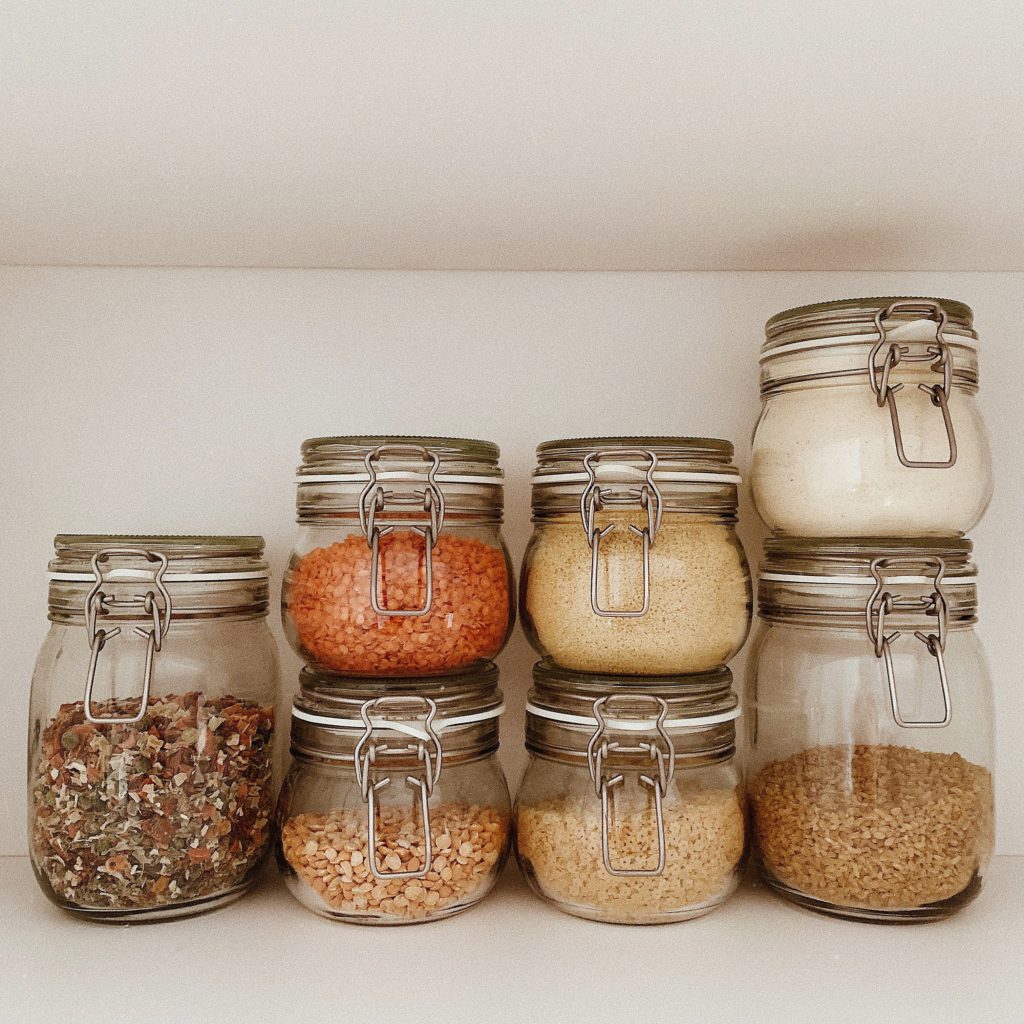
Zero-waste kitchen organisation is one of the most photogenic corners of the internet, and one of the easiest to get wrong. Matching glass jars, woven baskets and a labelled everything look clean on a phone screen. Buying them all in one sweep isn’t particularly clean for the planet.
The more useful version of the same instinct: work with what you have. The Tupperware in the back of the cupboard, the jam jars with labels still on, the takeaway containers you washed out. All of it is already in your house and already paid for. Pool them, sort them, label them clearly. Your pantry won’t look Pinterest-perfect. It’ll work just as well, and you won’t have added a new haul of containers to the world to hold the same amount of food.
The pattern is the same in every kitchen drawer. Before you buy a new version of something, check whether an existing version could do the job. The sustainable answer is almost always the one you already own. If you genuinely do need new storage (glass jars for bulk-bought grains, for instance), browse the Kitchen Storage edit for options made to last.
The sustainable declutter, in one line
Decluttering sustainably isn’t about getting rid of everything you own. It’s about using what you have more fully, finding careful next homes for the things you can’t, and being honest with yourself about what you actually need to replace. Fewer things bought badly. More things used well.
For more on the second half of that equation, see our guides to eco swaps for home and how to make better fashion choices.
Every brand in the Home and Sanctuary and Beauty and Self-Care categories on Ziracle has passed the same standard: built to last, transparent about materials and supply chain, and designed around longevity rather than disposability. Filter by Refillable across both departments to find products that don’t add to the stack you’re trying to clear.
Ready to shop? Browse the Clean Home edit for the things you will use and finish.
FAQs
Yes, measurably. A 2010 study in Personality and Social Psychology Bulletin found that people who described their homes as cluttered had higher cortisol levels throughout the day than people who described their homes as restorative. Follow-up research in Environment and Behavior linked chaotic kitchen environments to meaningfully higher snack intake. The effect isn’t huge in any single moment, but it compounds over the hours you spend at home each week. A calmer space isn’t vanity. It’s measurable stress reduction.
Charity shops are overwhelmed, particularly with low-quality fast-fashion donations. A significant share of what doesn’t sell on the shop floor gets baled up and exported to countries in East Africa and elsewhere, where it often ends up in landfills, rivers or wetlands. Greenpeace’s 2023 investigation documented this route clearly. Donation isn’t wrong. Indiscriminate donation is. Sort honestly: good quality, clean, fully functional pieces are genuinely useful to charity shops. Pilled fast-fashion basics usually aren’t.
Textile recycling banks (usually at supermarket car parks or recycling centres), brand take-back schemes, H&M’s garment collecting programme, and online marketplaces like Vinted and eBay for anything still wearable. Some local councils also run fabric recycling collections. The general waste bin should be the genuine last resort, not the default.
Bin the product itself, but recycle the packaging where you can. Most empty plastic bottles with a recycling symbol go in your kerbside recycling. Some brands (including MAC, Kiehl’s, and L’Occitane) run take-back programmes for their own empty packaging. TerraCycle runs collection schemes for harder-to-recycle items like mascara tubes and lipstick bullets. If the product is unopened and in date, Beauty Banks distributes unused toiletries to people experiencing hygiene poverty in the UK, and the British Beauty Council’s interactive recycling map helps you locate drop-off points for hard-to-recycle beauty packaging near you.
Less often than Instagram suggests. A full wardrobe and bathroom audit once or twice a year is plenty for most people. More useful is a running one-in, one-out habit: when you buy something new, pass on something already in the wardrobe or cupboard. That stops the accumulation in the first place, which is a better problem to solve than the declutter it would otherwise require.