Biodegradable. Compostable. Recyclable. They sit next to each other on packaging, with similar leaf-green logos and similar implicit promises, and they do not mean the same thing. The words describe three different processes, with different timelines, different conditions, and different outcomes for what actually happens to the item after you throw it away.
Marketing departments rely on that confusion. When most people read “biodegradable” on a plastic bottle, they picture it quietly dissolving into soil. What it usually means, in practice, is that it fragments into microplastics that persist in the environment for decades or centuries. The gap between the promise and the practice is where greenwashing lives, and closing it is the main point of this guide.
None of what follows requires a science degree. It requires five minutes of reading the label instead of the logo.
Biodegradable: the weakest claim
Biodegradable, as a word, means capable of being broken down by microorganisms. In practice it has no legally binding timeline, no test for what the material becomes, and no requirement for the residue to be harmless. Which means it is, on its own, almost meaningless as a consumer signal.
Paper is biodegradable. So is cotton, wool, and most untreated plant fibre. Those biodegrade into the same constituents they came from, within months, in normal conditions.
Then there is “biodegradable plastic.” This is the label that does the most damage. In most cases, it refers to plastic that has been chemically engineered to fragment faster than conventional plastic, or blended with additives that speed that fragmentation.
What it becomes as it “biodegrades” is smaller and smaller pieces of plastic -microplastics, then nanoplastics -which do not meaningfully return to nature. They persist, they enter the food chain, and they end up in human blood.
The useful question to ask when you see the word is not “does it break down?” but “what does it break down into?” Paper, plant fibres, and certified compostable materials give a clean answer. Plastic labelled biodegradable usually does not.
Compostable: the precise claim
Compostable is the term that actually means something, because it is tied to a testable standard. In Europe, that standard is EN 13432, published by the European Committee for Standardization in 2000 and adopted by national bodies including the British Standards Institution (BSI). In the UK you will often see it as BS EN 13432
The standard requires four things. The material must disintegrate, meaning fragment to pieces smaller than 2 mm, within 12 weeks in industrial composting conditions. It must fully biodegrade, meaning at least 90% of its organic carbon converts to carbon dioxide within six months, according to the European Bioplastics association. The residue must not harm the compost or the plants grown in it. And it must contain only trace amounts of heavy metals.
Crucially, EN 13432 certifies industrial compostability. Industrial composting runs at around 58°C for several weeks. A home compost heap typically runs at 20 to 30°C, takes much longer, and will not break down most EN 13432-certified materials in any reasonable timeframe. If you want compostable material that also breaks down in a garden compost, look for the separate “OK Compost Home” certification, which tests for 12 months at ambient temperature.
The honest version of the claim is therefore: a certified compostable item will break down completely, in the right facility, without leaving harmful residue. A compostable item in a landfill or your kitchen bin just sits there.
Recyclable: the word that has done the most harm
Recyclable means a material can, in principle, be reprocessed into something new. It does not mean it will be. The gap between those two is the entire problem.
The UK government’s official figures for 2024 show a plastic packaging recycling rate of between 51 and 53.7%, according to DEFRA’s waste statistics, based on data submitted by accredited reprocessors and exporters. That includes plastic exported to other countries for processing, not all of which reaches a reprocessor.
Independent surveys suggest the real-world number for household plastic is considerably lower. The Big Plastic Count 2024, a citizen-science survey of 225,000 UK households run by Greenpeace UK and Everyday Plastic with academic support from the University of Portsmouth, estimated that only around 17% of UK household plastic waste is actually recycled.
The practical rule is this: of the seven plastic types identified by the resin identification code on packaging, only two recycle reliably at scale. PET (code 1, used for drinks bottles) and HDPE (code 2, used for milk bottles and detergent containers). Polypropylene (code 5) is recyclable in principle and increasingly in UK kerbside schemes, but recovery rates are lower. Polystyrene (code 6), PVC (code 3), and mixed plastics (code 7) almost never recycle in practice. Once you colour a plastic, add a film layer, or combine two types into a composite, the cost of separating them usually exceeds the value of the recovered material.
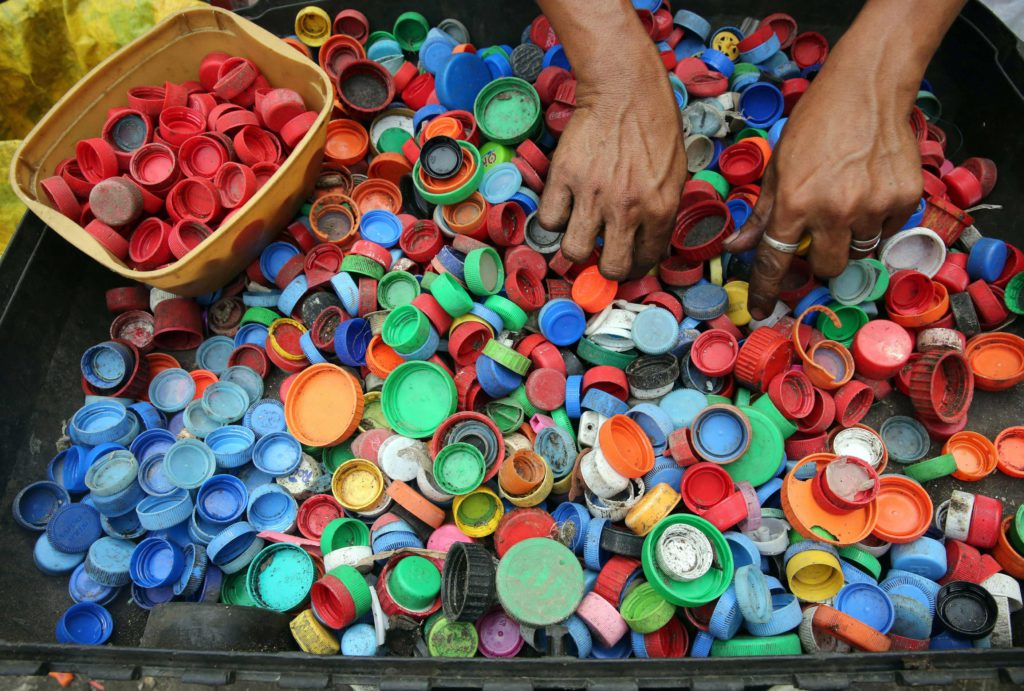
Black plastic ready-meal trays, crisp packets, toothpaste tubes, squeezable sauce bottles, coffee cup lids -these carry the recycling symbol because they contain recyclable polymer, but the sorting infrastructure does not recover them. The symbol is the manufacturer’s aspiration, not the council’s capability.
The downcycling problem
Even when plastic is recycled, it usually comes out lower-quality than it went in. Contaminants accumulate. Polymer chains shorten. A plastic bottle becomes fibre for a fleece jacket, which then becomes filling for upholstery, which then becomes landfill. The material has been recycled, technically, but the recycling has delayed the landfill trip rather than prevented it.
Glass, metal and paper downcycle far less. Aluminium is the standout: it can be recycled indefinitely with minimal quality loss, and around 75% of all aluminium ever produced is still in use today, according to European Aluminium — the industry body representing Europe’s primary aluminium producers, whose figure is consistent with data from the International Aluminium Institute. Glass behaves similarly. This is one reason many circular-economy efforts prioritise these materials over recyclable plastic.
The hierarchy that actually works
Put these three words in order of real-world impact and they invert almost entirely from the marketing.
Reuse beats recycling, every time. A glass jar used a hundred times, a metal water bottle, a refillable aluminium deodorant case -these remove the disposal question from the equation rather than trying to solve it after the fact. Reusable formats carry an initial carbon cost from manufacturing, but that cost is amortised across hundreds or thousands of uses rather than one. Any WRAP analysis of consumer packaging consistently shows reuse as the dominant lever.
Compostable is second best, in the narrow case where there is a certified industrial composting route and the material is certified for it. For most UK households, that means looking for the Seedling logo from Din Certco or the TÜV Austria “OK Compost” mark, and checking whether your local authority collects food waste (this is becoming mandatory across England by March 2026 under the Simpler Recycling reforms).
Recyclable is third best, and only within the plastic types and local infrastructure that actually recycle. The recycling symbol alone is not enough.
Biodegradable, without a specific standard attached, should be treated as a marketing term.
How to shop around this
Four practical rules hold up against almost any “eco-friendly” claim.
Ask what it becomes. Paper and certified compostable items become soil. Aluminium, glass and PET become themselves again. Most plastics become something lower-grade. Biodegradable plastics often become microplastics.
Favour reusable over single-use, even when the single-use is labelled eco. The carbon maths almost always works out after ten to twenty uses, and most reusable containers last for thousands.
Read the small print on “compostable” claims. Industrial-compostable only (which is most of them) is useful only if you have the collection route. Home-compostable items are genuinely compostable in an ordinary garden heap.
Distrust “biodegradable plastic” as a category. If it matters to you that the item returns to nature rather than fragmenting into pollution, choose paper, cardboard, certified compostable plant-based fibres, or a reusable alternative.
Where to start on Ziracle
Every brand in our Refills and Reusables edit has been chosen for the same reason: the packaging is either designed to be used hundreds of times or designed to disappear cleanly at end of life. Filter by Plastic Free for the zero-plastic options, or by Refillable for the refill systems that work across years rather than months.
For the broader strategy, see our plastic-free living guide and zero waste swaps for everyday life for practical, habit-level changes that make the next purchase easier.
If your starting point is your kitchen or bathroom, Clean Home is the goal page to bookmark.
FAQs
Almost certainly not. Most compostable cups and packaging are certified to EN 13432 for industrial composting only, which runs at around 58°C. A home compost runs at 20 to 30°C and will not break the material down in any reasonable timeframe. Look for the separate “OK Compost Home” certification if home composting matters to you. Otherwise, the compostable cup needs to go into a council food-waste collection where your area has one, or it acts like any other landfill waste.
The majority is incinerated for energy recovery in the UK, which means it’s burned in waste-to-energy plants. DEFRA’s figures show this share has grown significantly over the past decade as exports have become harder. The remainder is landfilled or exported to countries with weaker recycling infrastructure. Incineration is less harmful than landfill in narrow carbon-accounting terms but produces local air pollution and releases the carbon embodied in the plastic rather than sequestering it.
PET (code 1) and HDPE (code 2) recycle reliably and are collected by almost every UK council. Polypropylene (code 5) is increasingly collected as the Simpler Recycling reforms roll out, but the recycled material has lower quality. Polystyrene (code 6), PVC (code 3), LDPE film (code 4), and composite plastics (code 7) rarely recycle in household streams. From March 2027 plastic film will be collected at kerbside across England, which will improve the picture for some categories but not all.
Generally not, and often worse. Most “biodegradable” plastic is conventional plastic with additives that accelerate fragmentation. It breaks into microplastics faster, which is worse for the environment than slower breakdown. Certified compostable plant-based plastics (like properly certified PLA) are genuinely different and can return to soil, but only in industrial composting conditions. The word “biodegradable” alone, without a standard attached, is not a meaningful claim.
A reusable water bottle, a reusable coffee cup, and a few reusable bags, used consistently, eliminate hundreds of single-use items from your household each year. Starting here also builds the habit that makes the subsequent swaps (refillable cleaning, shampoo bars, reusable food wraps) easier to maintain. The exact carbon savings depend on what they replace, but reusable almost always wins once you’ve used the item a couple of dozen times.